

34
B. Sutcliffe and R.G. Woolley
Consider a self-adjoint operator T that depends on a parameter X, so T = T (X).
The parameter X = −∞ ≤ X ≤ +∞, covers the whole real line R, and T (X) is
assumed to be defined for all X. T (X) is an operator on a Hilbert space, which is
denoted H (X); its eigenfunctions {φ} defined by
T (X)φ(X) k = λ k (X)φ(X) k ,
form a complete orthogonal set for the space H (X). The scalar product is
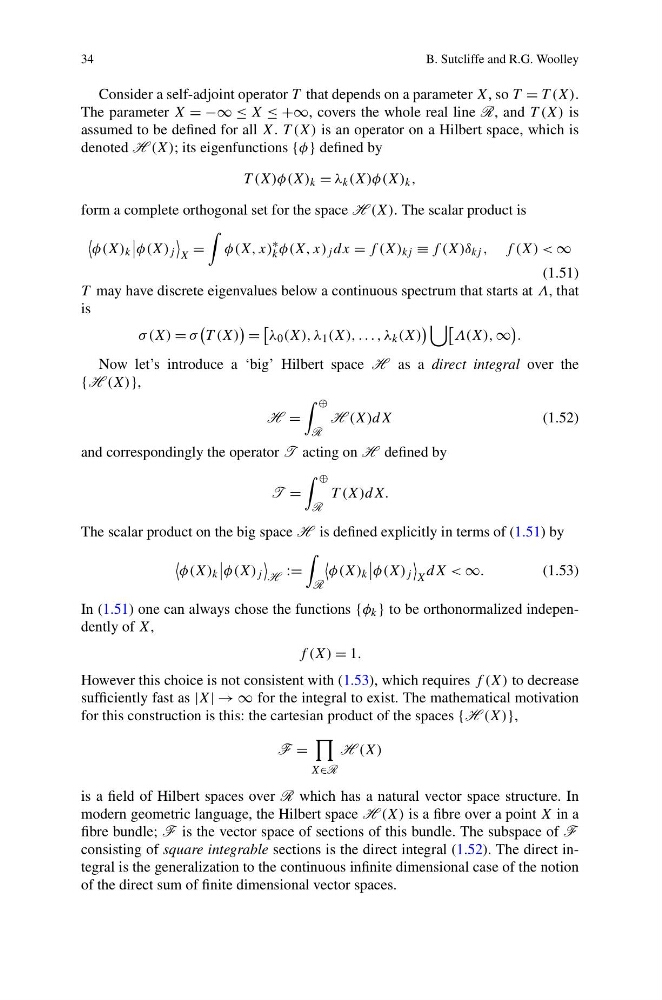
φ(X) k
φ(X) j
X
=
φ(X, x)
∗
k φ(X, x) j dx = f (X) kj ≡ f (X)δ kj , f(X)<∞
(1.51)
T may have discrete eigenvalues below a continuous spectrum that starts at Λ, that
is
σ (X) = σ
T (X)
=
λ 0 (X), λ 1 (X), . . . , λ k (X)
Λ(X), ∞
.
Now let’s introduce a ‘big’ Hilbert space H as a direct integral over the
{H (X)},
H =
⊕
R
H (X)dX
(1.52)
and correspondingly the operator T acting on H defined by
T =
⊕
R
T (X)dX.
The scalar product on the big space H is defined explicitly in terms of (1.51) by
φ(X) k
φ(X) j
H :=
R
φ(X) k
φ(X) j
X
dX < ∞.
(1.53)
In (1.51) one can always chose the functions {φ k } to be orthonormalized independently of X,
f (X) = 1.
However this choice is not consistent with (1.53), which requires f (X) to decrease
sufficiently fast as |X| → ∞ for the integral to exist. The mathematical motivation
for this construction is this: the cartesian product of the spaces {H (X)},
F =
X∈R
H (X)
is a field of Hilbert spaces over R which has a natural vector space structure. In
modern geometric language, the Hilbert space H (X) is a fibre over a point X in a
fibre bundle; F is the vector space of sections of this bundle. The subspace of F
consisting of square integrable sections is the direct integral (1.52). The direct integral is the generalization to the continuous infinite dimensional case of the notion
of the direct sum of finite dimensional vector spaces.
B. Sutcliffe and R.G. Woolley
Consider a self-adjoint operator T that depends on a parameter X, so T = T (X).
The parameter X = −∞ ≤ X ≤ +∞, covers the whole real line R, and T (X) is
assumed to be defined for all X. T (X) is an operator on a Hilbert space, which is
denoted H (X); its eigenfunctions {φ} defined by
T (X)φ(X) k = λ k (X)φ(X) k ,
form a complete orthogonal set for the space H (X). The scalar product is
φ(X) k
φ(X) j
X
=
φ(X, x)
∗
k φ(X, x) j dx = f (X) kj ≡ f (X)δ kj , f(X)<∞
(1.51)
T may have discrete eigenvalues below a continuous spectrum that starts at Λ, that
is
σ (X) = σ
T (X)
=
λ 0 (X), λ 1 (X), . . . , λ k (X)
Λ(X), ∞
.
Now let’s introduce a ‘big’ Hilbert space H as a direct integral over the
{H (X)},
H =
⊕
R
H (X)dX
(1.52)
and correspondingly the operator T acting on H defined by
T =
⊕
R
T (X)dX.
The scalar product on the big space H is defined explicitly in terms of (1.51) by
φ(X) k
φ(X) j
H :=
R
φ(X) k
φ(X) j
X
dX < ∞.
(1.53)
In (1.51) one can always chose the functions {φ k } to be orthonormalized independently of X,
f (X) = 1.
However this choice is not consistent with (1.53), which requires f (X) to decrease
sufficiently fast as |X| → ∞ for the integral to exist. The mathematical motivation
for this construction is this: the cartesian product of the spaces {H (X)},
F =
X∈R
H (X)
is a field of Hilbert spaces over R which has a natural vector space structure. In
modern geometric language, the Hilbert space H (X) is a fibre over a point X in a
fibre bundle; F is the vector space of sections of this bundle. The subspace of F
consisting of square integrable sections is the direct integral (1.52). The direct integral is the generalization to the continuous infinite dimensional case of the notion
of the direct sum of finite dimensional vector spaces.