

19 Analysis of Water Molecules in the Hras-GTP and GDP Complexes
355
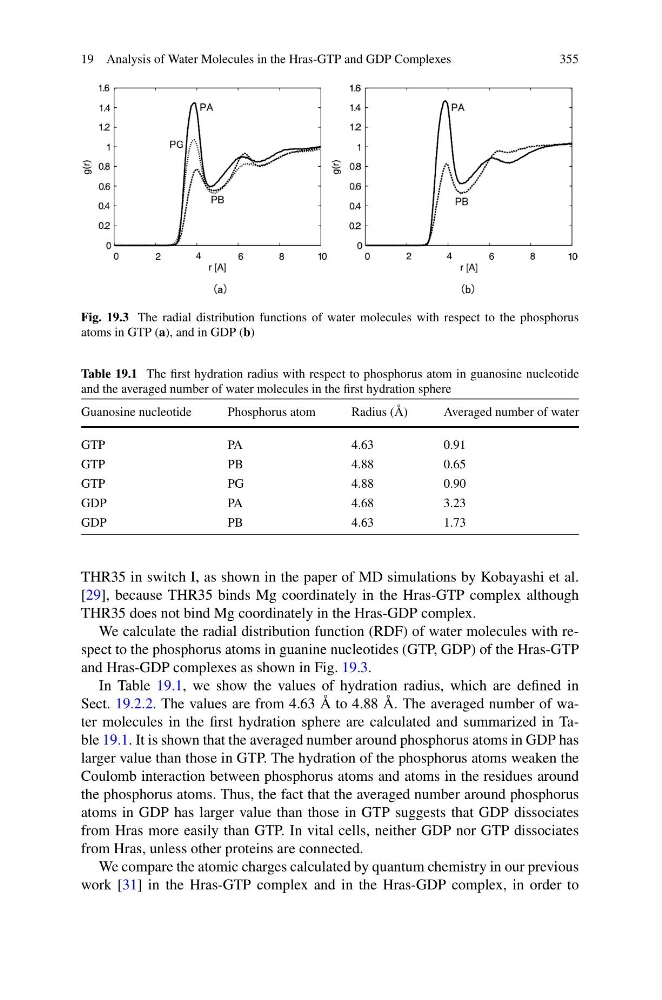
Fig. 19.3 The radial distribution functions of water molecules with respect to the phosphorus
atoms in GTP (a), and in GDP (b)
Table 19.1 The first hydration radius with respect to phosphorus atom in guanosine nucleotide
and the averaged number of water molecules in the first hydration sphere
Guanosine nucleotide
Phosphorus atom
Radius (Å)
Averaged number of water
GTP
PA
4.63
0.91
GTP
PB
4.88
0.65
GTP
PG
4.88
0.90
GDP
PA
4.68
3.23
GDP
PB
4.63
1.73
THR35 in switch I, as shown in the paper of MD simulations by Kobayashi et al.
[29], because THR35 binds Mg coordinately in the Hras-GTP complex although
THR35 does not bind Mg coordinately in the Hras-GDP complex.
We calculate the radial distribution function (RDF) of water molecules with respect to the phosphorus atoms in guanine nucleotides (GTP, GDP) of the Hras-GTP
and Hras-GDP complexes as shown in Fig. 19.3.
In Table 19.1, we show the values of hydration radius, which are defined in
Sect. 19.2.2. The values are from 4.63 Å to 4.88 Å. The averaged number of water molecules in the first hydration sphere are calculated and summarized in Table 19.1. It is shown that the averaged number around phosphorus atoms in GDP has
larger value than those in GTP. The hydration of the phosphorus atoms weaken the
Coulomb interaction between phosphorus atoms and atoms in the residues around
the phosphorus atoms. Thus, the fact that the averaged number around phosphorus
atoms in GDP has larger value than those in GTP suggests that GDP dissociates
from Hras more easily than GTP. In vital cells, neither GDP nor GTP dissociates
from Hras, unless other proteins are connected.
We compare the atomic charges calculated by quantum chemistry in our previous
work [31] in the Hras-GTP complex and in the Hras-GDP complex, in order to
355
Fig. 19.3 The radial distribution functions of water molecules with respect to the phosphorus
atoms in GTP (a), and in GDP (b)
Table 19.1 The first hydration radius with respect to phosphorus atom in guanosine nucleotide
and the averaged number of water molecules in the first hydration sphere
Guanosine nucleotide
Phosphorus atom
Radius (Å)
Averaged number of water
GTP
PA
4.63
0.91
GTP
PB
4.88
0.65
GTP
PG
4.88
0.90
GDP
PA
4.68
3.23
GDP
PB
4.63
1.73
THR35 in switch I, as shown in the paper of MD simulations by Kobayashi et al.
[29], because THR35 binds Mg coordinately in the Hras-GTP complex although
THR35 does not bind Mg coordinately in the Hras-GDP complex.
We calculate the radial distribution function (RDF) of water molecules with respect to the phosphorus atoms in guanine nucleotides (GTP, GDP) of the Hras-GTP
and Hras-GDP complexes as shown in Fig. 19.3.
In Table 19.1, we show the values of hydration radius, which are defined in
Sect. 19.2.2. The values are from 4.63 Å to 4.88 Å. The averaged number of water molecules in the first hydration sphere are calculated and summarized in Table 19.1. It is shown that the averaged number around phosphorus atoms in GDP has
larger value than those in GTP. The hydration of the phosphorus atoms weaken the
Coulomb interaction between phosphorus atoms and atoms in the residues around
the phosphorus atoms. Thus, the fact that the averaged number around phosphorus
atoms in GDP has larger value than those in GTP suggests that GDP dissociates
from Hras more easily than GTP. In vital cells, neither GDP nor GTP dissociates
from Hras, unless other proteins are connected.
We compare the atomic charges calculated by quantum chemistry in our previous
work [31] in the Hras-GTP complex and in the Hras-GDP complex, in order to