

214
F.Y. Naumkin and D.J. Wales
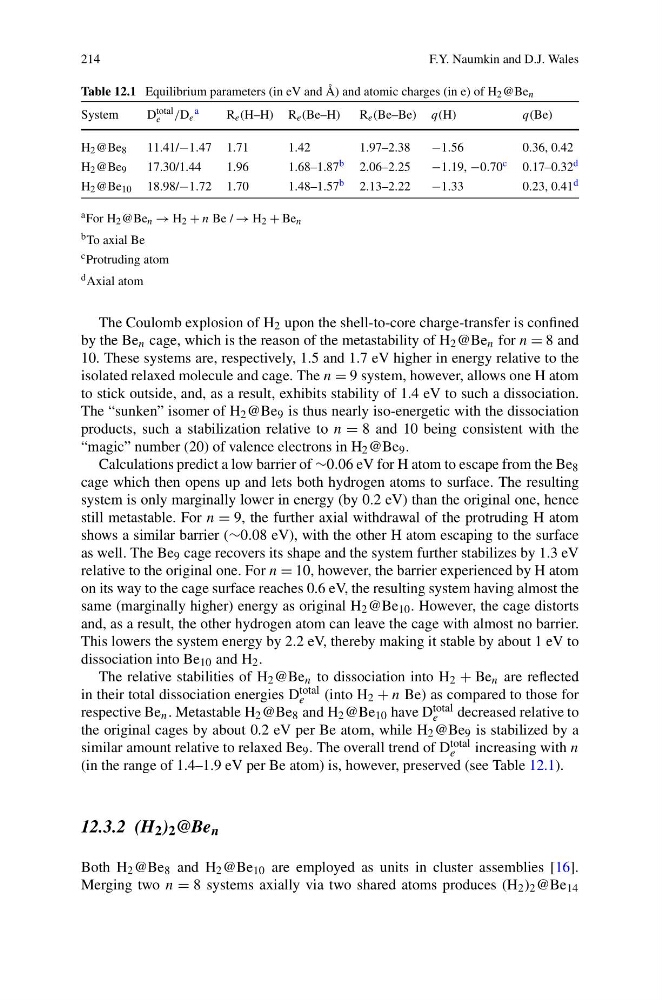
Table 12.1 Equilibrium parameters (in eV and Å) and atomic charges (in e) of H 2 @Be n
System
D total
e /D e
a
R e (H–H) R e (Be–H)
R e (Be–Be) q(H)
q(Be)
H 2 @Be 8
11.41/−1.47 1.71
1.42
1.97–2.38
−1.56
0.36, 0.42
H 2 @Be 9
17.30/1.44
1.96
1.68–1.87 b 2.06–2.25
−1.19, −0.70 c 0.17–0.32 d
H 2 @Be 10 18.98/−1.72 1.70
1.48–1.57 b 2.13–2.22
−1.33
0.23, 0.41 d
a For H 2 @Be n → H 2 + n Be / → H 2 + Be n
b To axial Be
c Protruding atom
d Axial atom
The Coulomb explosion of H 2 upon the shell-to-core charge-transfer is confined
by the Be n cage, which is the reason of the metastability of H 2 @Be n for n = 8 and
10. These systems are, respectively, 1.5 and 1.7 eV higher in energy relative to the
isolated relaxed molecule and cage. The n = 9 system, however, allows one H atom
to stick outside, and, as a result, exhibits stability of 1.4 eV to such a dissociation.
The “sunken” isomer of H 2 @Be 9 is thus nearly iso-energetic with the dissociation
products, such a stabilization relative to n = 8 and 10 being consistent with the
“magic” number (20) of valence electrons in H 2 @Be 9 .
Calculations predict a low barrier of ∼0.06 eV for H atom to escape from the Be 8
cage which then opens up and lets both hydrogen atoms to surface. The resulting
system is only marginally lower in energy (by 0.2 eV) than the original one, hence
still metastable. For n = 9, the further axial withdrawal of the protruding H atom
shows a similar barrier (∼0.08 eV), with the other H atom escaping to the surface
as well. The Be 9 cage recovers its shape and the system further stabilizes by 1.3 eV
relative to the original one. For n = 10, however, the barrier experienced by H atom
on its way to the cage surface reaches 0.6 eV, the resulting system having almost the
same (marginally higher) energy as original H 2 @Be 10 . However, the cage distorts
and, as a result, the other hydrogen atom can leave the cage with almost no barrier.
This lowers the system energy by 2.2 eV, thereby making it stable by about 1 eV to
dissociation into Be 10 and H 2 .
The relative stabilities of H 2 @Be n to dissociation into H 2 + Be n are reflected
in their total dissociation energies D total
e
(into H 2 + n Be) as compared to those for
respective Be n . Metastable H 2 @Be 8 and H 2 @Be 10 have D total
e
decreased relative to
the original cages by about 0.2 eV per Be atom, while H 2 @Be 9 is stabilized by a
similar amount relative to relaxed Be 9 . The overall trend of D total
e
increasing with n
(in the range of 1.4–1.9 eV per Be atom) is, however, preserved (see Table 12.1).
12.3.2 (H 2 ) 2 @Be n
Both H 2 @Be 8 and H 2 @Be 10 are employed as units in cluster assemblies [16].
Merging two n = 8 systems axially via two shared atoms produces (H 2 ) 2 @Be 14
F.Y. Naumkin and D.J. Wales
Table 12.1 Equilibrium parameters (in eV and Å) and atomic charges (in e) of H 2 @Be n
System
D total
e /D e
a
R e (H–H) R e (Be–H)
R e (Be–Be) q(H)
q(Be)
H 2 @Be 8
11.41/−1.47 1.71
1.42
1.97–2.38
−1.56
0.36, 0.42
H 2 @Be 9
17.30/1.44
1.96
1.68–1.87 b 2.06–2.25
−1.19, −0.70 c 0.17–0.32 d
H 2 @Be 10 18.98/−1.72 1.70
1.48–1.57 b 2.13–2.22
−1.33
0.23, 0.41 d
a For H 2 @Be n → H 2 + n Be / → H 2 + Be n
b To axial Be
c Protruding atom
d Axial atom
The Coulomb explosion of H 2 upon the shell-to-core charge-transfer is confined
by the Be n cage, which is the reason of the metastability of H 2 @Be n for n = 8 and
10. These systems are, respectively, 1.5 and 1.7 eV higher in energy relative to the
isolated relaxed molecule and cage. The n = 9 system, however, allows one H atom
to stick outside, and, as a result, exhibits stability of 1.4 eV to such a dissociation.
The “sunken” isomer of H 2 @Be 9 is thus nearly iso-energetic with the dissociation
products, such a stabilization relative to n = 8 and 10 being consistent with the
“magic” number (20) of valence electrons in H 2 @Be 9 .
Calculations predict a low barrier of ∼0.06 eV for H atom to escape from the Be 8
cage which then opens up and lets both hydrogen atoms to surface. The resulting
system is only marginally lower in energy (by 0.2 eV) than the original one, hence
still metastable. For n = 9, the further axial withdrawal of the protruding H atom
shows a similar barrier (∼0.08 eV), with the other H atom escaping to the surface
as well. The Be 9 cage recovers its shape and the system further stabilizes by 1.3 eV
relative to the original one. For n = 10, however, the barrier experienced by H atom
on its way to the cage surface reaches 0.6 eV, the resulting system having almost the
same (marginally higher) energy as original H 2 @Be 10 . However, the cage distorts
and, as a result, the other hydrogen atom can leave the cage with almost no barrier.
This lowers the system energy by 2.2 eV, thereby making it stable by about 1 eV to
dissociation into Be 10 and H 2 .
The relative stabilities of H 2 @Be n to dissociation into H 2 + Be n are reflected
in their total dissociation energies D total
e
(into H 2 + n Be) as compared to those for
respective Be n . Metastable H 2 @Be 8 and H 2 @Be 10 have D total
e
decreased relative to
the original cages by about 0.2 eV per Be atom, while H 2 @Be 9 is stabilized by a
similar amount relative to relaxed Be 9 . The overall trend of D total
e
increasing with n
(in the range of 1.4–1.9 eV per Be atom) is, however, preserved (see Table 12.1).
12.3.2 (H 2 ) 2 @Be n
Both H 2 @Be 8 and H 2 @Be 10 are employed as units in cluster assemblies [16].
Merging two n = 8 systems axially via two shared atoms produces (H 2 ) 2 @Be 14