

190
Y. Dong et al.
Fig. 10.7 Results of a common-neighbor analysis. Each curve shows the relative occurrence
of a certain set of indices (i, j, k) (described in the text), when excluding (i, j, k) = (0, 0, 0),
and the thicker curves show the occurrences for (i, j, k) = (1, 0, 0), (i, j, k) = (2, 1, 1), and
(i, j, k) = (4, 2, 1), whereas (i, j, k) = (4, 4, 4) is not found in this size range
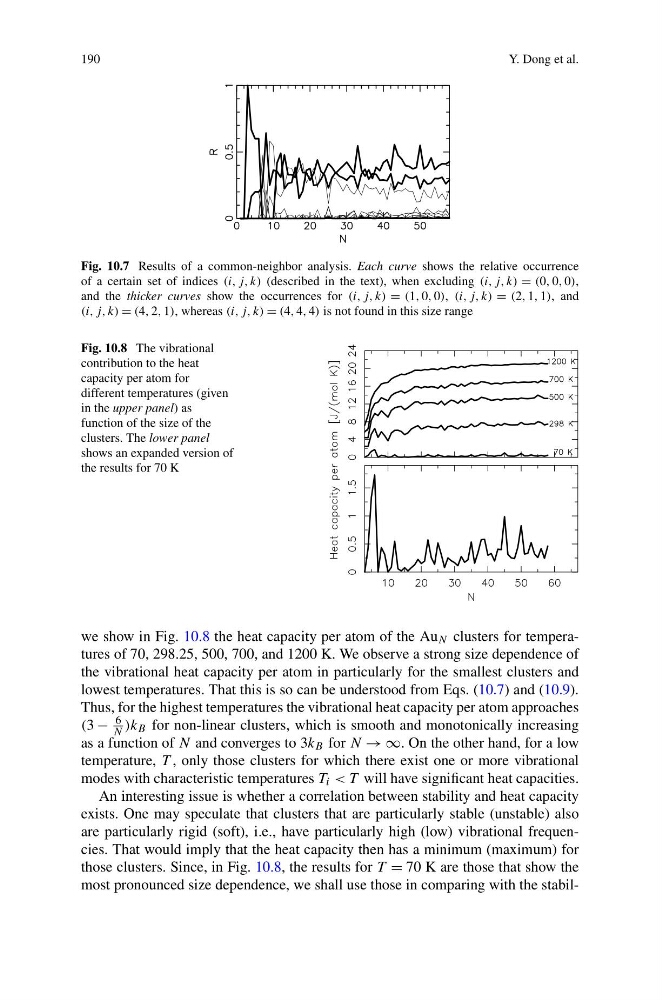
Fig. 10.8 The vibrational
contribution to the heat
capacity per atom for
different temperatures (given
in the upper panel) as
function of the size of the
clusters. The lower panel
shows an expanded version of
the results for 70 K
we show in Fig. 10.8 the heat capacity per atom of the Au N clusters for temperatures of 70, 298.25, 500, 700, and 1200 K. We observe a strong size dependence of
the vibrational heat capacity per atom in particularly for the smallest clusters and
lowest temperatures. That this is so can be understood from Eqs. (10.7) and (10.9).
Thus, for the highest temperatures the vibrational heat capacity per atom approaches
(3 −
6
N )k B for non-linear clusters, which is smooth and monotonically increasing
as a function of N and converges to 3k B for N → ∞. On the other hand, for a low
temperature, T , only those clusters for which there exist one or more vibrational
modes with characteristic temperatures T i < T will have significant heat capacities.
An interesting issue is whether a correlation between stability and heat capacity
exists. One may speculate that clusters that are particularly stable (unstable) also
are particularly rigid (soft), i.e., have particularly high (low) vibrational frequencies. That would imply that the heat capacity then has a minimum (maximum) for
those clusters. Since, in Fig. 10.8, the results for T = 70 K are those that show the
most pronounced size dependence, we shall use those in comparing with the stabil-
Y. Dong et al.
Fig. 10.7 Results of a common-neighbor analysis. Each curve shows the relative occurrence
of a certain set of indices (i, j, k) (described in the text), when excluding (i, j, k) = (0, 0, 0),
and the thicker curves show the occurrences for (i, j, k) = (1, 0, 0), (i, j, k) = (2, 1, 1), and
(i, j, k) = (4, 2, 1), whereas (i, j, k) = (4, 4, 4) is not found in this size range
Fig. 10.8 The vibrational
contribution to the heat
capacity per atom for
different temperatures (given
in the upper panel) as
function of the size of the
clusters. The lower panel
shows an expanded version of
the results for 70 K
we show in Fig. 10.8 the heat capacity per atom of the Au N clusters for temperatures of 70, 298.25, 500, 700, and 1200 K. We observe a strong size dependence of
the vibrational heat capacity per atom in particularly for the smallest clusters and
lowest temperatures. That this is so can be understood from Eqs. (10.7) and (10.9).
Thus, for the highest temperatures the vibrational heat capacity per atom approaches
(3 −
6
N )k B for non-linear clusters, which is smooth and monotonically increasing
as a function of N and converges to 3k B for N → ∞. On the other hand, for a low
temperature, T , only those clusters for which there exist one or more vibrational
modes with characteristic temperatures T i < T will have significant heat capacities.
An interesting issue is whether a correlation between stability and heat capacity
exists. One may speculate that clusters that are particularly stable (unstable) also
are particularly rigid (soft), i.e., have particularly high (low) vibrational frequencies. That would imply that the heat capacity then has a minimum (maximum) for
those clusters. Since, in Fig. 10.8, the results for T = 70 K are those that show the
most pronounced size dependence, we shall use those in comparing with the stabil-