

10 Structural and Thermodynamic Properties of Au 2–58 Clusters
185
with M i being the mass for the ith coordinate. Then, the vibrational frequencies, ω i ,
are found as the square roots of the eigenvalues of the dynamical matrix.
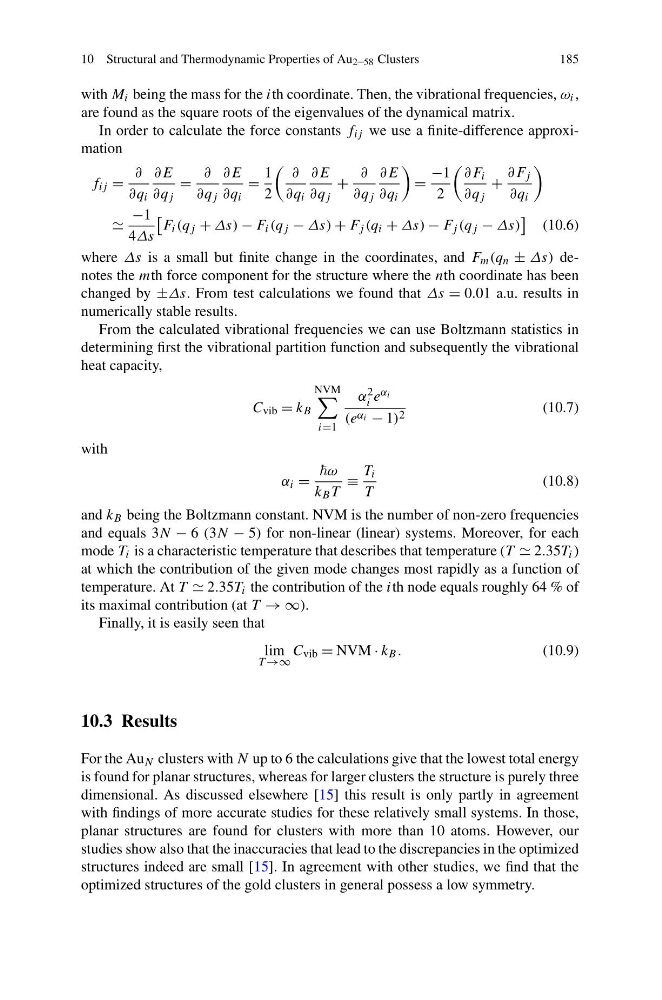
In order to calculate the force constants f ij we use a finite-difference approximation
f ij =
∂
∂q i
∂E
∂q j
=
∂
∂q j
∂E
∂q i
=
1
2
∂
∂q i
∂E
∂q j
+
∂
∂q j
∂E
∂q i
=
−1
2
∂F i
∂q j
+
∂F j
∂q i
−1
4Δs
F i (q j + Δs) − F i (q j − Δs) + F j (q i + Δs) − F j (q j − Δs)
(10.6)
where Δs is a small but finite change in the coordinates, and F m (q n ± Δs) denotes the mth force component for the structure where the nth coordinate has been
changed by ±Δs. From test calculations we found that Δs = 0.01 a.u. results in
numerically stable results.
From the calculated vibrational frequencies we can use Boltzmann statistics in
determining first the vibrational partition function and subsequently the vibrational
heat capacity,
C vib = k B
NVM
i=1
α 2
i e α i
(e α i − 1) 2
(10.7)
with
α i =
ω
k B T
≡
T i
T
(10.8)
and k B being the Boltzmann constant. NVM is the number of non-zero frequencies
and equals 3N − 6 (3N − 5) for non-linear (linear) systems. Moreover, for each
mode T i is a characteristic temperature that describes that temperature (T 2.35T i )
at which the contribution of the given mode changes most rapidly as a function of
temperature. At T 2.35T i the contribution of the ith node equals roughly 64 % of
its maximal contribution (at T → ∞).
Finally, it is easily seen that
lim
T →∞
C vib = NVM · k B .
(10.9)
10.3 Results
For the Au N clusters with N up to 6 the calculations give that the lowest total energy
is found for planar structures, whereas for larger clusters the structure is purely three
dimensional. As discussed elsewhere [15] this result is only partly in agreement
with findings of more accurate studies for these relatively small systems. In those,
planar structures are found for clusters with more than 10 atoms. However, our
studies show also that the inaccuracies that lead to the discrepancies in the optimized
structures indeed are small [15]. In agreement with other studies, we find that the
optimized structures of the gold clusters in general possess a low symmetry.
185
with M i being the mass for the ith coordinate. Then, the vibrational frequencies, ω i ,
are found as the square roots of the eigenvalues of the dynamical matrix.
In order to calculate the force constants f ij we use a finite-difference approximation
f ij =
∂
∂q i
∂E
∂q j
=
∂
∂q j
∂E
∂q i
=
1
2
∂
∂q i
∂E
∂q j
+
∂
∂q j
∂E
∂q i
=
−1
2
∂F i
∂q j
+
∂F j
∂q i
−1
4Δs
F i (q j + Δs) − F i (q j − Δs) + F j (q i + Δs) − F j (q j − Δs)
(10.6)
where Δs is a small but finite change in the coordinates, and F m (q n ± Δs) denotes the mth force component for the structure where the nth coordinate has been
changed by ±Δs. From test calculations we found that Δs = 0.01 a.u. results in
numerically stable results.
From the calculated vibrational frequencies we can use Boltzmann statistics in
determining first the vibrational partition function and subsequently the vibrational
heat capacity,
C vib = k B
NVM
i=1
α 2
i e α i
(e α i − 1) 2
(10.7)
with
α i =
ω
k B T
≡
T i
T
(10.8)
and k B being the Boltzmann constant. NVM is the number of non-zero frequencies
and equals 3N − 6 (3N − 5) for non-linear (linear) systems. Moreover, for each
mode T i is a characteristic temperature that describes that temperature (T 2.35T i )
at which the contribution of the given mode changes most rapidly as a function of
temperature. At T 2.35T i the contribution of the ith node equals roughly 64 % of
its maximal contribution (at T → ∞).
Finally, it is easily seen that
lim
T →∞
C vib = NVM · k B .
(10.9)
10.3 Results
For the Au N clusters with N up to 6 the calculations give that the lowest total energy
is found for planar structures, whereas for larger clusters the structure is purely three
dimensional. As discussed elsewhere [15] this result is only partly in agreement
with findings of more accurate studies for these relatively small systems. In those,
planar structures are found for clusters with more than 10 atoms. However, our
studies show also that the inaccuracies that lead to the discrepancies in the optimized
structures indeed are small [15]. In agreement with other studies, we find that the
optimized structures of the gold clusters in general possess a low symmetry.