

172
A.V. Glushkov
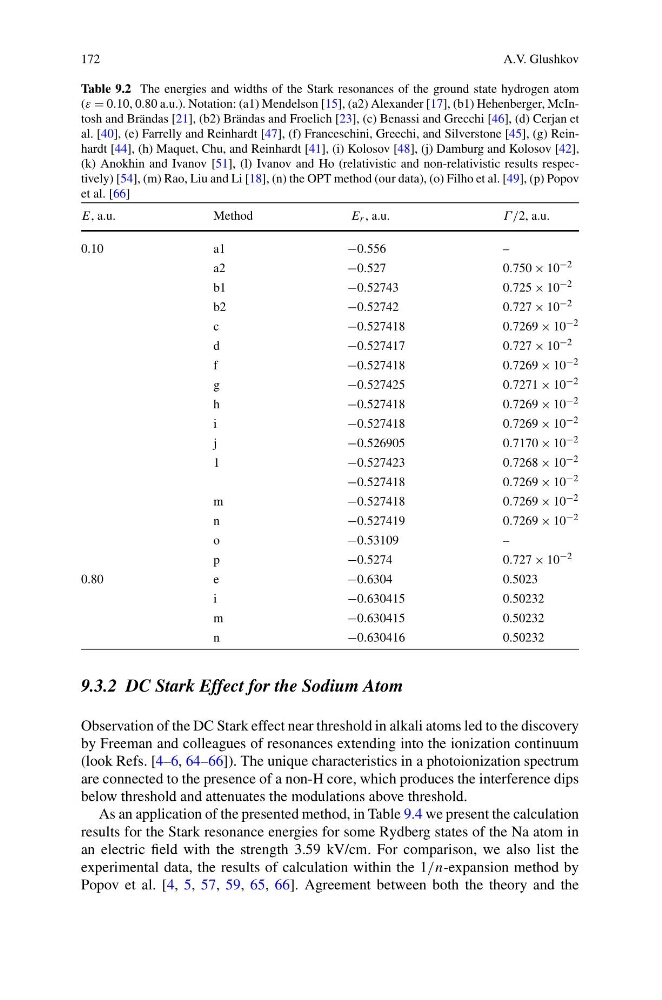
Table 9.2 The energies and widths of the Stark resonances of the ground state hydrogen atom
(ε = 0.10, 0.80 a.u.). Notation: (a1) Mendelson [15], (a2) Alexander [17], (b1) Hehenberger, McIntosh and Brändas [21], (b2) Brändas and Froelich [23], (c) Benassi and Grecchi [46], (d) Cerjan et
al. [40], (e) Farrelly and Reinhardt [47], (f) Franceschini, Greechi, and Silverstone [45], (g) Reinhardt [44], (h) Maquet, Chu, and Reinhardt [41], (i) Kolosov [48], (j) Damburg and Kolosov [42],
(k) Anokhin and Ivanov [51], (l) Ivanov and Ho (relativistic and non-relativistic results respectively) [54], (m) Rao, Liu and Li [18], (n) the OPT method (our data), (o) Filho et al. [49], (p) Popov
et al. [66]
E, a.u.
Method
E r , a.u.
Γ /2, a.u.
0.10
a1
−0.556
–
a2
−0.527
0.750 × 10 −2
b1
−0.52743
0.725 × 10 −2
b2
−0.52742
0.727 × 10 −2
c
−0.527418
0.7269 × 10 −2
d
−0.527417
0.727 × 10 −2
f
−0.527418
0.7269 × 10 −2
g
−0.527425
0.7271 × 10 −2
h
−0.527418
0.7269 × 10 −2
i
−0.527418
0.7269 × 10 −2
j
−0.526905
0.7170 × 10 −2
1
−0.527423
0.7268 × 10 −2
−0.527418
0.7269 × 10 −2
m
−0.527418
0.7269 × 10 −2
n
−0.527419
0.7269 × 10 −2
o
−0.53109
–
p
−0.5274
0.727 × 10 −2
0.80
e
−0.6304
0.5023
i
−0.630415
0.50232
m
−0.630415
0.50232
n
−0.630416
0.50232
9.3.2 DC Stark Effect for the Sodium Atom
Observation of the DC Stark effect near threshold in alkali atoms led to the discovery
by Freeman and colleagues of resonances extending into the ionization continuum
(look Refs. [4–6, 64–66]). The unique characteristics in a photoionization spectrum
are connected to the presence of a non-H core, which produces the interference dips
below threshold and attenuates the modulations above threshold.
As an application of the presented method, in Table 9.4 we present the calculation
results for the Stark resonance energies for some Rydberg states of the Na atom in
an electric field with the strength 3.59 kV/cm. For comparison, we also list the
experimental data, the results of calculation within the 1/n-expansion method by
Popov et al. [4, 5, 57, 59, 65, 66]. Agreement between both the theory and the
A.V. Glushkov
Table 9.2 The energies and widths of the Stark resonances of the ground state hydrogen atom
(ε = 0.10, 0.80 a.u.). Notation: (a1) Mendelson [15], (a2) Alexander [17], (b1) Hehenberger, McIntosh and Brändas [21], (b2) Brändas and Froelich [23], (c) Benassi and Grecchi [46], (d) Cerjan et
al. [40], (e) Farrelly and Reinhardt [47], (f) Franceschini, Greechi, and Silverstone [45], (g) Reinhardt [44], (h) Maquet, Chu, and Reinhardt [41], (i) Kolosov [48], (j) Damburg and Kolosov [42],
(k) Anokhin and Ivanov [51], (l) Ivanov and Ho (relativistic and non-relativistic results respectively) [54], (m) Rao, Liu and Li [18], (n) the OPT method (our data), (o) Filho et al. [49], (p) Popov
et al. [66]
E, a.u.
Method
E r , a.u.
Γ /2, a.u.
0.10
a1
−0.556
–
a2
−0.527
0.750 × 10 −2
b1
−0.52743
0.725 × 10 −2
b2
−0.52742
0.727 × 10 −2
c
−0.527418
0.7269 × 10 −2
d
−0.527417
0.727 × 10 −2
f
−0.527418
0.7269 × 10 −2
g
−0.527425
0.7271 × 10 −2
h
−0.527418
0.7269 × 10 −2
i
−0.527418
0.7269 × 10 −2
j
−0.526905
0.7170 × 10 −2
1
−0.527423
0.7268 × 10 −2
−0.527418
0.7269 × 10 −2
m
−0.527418
0.7269 × 10 −2
n
−0.527419
0.7269 × 10 −2
o
−0.53109
–
p
−0.5274
0.727 × 10 −2
0.80
e
−0.6304
0.5023
i
−0.630415
0.50232
m
−0.630415
0.50232
n
−0.630416
0.50232
9.3.2 DC Stark Effect for the Sodium Atom
Observation of the DC Stark effect near threshold in alkali atoms led to the discovery
by Freeman and colleagues of resonances extending into the ionization continuum
(look Refs. [4–6, 64–66]). The unique characteristics in a photoionization spectrum
are connected to the presence of a non-H core, which produces the interference dips
below threshold and attenuates the modulations above threshold.
As an application of the presented method, in Table 9.4 we present the calculation
results for the Stark resonance energies for some Rydberg states of the Na atom in
an electric field with the strength 3.59 kV/cm. For comparison, we also list the
experimental data, the results of calculation within the 1/n-expansion method by
Popov et al. [4, 5, 57, 59, 65, 66]. Agreement between both the theory and the