

9 Operator Perturbation Theory for Atomic Systems
169
characteristics of multi-electron atoms in an external electric field, regardless of its
strength. Obviously, such a method would be extremely useful and effective. Note,
however, that one of the ways this problem could be related to the use of effective potentials, chosen in such a way that to achieve the separation of variables in
the Schrödinger equation. Here the model potential approach or the quantum defect
approximation can be used. One may introduce the ion core charge z ∗ for the multielectron atom. According to standard quantum defect theory, the relation between
quantum defect value μ 1 , electron energy E and principal quantum number n is:
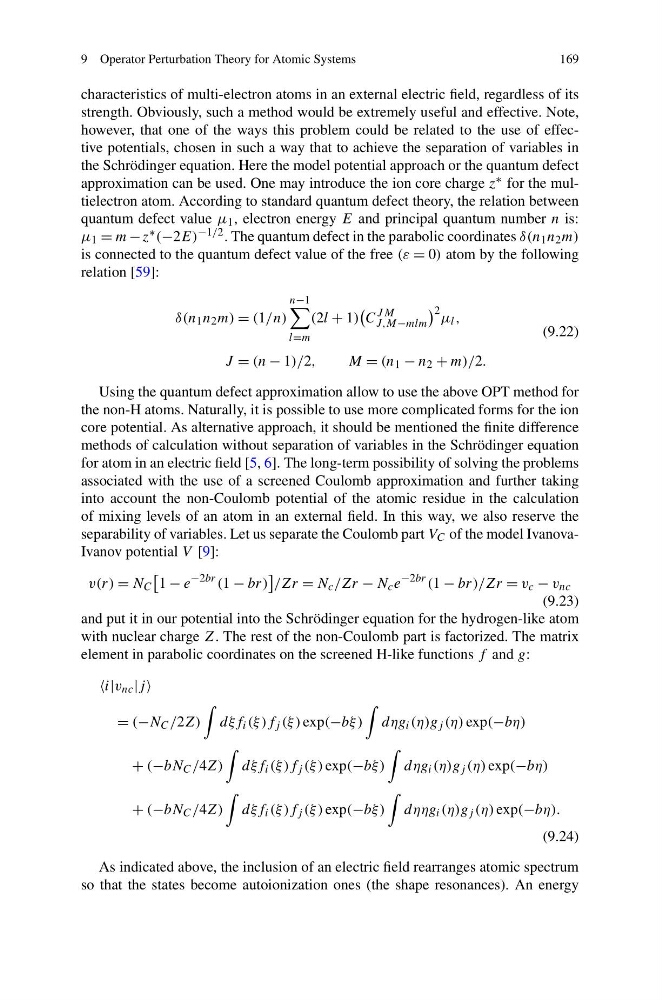
μ 1 = m − z ∗ (−2E) −1/2 . The quantum defect in the parabolic coordinates δ(n 1 n 2 m)
is connected to the quantum defect value of the free (ε = 0) atom by the following
relation [59]:
δ(n 1 n 2 m) = (1/n)
n−1
l=m
(2l + 1)
C
J M
J,M−mlm
2 μ l ,
J = (n − 1)/2,
M= (n 1 − n 2 + m)/2.
(9.22)
Using the quantum defect approximation allow to use the above OPT method for
the non-H atoms. Naturally, it is possible to use more complicated forms for the ion
core potential. As alternative approach, it should be mentioned the finite difference
methods of calculation without separation of variables in the Schrödinger equation
for atom in an electric field [5, 6]. The long-term possibility of solving the problems
associated with the use of a screened Coulomb approximation and further taking
into account the non-Coulomb potential of the atomic residue in the calculation
of mixing levels of an atom in an external field. In this way, we also reserve the
separability of variables. Let us separate the Coulomb part V C of the model IvanovaIvanov potential V [9]:
v(r) = N C
1 − e
−2br (1 − br)
/Zr = N c /Zr − N c e
−2br (1 − br)/Zr = v c − v nc
(9.23)
and put it in our potential into the Schrödinger equation for the hydrogen-like atom
with nuclear charge Z. The rest of the non-Coulomb part is factorized. The matrix
element in parabolic coordinates on the screened H-like functions f and g:
i|v nc |j
= (−N C /2Z)
dξf i (ξ )f j (ξ ) exp(−bξ )
dηg i (η)g j (η) exp(−bη)
+ (−bN C /4Z)
dξf i (ξ )f j (ξ ) exp(−bξ )
dηg i (η)g j (η) exp(−bη)
+ (−bN C /4Z)
dξf i (ξ )f j (ξ ) exp(−bξ )
dηηg i (η)g j (η) exp(−bη).
(9.24)
As indicated above, the inclusion of an electric field rearranges atomic spectrum
so that the states become autoionization ones (the shape resonances). An energy
169
characteristics of multi-electron atoms in an external electric field, regardless of its
strength. Obviously, such a method would be extremely useful and effective. Note,
however, that one of the ways this problem could be related to the use of effective potentials, chosen in such a way that to achieve the separation of variables in
the Schrödinger equation. Here the model potential approach or the quantum defect
approximation can be used. One may introduce the ion core charge z ∗ for the multielectron atom. According to standard quantum defect theory, the relation between
quantum defect value μ 1 , electron energy E and principal quantum number n is:
μ 1 = m − z ∗ (−2E) −1/2 . The quantum defect in the parabolic coordinates δ(n 1 n 2 m)
is connected to the quantum defect value of the free (ε = 0) atom by the following
relation [59]:
δ(n 1 n 2 m) = (1/n)
n−1
l=m
(2l + 1)
C
J M
J,M−mlm
2 μ l ,
J = (n − 1)/2,
M= (n 1 − n 2 + m)/2.
(9.22)
Using the quantum defect approximation allow to use the above OPT method for
the non-H atoms. Naturally, it is possible to use more complicated forms for the ion
core potential. As alternative approach, it should be mentioned the finite difference
methods of calculation without separation of variables in the Schrödinger equation
for atom in an electric field [5, 6]. The long-term possibility of solving the problems
associated with the use of a screened Coulomb approximation and further taking
into account the non-Coulomb potential of the atomic residue in the calculation
of mixing levels of an atom in an external field. In this way, we also reserve the
separability of variables. Let us separate the Coulomb part V C of the model IvanovaIvanov potential V [9]:
v(r) = N C
1 − e
−2br (1 − br)
/Zr = N c /Zr − N c e
−2br (1 − br)/Zr = v c − v nc
(9.23)
and put it in our potential into the Schrödinger equation for the hydrogen-like atom
with nuclear charge Z. The rest of the non-Coulomb part is factorized. The matrix
element in parabolic coordinates on the screened H-like functions f and g:
i|v nc |j
= (−N C /2Z)
dξf i (ξ )f j (ξ ) exp(−bξ )
dηg i (η)g j (η) exp(−bη)
+ (−bN C /4Z)
dξf i (ξ )f j (ξ ) exp(−bξ )
dηg i (η)g j (η) exp(−bη)
+ (−bN C /4Z)
dξf i (ξ )f j (ξ ) exp(−bξ )
dηηg i (η)g j (η) exp(−bη).
(9.24)
As indicated above, the inclusion of an electric field rearranges atomic spectrum
so that the states become autoionization ones (the shape resonances). An energy