

6 Charge Transfer Rate Constants
127
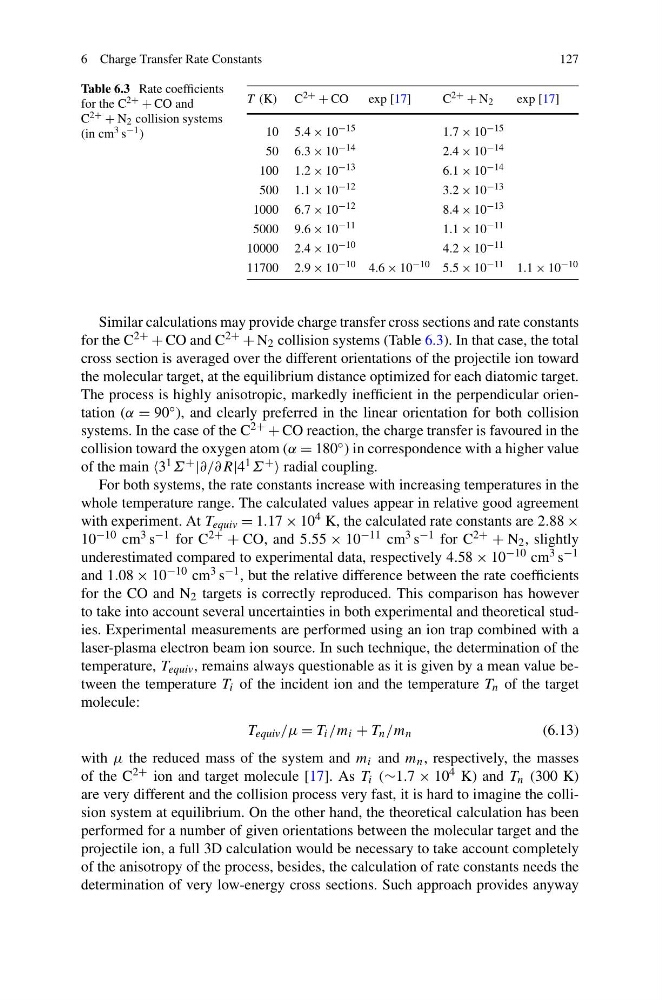
Table 6.3 Rate coefficients
for the C 2+ + CO and
C 2+ + N 2 collision systems
(in cm 3 s −1 )
T (K) C 2+ + CO
exp [17]
C 2+ + N 2
exp [17]
10 5.4 × 10 −15
1.7 × 10 −15
50 6.3 × 10 −14
2.4 × 10 −14
100 1.2 × 10 −13
6.1 × 10 −14
500 1.1 × 10 −12
3.2 × 10 −13
1000 6.7 × 10 −12
8.4 × 10 −13
5000 9.6 × 10 −11
1.1 × 10 −11
10000 2.4 × 10 −10
4.2 × 10 −11
11700 2.9 × 10 −10 4.6 × 10 −10 5.5 × 10 −11 1.1 × 10 −10
Similar calculations may provide charge transfer cross sections and rate constants
for the C 2+ + CO and C 2+ + N 2 collision systems (Table 6.3). In that case, the total
cross section is averaged over the different orientations of the projectile ion toward
the molecular target, at the equilibrium distance optimized for each diatomic target.
The process is highly anisotropic, markedly inefficient in the perpendicular orientation (α = 90 ◦ ), and clearly preferred in the linear orientation for both collision
systems. In the case of the C 2+ + CO reaction, the charge transfer is favoured in the
collision toward the oxygen atom (α = 180 ◦ ) in correspondence with a higher value
of the main 3 1 Σ + |∂/∂R|4 1 Σ + radial coupling.
For both systems, the rate constants increase with increasing temperatures in the
whole temperature range. The calculated values appear in relative good agreement
with experiment. At T equiv = 1.17 × 10 4 K, the calculated rate constants are 2.88 ×
10 −10 cm 3 s −1 for C 2+ + CO, and 5.55 × 10 −11 cm 3 s −1 for C 2+ + N 2 , slightly
underestimated compared to experimental data, respectively 4.58 × 10 −10 cm 3 s −1
and 1.08 × 10 −10 cm 3 s −1 , but the relative difference between the rate coefficients
for the CO and N 2 targets is correctly reproduced. This comparison has however
to take into account several uncertainties in both experimental and theoretical studies. Experimental measurements are performed using an ion trap combined with a
laser-plasma electron beam ion source. In such technique, the determination of the
temperature, T equiv , remains always questionable as it is given by a mean value between the temperature T i of the incident ion and the temperature T n of the target
molecule:
T equiv /μ = T i /m i + T n /m n
(6.13)
with μ the reduced mass of the system and m i and m n , respectively, the masses
of the C 2+ ion and target molecule [17]. As T i (∼1.7 × 10 4 K) and T n (300 K)
are very different and the collision process very fast, it is hard to imagine the collision system at equilibrium. On the other hand, the theoretical calculation has been
performed for a number of given orientations between the molecular target and the
projectile ion, a full 3D calculation would be necessary to take account completely
of the anisotropy of the process, besides, the calculation of rate constants needs the
determination of very low-energy cross sections. Such approach provides anyway
127
Table 6.3 Rate coefficients
for the C 2+ + CO and
C 2+ + N 2 collision systems
(in cm 3 s −1 )
T (K) C 2+ + CO
exp [17]
C 2+ + N 2
exp [17]
10 5.4 × 10 −15
1.7 × 10 −15
50 6.3 × 10 −14
2.4 × 10 −14
100 1.2 × 10 −13
6.1 × 10 −14
500 1.1 × 10 −12
3.2 × 10 −13
1000 6.7 × 10 −12
8.4 × 10 −13
5000 9.6 × 10 −11
1.1 × 10 −11
10000 2.4 × 10 −10
4.2 × 10 −11
11700 2.9 × 10 −10 4.6 × 10 −10 5.5 × 10 −11 1.1 × 10 −10
Similar calculations may provide charge transfer cross sections and rate constants
for the C 2+ + CO and C 2+ + N 2 collision systems (Table 6.3). In that case, the total
cross section is averaged over the different orientations of the projectile ion toward
the molecular target, at the equilibrium distance optimized for each diatomic target.
The process is highly anisotropic, markedly inefficient in the perpendicular orientation (α = 90 ◦ ), and clearly preferred in the linear orientation for both collision
systems. In the case of the C 2+ + CO reaction, the charge transfer is favoured in the
collision toward the oxygen atom (α = 180 ◦ ) in correspondence with a higher value
of the main 3 1 Σ + |∂/∂R|4 1 Σ + radial coupling.
For both systems, the rate constants increase with increasing temperatures in the
whole temperature range. The calculated values appear in relative good agreement
with experiment. At T equiv = 1.17 × 10 4 K, the calculated rate constants are 2.88 ×
10 −10 cm 3 s −1 for C 2+ + CO, and 5.55 × 10 −11 cm 3 s −1 for C 2+ + N 2 , slightly
underestimated compared to experimental data, respectively 4.58 × 10 −10 cm 3 s −1
and 1.08 × 10 −10 cm 3 s −1 , but the relative difference between the rate coefficients
for the CO and N 2 targets is correctly reproduced. This comparison has however
to take into account several uncertainties in both experimental and theoretical studies. Experimental measurements are performed using an ion trap combined with a
laser-plasma electron beam ion source. In such technique, the determination of the
temperature, T equiv , remains always questionable as it is given by a mean value between the temperature T i of the incident ion and the temperature T n of the target
molecule:
T equiv /μ = T i /m i + T n /m n
(6.13)
with μ the reduced mass of the system and m i and m n , respectively, the masses
of the C 2+ ion and target molecule [17]. As T i (∼1.7 × 10 4 K) and T n (300 K)
are very different and the collision process very fast, it is hard to imagine the collision system at equilibrium. On the other hand, the theoretical calculation has been
performed for a number of given orientations between the molecular target and the
projectile ion, a full 3D calculation would be necessary to take account completely
of the anisotropy of the process, besides, the calculation of rate constants needs the
determination of very low-energy cross sections. Such approach provides anyway