

6 Charge Transfer Rate Constants
125
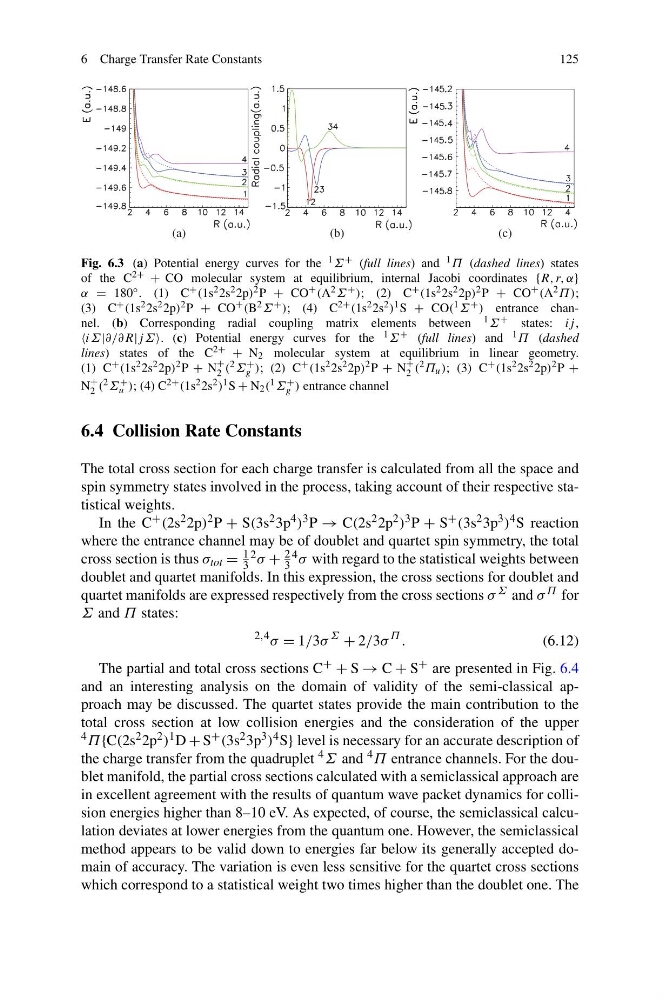
Fig. 6.3 (a) Potential energy curves for the 1 Σ + (full lines) and 1 Π (dashed lines) states
of the C 2+ + CO molecular system at equilibrium, internal Jacobi coordinates {R, r, α}
α = 180 ◦ . (1) C + (1s 2 2s 2 2p) 2 P + CO
+ (A 2 Σ + ); (2) C + (1s 2 2s 2 2p) 2 P + CO
+ (A 2 Π);
(3) C + (1s 2 2s 2 2p) 2 P + CO
+ (B 2 Σ + ); (4) C 2+ (1s 2 2s 2 ) 1 S + CO( 1 Σ + ) entrance channel. (b) Corresponding radial coupling matrix elements between 1 Σ + states: ij ,
iΣ|∂/∂R|jΣ. (c) Potential energy curves for the 1 Σ + (full lines) and 1 Π (dashed
lines) states of the C 2+ + N 2 molecular system at equilibrium in linear geometry.
(1) C + (1s 2 2s 2 2p) 2 P + N
+
2 ( 2 Σ +
g ); (2) C + (1s 2 2s 2 2p) 2 P + N
+
2 ( 2 Π u ); (3) C + (1s 2 2s 2 2p) 2 P +
N
+
2 ( 2 Σ +
u ); (4) C 2+ (1s 2 2s 2 ) 1 S + N 2 ( 1 Σ +
g ) entrance channel
6.4 Collision Rate Constants
The total cross section for each charge transfer is calculated from all the space and
spin symmetry states involved in the process, taking account of their respective statistical weights.
In the C + (2s 2 2p) 2 P + S(3s 2 3p 4 ) 3 P → C(2s 2 2p 2 ) 3 P + S + (3s 2 3p 3 ) 4 S reaction
where the entrance channel may be of doublet and quartet spin symmetry, the total
cross section is thus σ tot =
1
3
2 σ +
2
3
4 σ with regard to the statistical weights between
doublet and quartet manifolds. In this expression, the cross sections for doublet and
quartet manifolds are expressed respectively from the cross sections σ Σ and σ Π for
Σ and Π states:
2,4 σ = 1/3σ
Σ
+ 2/3σ
Π .
(6.12)
The partial and total cross sections C + + S → C + S + are presented in Fig. 6.4
and an interesting analysis on the domain of validity of the semi-classical approach may be discussed. The quartet states provide the main contribution to the
total cross section at low collision energies and the consideration of the upper
4 Π{C(2s 2 2p 2 ) 1 D + S + (3s 2 3p 3 ) 4 S} level is necessary for an accurate description of
the charge transfer from the quadruplet 4 Σ and 4 Π entrance channels. For the doublet manifold, the partial cross sections calculated with a semiclassical approach are
in excellent agreement with the results of quantum wave packet dynamics for collision energies higher than 8–10 eV. As expected, of course, the semiclassical calculation deviates at lower energies from the quantum one. However, the semiclassical
method appears to be valid down to energies far below its generally accepted domain of accuracy. The variation is even less sensitive for the quartet cross sections
which correspond to a statistical weight two times higher than the doublet one. The
125
Fig. 6.3 (a) Potential energy curves for the 1 Σ + (full lines) and 1 Π (dashed lines) states
of the C 2+ + CO molecular system at equilibrium, internal Jacobi coordinates {R, r, α}
α = 180 ◦ . (1) C + (1s 2 2s 2 2p) 2 P + CO
+ (A 2 Σ + ); (2) C + (1s 2 2s 2 2p) 2 P + CO
+ (A 2 Π);
(3) C + (1s 2 2s 2 2p) 2 P + CO
+ (B 2 Σ + ); (4) C 2+ (1s 2 2s 2 ) 1 S + CO( 1 Σ + ) entrance channel. (b) Corresponding radial coupling matrix elements between 1 Σ + states: ij ,
iΣ|∂/∂R|jΣ. (c) Potential energy curves for the 1 Σ + (full lines) and 1 Π (dashed
lines) states of the C 2+ + N 2 molecular system at equilibrium in linear geometry.
(1) C + (1s 2 2s 2 2p) 2 P + N
+
2 ( 2 Σ +
g ); (2) C + (1s 2 2s 2 2p) 2 P + N
+
2 ( 2 Π u ); (3) C + (1s 2 2s 2 2p) 2 P +
N
+
2 ( 2 Σ +
u ); (4) C 2+ (1s 2 2s 2 ) 1 S + N 2 ( 1 Σ +
g ) entrance channel
6.4 Collision Rate Constants
The total cross section for each charge transfer is calculated from all the space and
spin symmetry states involved in the process, taking account of their respective statistical weights.
In the C + (2s 2 2p) 2 P + S(3s 2 3p 4 ) 3 P → C(2s 2 2p 2 ) 3 P + S + (3s 2 3p 3 ) 4 S reaction
where the entrance channel may be of doublet and quartet spin symmetry, the total
cross section is thus σ tot =
1
3
2 σ +
2
3
4 σ with regard to the statistical weights between
doublet and quartet manifolds. In this expression, the cross sections for doublet and
quartet manifolds are expressed respectively from the cross sections σ Σ and σ Π for
Σ and Π states:
2,4 σ = 1/3σ
Σ
+ 2/3σ
Π .
(6.12)
The partial and total cross sections C + + S → C + S + are presented in Fig. 6.4
and an interesting analysis on the domain of validity of the semi-classical approach may be discussed. The quartet states provide the main contribution to the
total cross section at low collision energies and the consideration of the upper
4 Π{C(2s 2 2p 2 ) 1 D + S + (3s 2 3p 3 ) 4 S} level is necessary for an accurate description of
the charge transfer from the quadruplet 4 Σ and 4 Π entrance channels. For the doublet manifold, the partial cross sections calculated with a semiclassical approach are
in excellent agreement with the results of quantum wave packet dynamics for collision energies higher than 8–10 eV. As expected, of course, the semiclassical calculation deviates at lower energies from the quantum one. However, the semiclassical
method appears to be valid down to energies far below its generally accepted domain of accuracy. The variation is even less sensitive for the quartet cross sections
which correspond to a statistical weight two times higher than the doublet one. The