

6 Charge Transfer Rate Constants
123
Table 6.1 Correlation diagram
Configuration
Molecular states Asymptotic energies (eV)
NIST database [34] 2 Π/ 2 Σ 4 Π/ 4 Σ states
C(2s 2 2p 2 ) 1 D + S + (3s 2 3p 3 ) 4 S 4 Σ, 4 Π , 4 Δ
1.26
1.32
C + (2s 2 2p) 2 P + S(3s 2 3p 4 ) 3 P
2,4 Σ, 2,4 Π , 2,4 Δ 0.92
0.98
0.93
C(2s 2 2p 2 ) 3 P + S + (3s 2 3p 3 ) 4 S 2,4,6 Σ, 2,4,6 Π
0.0
0.0
0.0
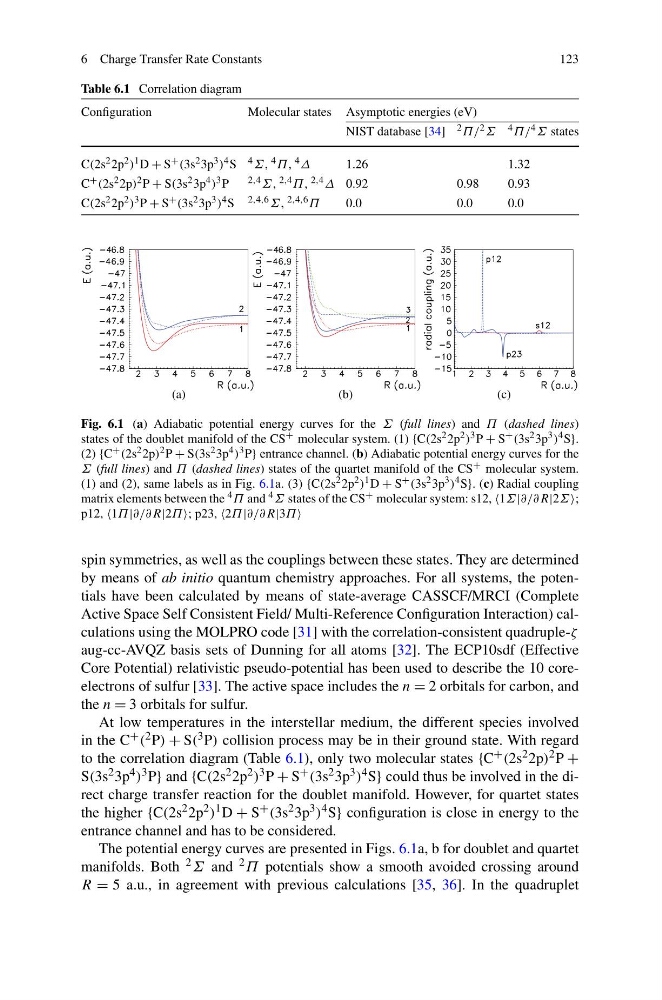
Fig. 6.1 (a) Adiabatic potential energy curves for the Σ (full lines) and Π (dashed lines)
states of the doublet manifold of the CS + molecular system. (1) {C(2s 2 2p 2 ) 3 P + S + (3s 2 3p 3 ) 4 S}.
(2) {C + (2s 2 2p) 2 P + S(3s 2 3p 4 ) 3 P} entrance channel. (b) Adiabatic potential energy curves for the
Σ (full lines) and Π (dashed lines) states of the quartet manifold of the CS + molecular system.
(1) and (2), same labels as in Fig. 6.1a. (3) {C(2s 2 2p 2 ) 1 D + S + (3s 2 3p 3 ) 4 S}. (c) Radial coupling
matrix elements between the 4 Π and 4 Σ states of the CS + molecular system: s12, 1Σ|∂/∂R|2Σ;
p12, 1Π |∂/∂R|2Π ; p23, 2Π |∂/∂R|3Π
spin symmetries, as well as the couplings between these states. They are determined
by means of ab initio quantum chemistry approaches. For all systems, the potentials have been calculated by means of state-average CASSCF/MRCI (Complete
Active Space Self Consistent Field/ Multi-Reference Configuration Interaction) calculations using the MOLPRO code [31] with the correlation-consistent quadruple-ζ
aug-cc-AVQZ basis sets of Dunning for all atoms [32]. The ECP10sdf (Effective
Core Potential) relativistic pseudo-potential has been used to describe the 10 coreelectrons of sulfur [33]. The active space includes the n = 2 orbitals for carbon, and
the n = 3 orbitals for sulfur.
At low temperatures in the interstellar medium, the different species involved
in the C + ( 2 P) + S( 3 P) collision process may be in their ground state. With regard
to the correlation diagram (Table 6.1), only two molecular states {C + (2s 2 2p) 2 P +
S(3s 2 3p 4 ) 3 P} and {C(2s 2 2p 2 ) 3 P + S + (3s 2 3p 3 ) 4 S} could thus be involved in the direct charge transfer reaction for the doublet manifold. However, for quartet states
the higher {C(2s 2 2p 2 ) 1 D + S + (3s 2 3p 3 ) 4 S} configuration is close in energy to the
entrance channel and has to be considered.
The potential energy curves are presented in Figs. 6.1a, b for doublet and quartet
manifolds. Both 2 Σ and 2 Π potentials show a smooth avoided crossing around
R = 5 a.u., in agreement with previous calculations [35, 36]. In the quadruplet
123
Table 6.1 Correlation diagram
Configuration
Molecular states Asymptotic energies (eV)
NIST database [34] 2 Π/ 2 Σ 4 Π/ 4 Σ states
C(2s 2 2p 2 ) 1 D + S + (3s 2 3p 3 ) 4 S 4 Σ, 4 Π , 4 Δ
1.26
1.32
C + (2s 2 2p) 2 P + S(3s 2 3p 4 ) 3 P
2,4 Σ, 2,4 Π , 2,4 Δ 0.92
0.98
0.93
C(2s 2 2p 2 ) 3 P + S + (3s 2 3p 3 ) 4 S 2,4,6 Σ, 2,4,6 Π
0.0
0.0
0.0
Fig. 6.1 (a) Adiabatic potential energy curves for the Σ (full lines) and Π (dashed lines)
states of the doublet manifold of the CS + molecular system. (1) {C(2s 2 2p 2 ) 3 P + S + (3s 2 3p 3 ) 4 S}.
(2) {C + (2s 2 2p) 2 P + S(3s 2 3p 4 ) 3 P} entrance channel. (b) Adiabatic potential energy curves for the
Σ (full lines) and Π (dashed lines) states of the quartet manifold of the CS + molecular system.
(1) and (2), same labels as in Fig. 6.1a. (3) {C(2s 2 2p 2 ) 1 D + S + (3s 2 3p 3 ) 4 S}. (c) Radial coupling
matrix elements between the 4 Π and 4 Σ states of the CS + molecular system: s12, 1Σ|∂/∂R|2Σ;
p12, 1Π |∂/∂R|2Π ; p23, 2Π |∂/∂R|3Π
spin symmetries, as well as the couplings between these states. They are determined
by means of ab initio quantum chemistry approaches. For all systems, the potentials have been calculated by means of state-average CASSCF/MRCI (Complete
Active Space Self Consistent Field/ Multi-Reference Configuration Interaction) calculations using the MOLPRO code [31] with the correlation-consistent quadruple-ζ
aug-cc-AVQZ basis sets of Dunning for all atoms [32]. The ECP10sdf (Effective
Core Potential) relativistic pseudo-potential has been used to describe the 10 coreelectrons of sulfur [33]. The active space includes the n = 2 orbitals for carbon, and
the n = 3 orbitals for sulfur.
At low temperatures in the interstellar medium, the different species involved
in the C + ( 2 P) + S( 3 P) collision process may be in their ground state. With regard
to the correlation diagram (Table 6.1), only two molecular states {C + (2s 2 2p) 2 P +
S(3s 2 3p 4 ) 3 P} and {C(2s 2 2p 2 ) 3 P + S + (3s 2 3p 3 ) 4 S} could thus be involved in the direct charge transfer reaction for the doublet manifold. However, for quartet states
the higher {C(2s 2 2p 2 ) 1 D + S + (3s 2 3p 3 ) 4 S} configuration is close in energy to the
entrance channel and has to be considered.
The potential energy curves are presented in Figs. 6.1a, b for doublet and quartet
manifolds. Both 2 Σ and 2 Π potentials show a smooth avoided crossing around
R = 5 a.u., in agreement with previous calculations [35, 36]. In the quadruplet