

108
S.O. Adamson et al.
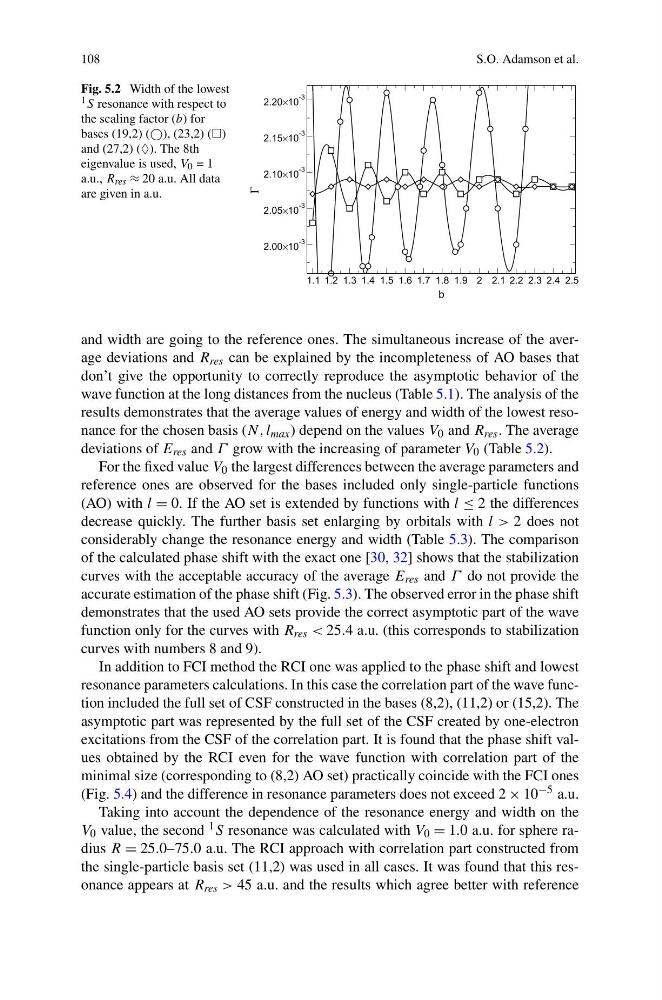
Fig. 5.2 Width of the lowest
1 S resonance with respect to
the scaling factor (b) for
bases (19,2) (), (23,2) ()
and (27,2) (♦). The 8th
eigenvalue is used, V 0 = 1
a.u., R res ≈ 20 a.u. All data
are given in a.u.
and width are going to the reference ones. The simultaneous increase of the average deviations and R res can be explained by the incompleteness of AO bases that
don’t give the opportunity to correctly reproduce the asymptotic behavior of the
wave function at the long distances from the nucleus (Table 5.1). The analysis of the
results demonstrates that the average values of energy and width of the lowest resonance for the chosen basis (N, l max ) depend on the values V 0 and R res . The average
deviations of E res and Γ grow with the increasing of parameter V 0 (Table 5.2).
For the fixed value V 0 the largest differences between the average parameters and
reference ones are observed for the bases included only single-particle functions
(AO) with l = 0. If the AO set is extended by functions with l ≤ 2 the differences
decrease quickly. The further basis set enlarging by orbitals with l > 2 does not
considerably change the resonance energy and width (Table 5.3). The comparison
of the calculated phase shift with the exact one [30, 32] shows that the stabilization
curves with the acceptable accuracy of the average E res and Γ do not provide the
accurate estimation of the phase shift (Fig. 5.3). The observed error in the phase shift
demonstrates that the used AO sets provide the correct asymptotic part of the wave
function only for the curves with R res < 25.4 a.u. (this corresponds to stabilization
curves with numbers 8 and 9).
In addition to FCI method the RCI one was applied to the phase shift and lowest
resonance parameters calculations. In this case the correlation part of the wave function included the full set of CSF constructed in the bases (8,2), (11,2) or (15,2). The
asymptotic part was represented by the full set of the CSF created by one-electron
excitations from the CSF of the correlation part. It is found that the phase shift values obtained by the RCI even for the wave function with correlation part of the
minimal size (corresponding to (8,2) AO set) practically coincide with the FCI ones
(Fig. 5.4) and the difference in resonance parameters does not exceed 2 × 10 −5 a.u.
Taking into account the dependence of the resonance energy and width on the
V 0 value, the second 1 S resonance was calculated with V 0 = 1.0 a.u. for sphere radius R = 25.0–75.0 a.u. The RCI approach with correlation part constructed from
the single-particle basis set (11,2) was used in all cases. It was found that this resonance appears at R res > 45 a.u. and the results which agree better with reference
S.O. Adamson et al.
Fig. 5.2 Width of the lowest
1 S resonance with respect to
the scaling factor (b) for
bases (19,2) (), (23,2) ()
and (27,2) (♦). The 8th
eigenvalue is used, V 0 = 1
a.u., R res ≈ 20 a.u. All data
are given in a.u.
and width are going to the reference ones. The simultaneous increase of the average deviations and R res can be explained by the incompleteness of AO bases that
don’t give the opportunity to correctly reproduce the asymptotic behavior of the
wave function at the long distances from the nucleus (Table 5.1). The analysis of the
results demonstrates that the average values of energy and width of the lowest resonance for the chosen basis (N, l max ) depend on the values V 0 and R res . The average
deviations of E res and Γ grow with the increasing of parameter V 0 (Table 5.2).
For the fixed value V 0 the largest differences between the average parameters and
reference ones are observed for the bases included only single-particle functions
(AO) with l = 0. If the AO set is extended by functions with l ≤ 2 the differences
decrease quickly. The further basis set enlarging by orbitals with l > 2 does not
considerably change the resonance energy and width (Table 5.3). The comparison
of the calculated phase shift with the exact one [30, 32] shows that the stabilization
curves with the acceptable accuracy of the average E res and Γ do not provide the
accurate estimation of the phase shift (Fig. 5.3). The observed error in the phase shift
demonstrates that the used AO sets provide the correct asymptotic part of the wave
function only for the curves with R res < 25.4 a.u. (this corresponds to stabilization
curves with numbers 8 and 9).
In addition to FCI method the RCI one was applied to the phase shift and lowest
resonance parameters calculations. In this case the correlation part of the wave function included the full set of CSF constructed in the bases (8,2), (11,2) or (15,2). The
asymptotic part was represented by the full set of the CSF created by one-electron
excitations from the CSF of the correlation part. It is found that the phase shift values obtained by the RCI even for the wave function with correlation part of the
minimal size (corresponding to (8,2) AO set) practically coincide with the FCI ones
(Fig. 5.4) and the difference in resonance parameters does not exceed 2 × 10 −5 a.u.
Taking into account the dependence of the resonance energy and width on the
V 0 value, the second 1 S resonance was calculated with V 0 = 1.0 a.u. for sphere radius R = 25.0–75.0 a.u. The RCI approach with correlation part constructed from
the single-particle basis set (11,2) was used in all cases. It was found that this resonance appears at R res > 45 a.u. and the results which agree better with reference