

4 Some Biochemical Reflections on Information and Communication
95
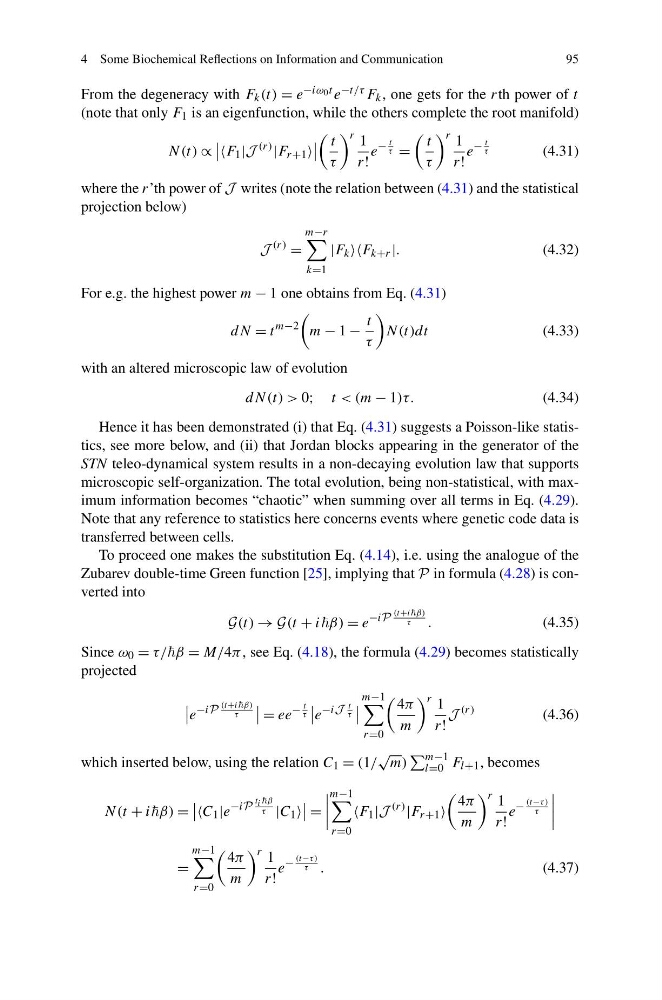
From the degeneracy with F k (t) = e −iω 0 t e −t/τ F k , one gets for the rth power of t
(note that only F 1 is an eigenfunction, while the others complete the root manifold)
N(t) ∝
F 1 |J
(r)
|F r+1
t
τ
r 1
r!
e
−
t
τ =
t
τ
r 1
r!
e
−
t
τ
(4.31)
where the r’th power of J writes (note the relation between (4.31) and the statistical
projection below)
J
(r)
=
m−r
k=1
|F k F k+r |.
(4.32)
For e.g. the highest power m − 1 one obtains from Eq. (4.31)
dN = t
m−2
m − 1 −
t
τ
N(t)dt
(4.33)
with an altered microscopic law of evolution
dN(t) > 0; t < (m − 1)τ.
(4.34)
Hence it has been demonstrated (i) that Eq. (4.31) suggests a Poisson-like statistics, see more below, and (ii) that Jordan blocks appearing in the generator of the
STN teleo-dynamical system results in a non-decaying evolution law that supports
microscopic self-organization. The total evolution, being non-statistical, with maximum information becomes “chaotic” when summing over all terms in Eq. (4.29).
Note that any reference to statistics here concerns events where genetic code data is
transferred between cells.
To proceed one makes the substitution Eq. (4.14), i.e. using the analogue of the
Zubarev double-time Green function [25], implying that P in formula (4.28) is converted into
G(t) → G(t + iβ) = e
−iP
(t+iβ)
τ
.
(4.35)
Since ω 0 = τ/β = M/4π , see Eq. (4.18), the formula (4.29) becomes statistically
projected
e
−iP
(t+iβ)
τ
= ee
−
t
τ
e
−iJ
t
τ
m−1
r=0
4π
m
r 1
r!
J
(r)
(4.36)
which inserted below, using the relation C 1 = (1/
√
m)
m−1
l=0 F l+1 , becomes
N(t + iβ) =
C 1 |e
−iP
t i β
τ |C 1
=
m−1
r=0
F 1 |J
(r)
|F r+1
4π
m
r 1
r!
e
−
(t−τ )
τ
=
m−1
r=0
4π
m
r 1
r!
e
−
(t−τ )
τ .
(4.37)
95
From the degeneracy with F k (t) = e −iω 0 t e −t/τ F k , one gets for the rth power of t
(note that only F 1 is an eigenfunction, while the others complete the root manifold)
N(t) ∝
F 1 |J
(r)
|F r+1
t
τ
r 1
r!
e
−
t
τ =
t
τ
r 1
r!
e
−
t
τ
(4.31)
where the r’th power of J writes (note the relation between (4.31) and the statistical
projection below)
J
(r)
=
m−r
k=1
|F k F k+r |.
(4.32)
For e.g. the highest power m − 1 one obtains from Eq. (4.31)
dN = t
m−2
m − 1 −
t
τ
N(t)dt
(4.33)
with an altered microscopic law of evolution
dN(t) > 0; t < (m − 1)τ.
(4.34)
Hence it has been demonstrated (i) that Eq. (4.31) suggests a Poisson-like statistics, see more below, and (ii) that Jordan blocks appearing in the generator of the
STN teleo-dynamical system results in a non-decaying evolution law that supports
microscopic self-organization. The total evolution, being non-statistical, with maximum information becomes “chaotic” when summing over all terms in Eq. (4.29).
Note that any reference to statistics here concerns events where genetic code data is
transferred between cells.
To proceed one makes the substitution Eq. (4.14), i.e. using the analogue of the
Zubarev double-time Green function [25], implying that P in formula (4.28) is converted into
G(t) → G(t + iβ) = e
−iP
(t+iβ)
τ
.
(4.35)
Since ω 0 = τ/β = M/4π , see Eq. (4.18), the formula (4.29) becomes statistically
projected
e
−iP
(t+iβ)
τ
= ee
−
t
τ
e
−iJ
t
τ
m−1
r=0
4π
m
r 1
r!
J
(r)
(4.36)
which inserted below, using the relation C 1 = (1/
√
m)
m−1
l=0 F l+1 , becomes
N(t + iβ) =
C 1 |e
−iP
t i β
τ |C 1
=
m−1
r=0
F 1 |J
(r)
|F r+1
4π
m
r 1
r!
e
−
(t−τ )
τ
=
m−1
r=0
4π
m
r 1
r!
e
−
(t−τ )
τ .
(4.37)