

67
Rock Crabs
Carapace broadly oval or hexagonal; front not produced in form of a rostrum but
having a central tooth; anterior lateral margins toothed (nine quadrangular or pentagonal teeth in species listed herein); lateral spines not strongly developed; antennules folding length wise. Found only in northern part of area. This family comprises
1 genus, Cancer Linnaeus, 1758, and 4 living species in the Atlantic ocean, 2 of
which are eastern Atlantic in distribution (Cancer bellianus Johnson, 1861, and
Cancer pagurus Linnaeus, 1758) and 2 western Atlantic (Cancer borealis Stimpson,
1859, and Cancer irroratus Say, 1817). Nations’ (1979) proposition of dividing the
genus Cancer into subgenera is followed here. Two species of interest to fisheries
marginally in the area: Cancer irroratur Say, 1817. Cancer (Metacarcinus) borealis
Stimpson, 1859 (Tavares 1998).
Land Crabs
Land crabs carapace transversely oval, not strongly depressed, antero lateral margins strongly arched, not divided into teeth or lobes; front o-orbital margin (between
outer orbital angles) very much shorter than greatest width of carapace; third millipedes gaping noticeably, exposing the mandibles; dactyls of walking legs ridged
and spiny. Live on land, always at the reach of the water table. A single species of
interest to fisheries in the area: Cardisoma guanhumi Latreille, 1828 (Tavares 1998).
Golden Crabs
Carapace hexagonal; dorsal surface relatively smooth to granular; frontal margin
with 4 teeth; antero lateral margins distinctly convex, each with 3–5 low, sometimes
indistinct teeth. Dactylus of walking legs is T-shaped incross-section. Male abdominal segments 3–5 fused, functionally immovable, but sutures still visible
(Tavares 1998).
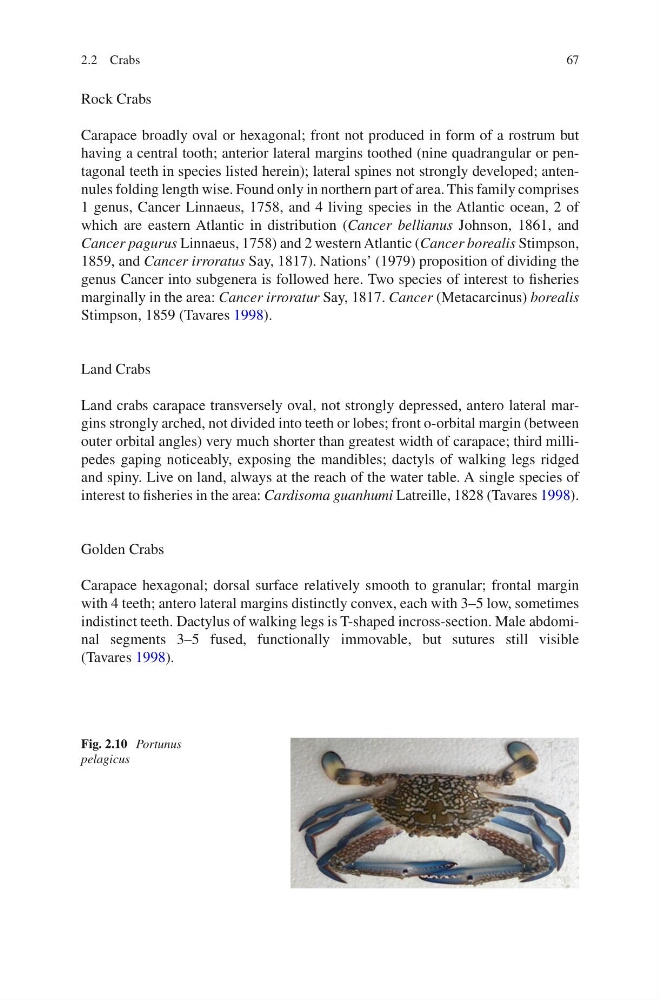
Fig. 2.10 Portunus
pelagicus
2.2 Crabs
Rock Crabs
Carapace broadly oval or hexagonal; front not produced in form of a rostrum but
having a central tooth; anterior lateral margins toothed (nine quadrangular or pentagonal teeth in species listed herein); lateral spines not strongly developed; antennules folding length wise. Found only in northern part of area. This family comprises
1 genus, Cancer Linnaeus, 1758, and 4 living species in the Atlantic ocean, 2 of
which are eastern Atlantic in distribution (Cancer bellianus Johnson, 1861, and
Cancer pagurus Linnaeus, 1758) and 2 western Atlantic (Cancer borealis Stimpson,
1859, and Cancer irroratus Say, 1817). Nations’ (1979) proposition of dividing the
genus Cancer into subgenera is followed here. Two species of interest to fisheries
marginally in the area: Cancer irroratur Say, 1817. Cancer (Metacarcinus) borealis
Stimpson, 1859 (Tavares 1998).
Land Crabs
Land crabs carapace transversely oval, not strongly depressed, antero lateral margins strongly arched, not divided into teeth or lobes; front o-orbital margin (between
outer orbital angles) very much shorter than greatest width of carapace; third millipedes gaping noticeably, exposing the mandibles; dactyls of walking legs ridged
and spiny. Live on land, always at the reach of the water table. A single species of
interest to fisheries in the area: Cardisoma guanhumi Latreille, 1828 (Tavares 1998).
Golden Crabs
Carapace hexagonal; dorsal surface relatively smooth to granular; frontal margin
with 4 teeth; antero lateral margins distinctly convex, each with 3–5 low, sometimes
indistinct teeth. Dactylus of walking legs is T-shaped incross-section. Male abdominal segments 3–5 fused, functionally immovable, but sutures still visible
(Tavares 1998).
Fig. 2.10 Portunus
pelagicus
2.2 Crabs