

53
interior, causing the internal temperature to increase, and is partly used for water
and vapour migration from the inside to the surface. The remaining amount of
energy is used to evaporate the surface water. The natural convection supported by
wind force removes the evaporating water from the surrounding air. Due to these
disadvantages of the conventional drying method, research has focused on the
development of alternative drying methods. For this purpose, different methods
such as spouted bed drying, heat pump drying, superheated steam drying, solar drying, drying with electromagnetic waves have been used (Nguyen et al. 2014).
Although it is an economically cheap method, it has the disadvantages such as
the difficulty in controlling the drying process and parameters, the irregularity of the
weather conditions, the need for a large drying area, insect infestation, mixing with
dust and other foreign substances (Gokoglu 2002; Jain and Pathare 2007;
Tirawanichakul et al. 2008). Also, there is a risk of unexpected rain or storm. In
addition, open sun-dried products do not meet the international quality standards
and lead to the product not being accepted in the international market (Sharma et al.
2009). The other disadvantages of open air drying are discontinuous drying and
dependent on the weather conditions and the region. At night when the sun is off,
the ambient temperature drops, relative humidity increases. In some cases, the product reabsorbs moisture and causes prolonged drying time and the formation of fungi
in the product.
Solar Drying
Solar dryers are widely used in drying of seafood. Solar drying is a detailed process
of drying in the sun and it is reported to be an energy efficient system. The term
solar dryer is defined as a device that collects and concentrates solar energy and thus
dries the product more quickly and improves its quality (Doe and Olley 1990). It has
also been reported that solar drying not only saves energy but also saves a lot of
time, does not require a large drying area, increases product quality, and protects the
environment and makes the process more efficient (Atul et al. 2009;
VijayaVenkataRaman et al. 2012). Compared to sun drying, solar dryers can provide higher air temperatures and lower relative humidity, which reduces the drying
rate and the moisture content of the final product. This means less infestation and
less spoilage. Therefore, it provides improved and more consistent product quality.
As a result of the economic analysis of the tunnel type solar crushers compared to
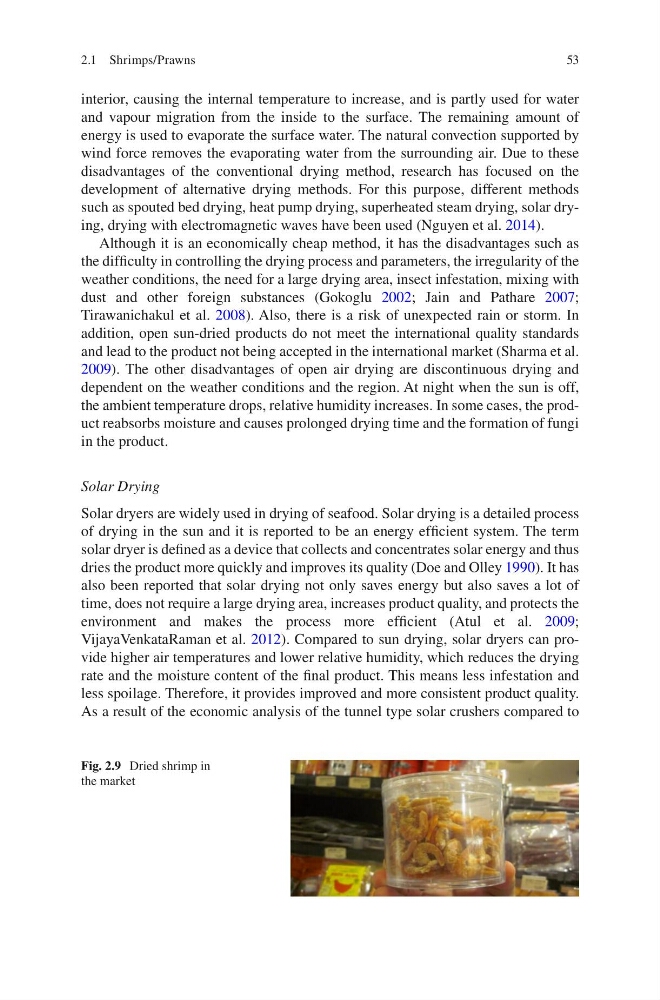
Fig. 2.9 Dried shrimp in
the market
2.1 Shrimps/Prawns
interior, causing the internal temperature to increase, and is partly used for water
and vapour migration from the inside to the surface. The remaining amount of
energy is used to evaporate the surface water. The natural convection supported by
wind force removes the evaporating water from the surrounding air. Due to these
disadvantages of the conventional drying method, research has focused on the
development of alternative drying methods. For this purpose, different methods
such as spouted bed drying, heat pump drying, superheated steam drying, solar drying, drying with electromagnetic waves have been used (Nguyen et al. 2014).
Although it is an economically cheap method, it has the disadvantages such as
the difficulty in controlling the drying process and parameters, the irregularity of the
weather conditions, the need for a large drying area, insect infestation, mixing with
dust and other foreign substances (Gokoglu 2002; Jain and Pathare 2007;
Tirawanichakul et al. 2008). Also, there is a risk of unexpected rain or storm. In
addition, open sun-dried products do not meet the international quality standards
and lead to the product not being accepted in the international market (Sharma et al.
2009). The other disadvantages of open air drying are discontinuous drying and
dependent on the weather conditions and the region. At night when the sun is off,
the ambient temperature drops, relative humidity increases. In some cases, the product reabsorbs moisture and causes prolonged drying time and the formation of fungi
in the product.
Solar Drying
Solar dryers are widely used in drying of seafood. Solar drying is a detailed process
of drying in the sun and it is reported to be an energy efficient system. The term
solar dryer is defined as a device that collects and concentrates solar energy and thus
dries the product more quickly and improves its quality (Doe and Olley 1990). It has
also been reported that solar drying not only saves energy but also saves a lot of
time, does not require a large drying area, increases product quality, and protects the
environment and makes the process more efficient (Atul et al. 2009;
VijayaVenkataRaman et al. 2012). Compared to sun drying, solar dryers can provide higher air temperatures and lower relative humidity, which reduces the drying
rate and the moisture content of the final product. This means less infestation and
less spoilage. Therefore, it provides improved and more consistent product quality.
As a result of the economic analysis of the tunnel type solar crushers compared to
Fig. 2.9 Dried shrimp in
the market
2.1 Shrimps/Prawns