

224
chemical, physical and nutritional properties of jumbo squid (Dosidicus gigas),
colour change at higher temperatures is more pronounced, and non-enzymatic
browning and protein denaturation are effective in this (Vega-Gálvez et al. 2011).
There are many methods for drying of cephalopods. Traditionally, the most
widely used method is sun drying. Since the sun drying method does not require
special equipment and energy consumption costs, it is an economical method.
However, this method has many disadvantages such as being time consuming,
weather dependent, requiring intense labour, loss of nutritional value, degradation
of physical characteristics, exposure to environmental contaminants such as insect
damage and contamination and bird excrement and feathers (Zhang and Mao 2004;
Deng et al. 2011a, b; Chen et al. 2013). Sun drying is currently main drying method
used in many developing countries in Asia, Africa, and the Pacific region due to
suitability of these regions in terms of plenty of sunshine and dry air.
Drying with hot air is a drying method that uses heated air as a carrier of heat and
moisture, where its parameters such as temperature, speed, relative humidity and
various sources of pollution can be well controlled, so relatively high quality products are obtained (Zhang and Mao 2004; Chen et al. 2013). Low investment costs
and ease of operation is another advantage of this method. However, hot air drying
requires high energy consumption and long drying time (Wang et al. 2011).
New techniques have been developed to avoid the disadvantages of traditional
drying methods and to improve the quality of the dried product. Heat pump drying
technique is one of these new methods, it is a drying technique that can increase the
energy efficiency and control the operating parameters independently. Besides, this
method has a wide range of drying conditions and controls drying conditions excellently for high value products and reduces energy consumption for low value products (Chou and Chua 2001). Since drying takes place at low temperatures, it is a
suitable technology for temperature sensitive products. It has been reported that
when combined with far infrared radiation (FIR) drying techniques, it can shorten
the drying time and improve the nutritional, sensory and functional properties of the
products. It is especially suitable for temperature sensitive products as it allows drying at low and medium temperatures. Squid (Illex illecebrosus) fillets dried using a
heat pump (HP) dryer combined with far infrared radiation (FIR) at 500, 1000 and
2000 W showed changes in hardness and colour increased with an increase in the
power supplied to FIR (Deng et al. 2011a). Squid fillets dried in a heat pump (HP)
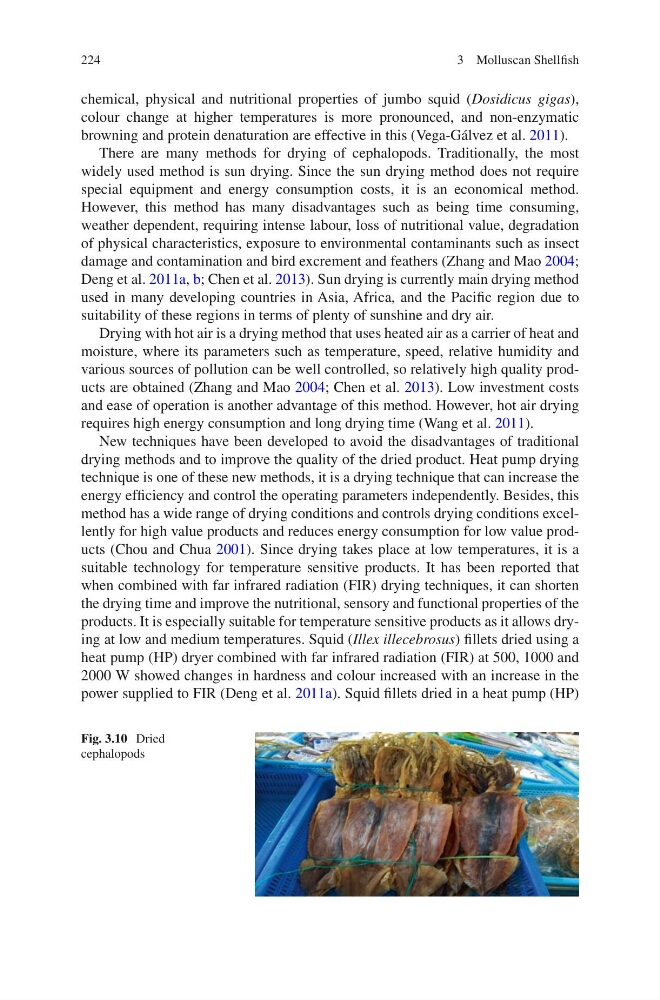
Fig. 3.10 Dried
cephalopods
3 Molluscan Shellfish
chemical, physical and nutritional properties of jumbo squid (Dosidicus gigas),
colour change at higher temperatures is more pronounced, and non-enzymatic
browning and protein denaturation are effective in this (Vega-Gálvez et al. 2011).
There are many methods for drying of cephalopods. Traditionally, the most
widely used method is sun drying. Since the sun drying method does not require
special equipment and energy consumption costs, it is an economical method.
However, this method has many disadvantages such as being time consuming,
weather dependent, requiring intense labour, loss of nutritional value, degradation
of physical characteristics, exposure to environmental contaminants such as insect
damage and contamination and bird excrement and feathers (Zhang and Mao 2004;
Deng et al. 2011a, b; Chen et al. 2013). Sun drying is currently main drying method
used in many developing countries in Asia, Africa, and the Pacific region due to
suitability of these regions in terms of plenty of sunshine and dry air.
Drying with hot air is a drying method that uses heated air as a carrier of heat and
moisture, where its parameters such as temperature, speed, relative humidity and
various sources of pollution can be well controlled, so relatively high quality products are obtained (Zhang and Mao 2004; Chen et al. 2013). Low investment costs
and ease of operation is another advantage of this method. However, hot air drying
requires high energy consumption and long drying time (Wang et al. 2011).
New techniques have been developed to avoid the disadvantages of traditional
drying methods and to improve the quality of the dried product. Heat pump drying
technique is one of these new methods, it is a drying technique that can increase the
energy efficiency and control the operating parameters independently. Besides, this
method has a wide range of drying conditions and controls drying conditions excellently for high value products and reduces energy consumption for low value products (Chou and Chua 2001). Since drying takes place at low temperatures, it is a
suitable technology for temperature sensitive products. It has been reported that
when combined with far infrared radiation (FIR) drying techniques, it can shorten
the drying time and improve the nutritional, sensory and functional properties of the
products. It is especially suitable for temperature sensitive products as it allows drying at low and medium temperatures. Squid (Illex illecebrosus) fillets dried using a
heat pump (HP) dryer combined with far infrared radiation (FIR) at 500, 1000 and
2000 W showed changes in hardness and colour increased with an increase in the
power supplied to FIR (Deng et al. 2011a). Squid fillets dried in a heat pump (HP)
Fig. 3.10 Dried
cephalopods
3 Molluscan Shellfish