

206
trawls and with set nets and jigs, or by using live cuttlefishes as lures during the
spawning season, and by hook, baited with live prawns or crabs, in other seasons.
The mantle flesh is thick and tasty and is, therefore, highly esteemed. The species
has been reared successfully in aquaculture experiments under the name Sepia subaculeata. Research indicates that waste materials obtained during the processing of
this species have potential in supplementing the skin of land vertebrates as a source
of collagen (Reid et al. 2005).
Sepia orbignyana
Sepia orbignyana is one of the most abundant cephalopod species in some areas of
its distributional range (e.g. within the Mediterranean: Aegean, southern Adriatic,
and Tyrrhenian Seas and in the Sicilian Channel). It is taken mainly as a by-catch
throughout the Mediterranean and in the West African trawl fisheries. Separate statistics are not reported, but S. orbignyana represents a very significant percentage of
the catches in some areas. In the Mediterranean Sea it is marketed along with S. elegans and small S. officinalis and constitutes a valuable resource locally. In the
Sicilian Channel, research studies showed an exploitation rate of 0.60 for this species, which suggests an intense fishing pressure on this resource. It is marketed fresh
and frozen (Reid et al. 2005).
Sepia pharaonis
This species supports industrial or artisanal fisheries throughout its range. With
S. esculenta Hoyle, 1885, it is the most abundant cuttlefish species caught in the
Philippines and the Samar and Visayan Seas, with the highest catches reported in
the Lingayen Gulf and Carigara Bay. In Iran, the fishing activity occurs during the
spawning season, when adults migrate from deeper waters to shallower waters in
the littoral zone. Sepia pharaonis is caught by bottom trawlers in the Oman Sea and
by traps in the Persian Gulf and is one of the most important cuttlefish species fished
in both areas. The species is important to the commercial cephalopod fishery of
Thailand, being highly abundant in the Gulf and the Andaman Sea, where it is the
most common species of cuttlefish caught. The species contributes about 90% of the
cuttlefishes caught off Australia by Chinese pair trawlers (Reid et al. 2005).
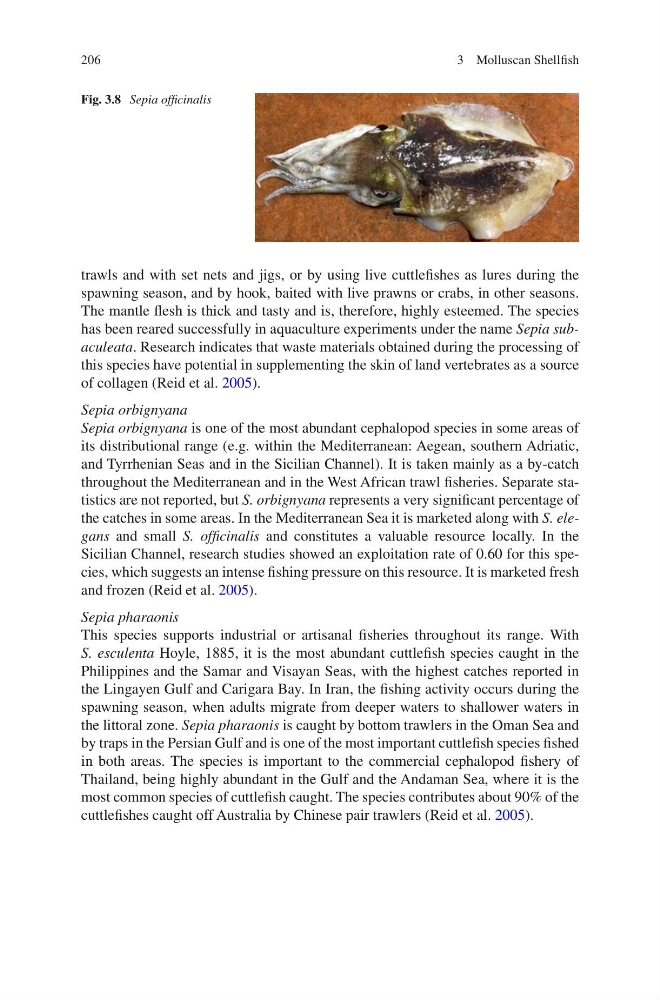
Fig. 3.8 Sepia officinalis
3 Molluscan Shellfish
trawls and with set nets and jigs, or by using live cuttlefishes as lures during the
spawning season, and by hook, baited with live prawns or crabs, in other seasons.
The mantle flesh is thick and tasty and is, therefore, highly esteemed. The species
has been reared successfully in aquaculture experiments under the name Sepia subaculeata. Research indicates that waste materials obtained during the processing of
this species have potential in supplementing the skin of land vertebrates as a source
of collagen (Reid et al. 2005).
Sepia orbignyana
Sepia orbignyana is one of the most abundant cephalopod species in some areas of
its distributional range (e.g. within the Mediterranean: Aegean, southern Adriatic,
and Tyrrhenian Seas and in the Sicilian Channel). It is taken mainly as a by-catch
throughout the Mediterranean and in the West African trawl fisheries. Separate statistics are not reported, but S. orbignyana represents a very significant percentage of
the catches in some areas. In the Mediterranean Sea it is marketed along with S. elegans and small S. officinalis and constitutes a valuable resource locally. In the
Sicilian Channel, research studies showed an exploitation rate of 0.60 for this species, which suggests an intense fishing pressure on this resource. It is marketed fresh
and frozen (Reid et al. 2005).
Sepia pharaonis
This species supports industrial or artisanal fisheries throughout its range. With
S. esculenta Hoyle, 1885, it is the most abundant cuttlefish species caught in the
Philippines and the Samar and Visayan Seas, with the highest catches reported in
the Lingayen Gulf and Carigara Bay. In Iran, the fishing activity occurs during the
spawning season, when adults migrate from deeper waters to shallower waters in
the littoral zone. Sepia pharaonis is caught by bottom trawlers in the Oman Sea and
by traps in the Persian Gulf and is one of the most important cuttlefish species fished
in both areas. The species is important to the commercial cephalopod fishery of
Thailand, being highly abundant in the Gulf and the Andaman Sea, where it is the
most common species of cuttlefish caught. The species contributes about 90% of the
cuttlefishes caught off Australia by Chinese pair trawlers (Reid et al. 2005).
Fig. 3.8 Sepia officinalis
3 Molluscan Shellfish