

201
year- round, but seasonal peaks exist and vary with area throughout the Mediterranean
and Atlantic. It lives close to muddy, sandy, and debris-rich bottoms, which are
often, covered by Funiculina spp. in the middle and lower sub-littoral and upper
bathyal domains. Illex coindetii is taken throughout the year in the Mediterranean,
off West Africa, and in the Northeast Atlantic as bycatch in bottom and pelagic
trawls, and, to a lesser extent, with gill- and trammel nets, in depths of 100–400 m.
It is of increasing fisheries value and represents a valuable resource in some areas of
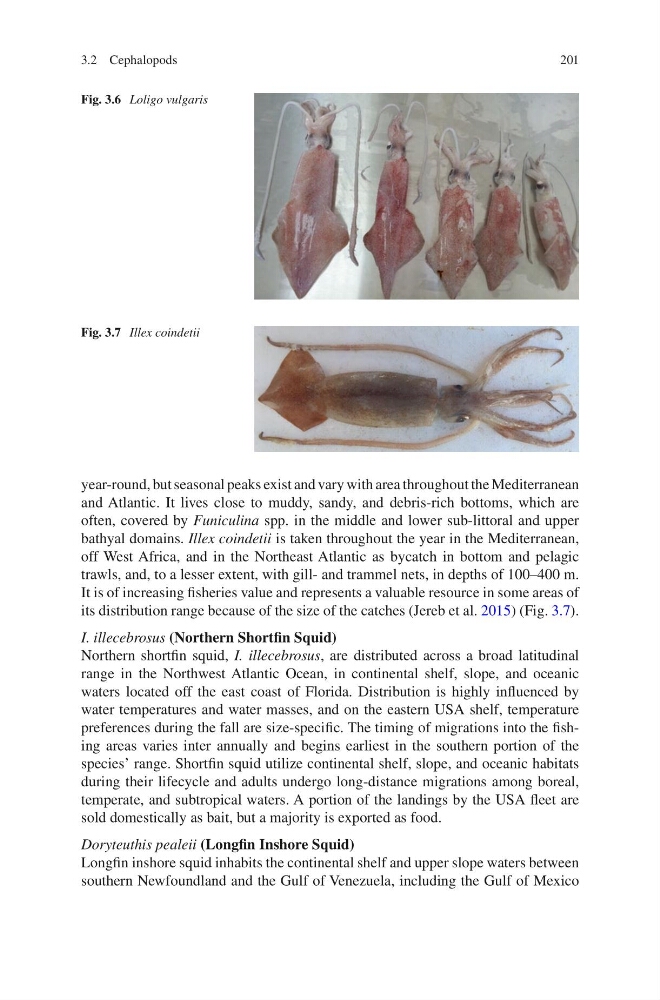
its distribution range because of the size of the catches (Jereb et al. 2015) (Fig. 3.7).
I. illecebrosus (Northern Shortfin Squid)
Northern shortfin squid, I. illecebrosus, are distributed across a broad latitudinal
range in the Northwest Atlantic Ocean, in continental shelf, slope, and oceanic
waters located off the east coast of Florida. Distribution is highly influenced by
water temperatures and water masses, and on the eastern USA shelf, temperature
preferences during the fall are size-specific. The timing of migrations into the fishing areas varies inter annually and begins earliest in the southern portion of the
species’ range. Shortfin squid utilize continental shelf, slope, and oceanic habitats
during their lifecycle and adults undergo long-distance migrations among boreal,
temperate, and subtropical waters. A portion of the landings by the USA fleet are
sold domestically as bait, but a majority is exported as food.
Doryteuthis pealeii (Longfin Inshore Squid)
Longfin inshore squid inhabits the continental shelf and upper slope waters between
southern Newfoundland and the Gulf of Venezuela, including the Gulf of Mexico
Fig. 3.6 Loligo vulgaris
Fig. 3.7 Illex coindetii
3.2 Cephalopods
year- round, but seasonal peaks exist and vary with area throughout the Mediterranean
and Atlantic. It lives close to muddy, sandy, and debris-rich bottoms, which are
often, covered by Funiculina spp. in the middle and lower sub-littoral and upper
bathyal domains. Illex coindetii is taken throughout the year in the Mediterranean,
off West Africa, and in the Northeast Atlantic as bycatch in bottom and pelagic
trawls, and, to a lesser extent, with gill- and trammel nets, in depths of 100–400 m.
It is of increasing fisheries value and represents a valuable resource in some areas of
its distribution range because of the size of the catches (Jereb et al. 2015) (Fig. 3.7).
I. illecebrosus (Northern Shortfin Squid)
Northern shortfin squid, I. illecebrosus, are distributed across a broad latitudinal
range in the Northwest Atlantic Ocean, in continental shelf, slope, and oceanic
waters located off the east coast of Florida. Distribution is highly influenced by
water temperatures and water masses, and on the eastern USA shelf, temperature
preferences during the fall are size-specific. The timing of migrations into the fishing areas varies inter annually and begins earliest in the southern portion of the
species’ range. Shortfin squid utilize continental shelf, slope, and oceanic habitats
during their lifecycle and adults undergo long-distance migrations among boreal,
temperate, and subtropical waters. A portion of the landings by the USA fleet are
sold domestically as bait, but a majority is exported as food.
Doryteuthis pealeii (Longfin Inshore Squid)
Longfin inshore squid inhabits the continental shelf and upper slope waters between
southern Newfoundland and the Gulf of Venezuela, including the Gulf of Mexico
Fig. 3.6 Loligo vulgaris
Fig. 3.7 Illex coindetii
3.2 Cephalopods