

199
along the Japanese Island including the East China Sea, the Sea of Japan, and southern Okhotsk Sea. This species is fished by using several fishing methods. It is mostly
fished by jiggers. It is mostly fished buy coastal jiggers and offshore jiggers in the
Sea of Japan. Along the Pacific side of Japanese waters T. pacificus is mainly caught
by coastal jiggers, but more than a half of total catch along the Pacific side is caught
by other fishing methods such as trawlers, purse seines and set nets (Sakurai
et al. 2013).
Todarodes sagittatus (European Flying Squid)
The European flying squid Todarodes sagittatus is one of the most abundant oceanic
cephalopods in the Atlantic Ocean and the adjacent Mediterranean Sea. It is found
from the polar seas in the north to the equator in the south, living in the open ocean
and near the coasts, at the surface and near the bottom at depths down to 2500 m.
Although its spawning areas are not known precisely, T. sagittatus is thought to
make extensive spawning and feeding migrations within the whole northern Atlantic.
In winter, T. sagittatus migrates into deeper offshore waters; spawning is thought to
take place on the continental slope (Piatkowski et al. 1998). Most individuals probably live 12–14 months, but the lifespan of the largest individuals may approach
2 years. Spawning is seasonal, its timing varying with geographic location.
Todarodes sagittatus may be found both in the open ocean and near the coast. It is
known to migrate vertically between the surface at night and near-bottom waters by
day. It can be found in surface waters above depths of 4595 m Todarodes sagittatus
undertakes pronounced migrations, probably mainly related to feeding and spawning. Common fishing methods include jigging off Norway and artisanal handjigging in parts of the Mediterranean and Canary Islands where there are directed
artisanal fisheries. Over much of its distribution, it is taken mainly as by-catch in
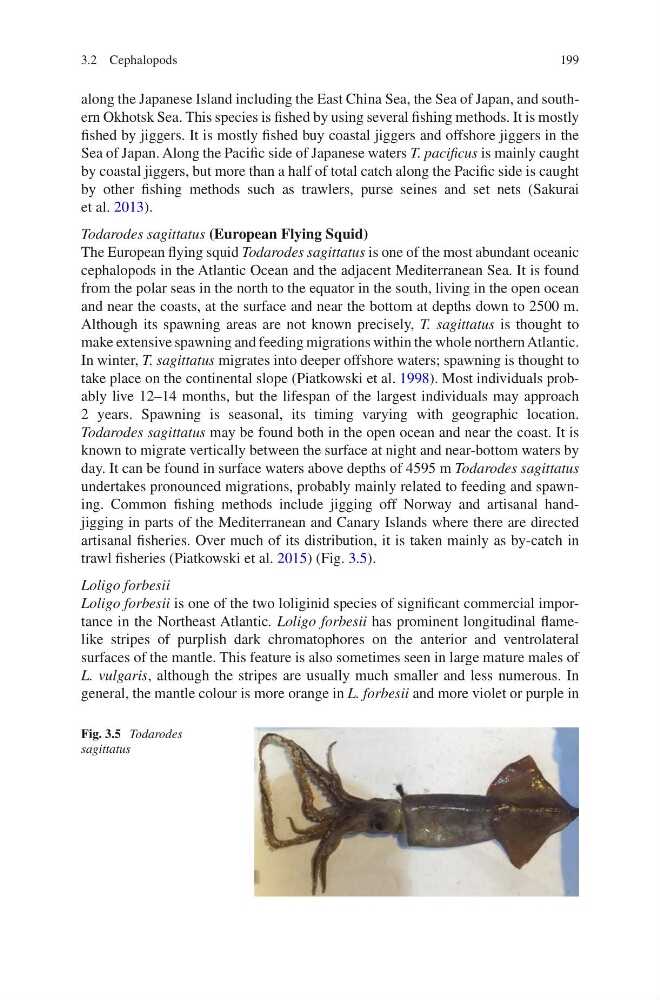
trawl fisheries (Piatkowski et al. 2015) (Fig. 3.5).
Loligo forbesii
Loligo forbesii is one of the two loliginid species of significant commercial importance in the Northeast Atlantic. Loligo forbesii has prominent longitudinal flamelike stripes of purplish dark chromatophores on the anterior and ventrolateral
surfaces of the mantle. This feature is also sometimes seen in large mature males of
L. vulgaris, although the stripes are usually much smaller and less numerous. In
general, the mantle colour is more orange in L. forbesii and more violet or purple in
Fig. 3.5 Todarodes
sagittatus
3.2 Cephalopods
along the Japanese Island including the East China Sea, the Sea of Japan, and southern Okhotsk Sea. This species is fished by using several fishing methods. It is mostly
fished by jiggers. It is mostly fished buy coastal jiggers and offshore jiggers in the
Sea of Japan. Along the Pacific side of Japanese waters T. pacificus is mainly caught
by coastal jiggers, but more than a half of total catch along the Pacific side is caught
by other fishing methods such as trawlers, purse seines and set nets (Sakurai
et al. 2013).
Todarodes sagittatus (European Flying Squid)
The European flying squid Todarodes sagittatus is one of the most abundant oceanic
cephalopods in the Atlantic Ocean and the adjacent Mediterranean Sea. It is found
from the polar seas in the north to the equator in the south, living in the open ocean
and near the coasts, at the surface and near the bottom at depths down to 2500 m.
Although its spawning areas are not known precisely, T. sagittatus is thought to
make extensive spawning and feeding migrations within the whole northern Atlantic.
In winter, T. sagittatus migrates into deeper offshore waters; spawning is thought to
take place on the continental slope (Piatkowski et al. 1998). Most individuals probably live 12–14 months, but the lifespan of the largest individuals may approach
2 years. Spawning is seasonal, its timing varying with geographic location.
Todarodes sagittatus may be found both in the open ocean and near the coast. It is
known to migrate vertically between the surface at night and near-bottom waters by
day. It can be found in surface waters above depths of 4595 m Todarodes sagittatus
undertakes pronounced migrations, probably mainly related to feeding and spawning. Common fishing methods include jigging off Norway and artisanal handjigging in parts of the Mediterranean and Canary Islands where there are directed
artisanal fisheries. Over much of its distribution, it is taken mainly as by-catch in
trawl fisheries (Piatkowski et al. 2015) (Fig. 3.5).
Loligo forbesii
Loligo forbesii is one of the two loliginid species of significant commercial importance in the Northeast Atlantic. Loligo forbesii has prominent longitudinal flamelike stripes of purplish dark chromatophores on the anterior and ventrolateral
surfaces of the mantle. This feature is also sometimes seen in large mature males of
L. vulgaris, although the stripes are usually much smaller and less numerous. In
general, the mantle colour is more orange in L. forbesii and more violet or purple in
Fig. 3.5 Todarodes
sagittatus
3.2 Cephalopods