

168
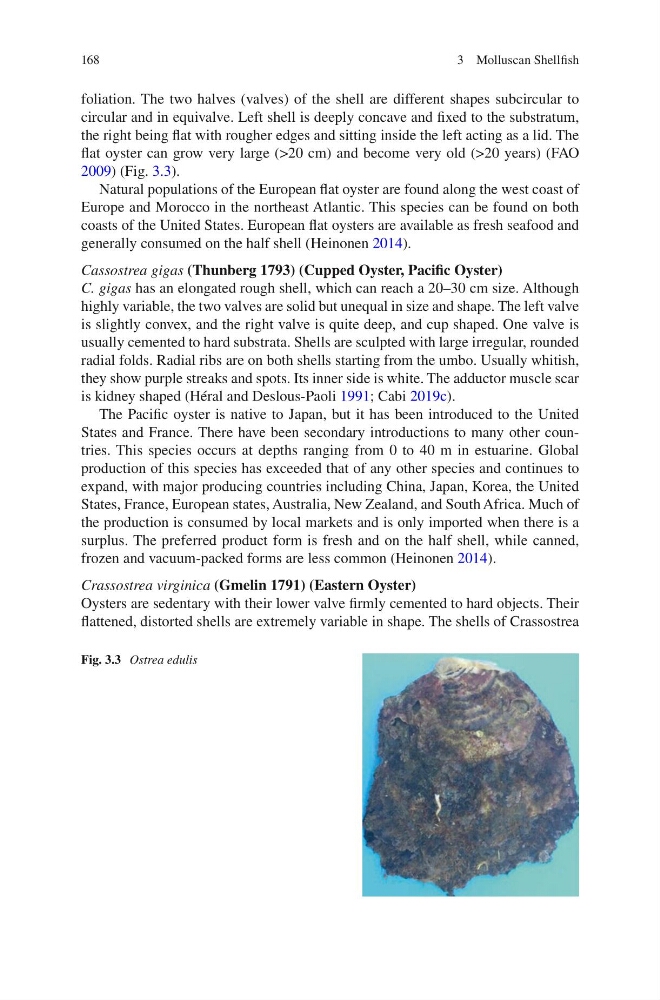
foliation. The two halves (valves) of the shell are different shapes subcircular to
circular and in equivalve. Left shell is deeply concave and fixed to the substratum,
the right being flat with rougher edges and sitting inside the left acting as a lid. The
flat oyster can grow very large (>20 cm) and become very old (>20 years) (FAO
2009) (Fig. 3.3).
Natural populations of the European flat oyster are found along the west coast of
Europe and Morocco in the northeast Atlantic. This species can be found on both
coasts of the United States. European flat oysters are available as fresh seafood and
generally consumed on the half shell (Heinonen 2014).
Cassostrea gigas (Thunberg 1793) (Cupped Oyster, Pacific Oyster)
C. gigas has an elongated rough shell, which can reach a 20–30 cm size. Although
highly variable, the two valves are solid but unequal in size and shape. The left valve
is slightly convex, and the right valve is quite deep, and cup shaped. One valve is
usually cemented to hard substrata. Shells are sculpted with large irregular, rounded
radial folds. Radial ribs are on both shells starting from the umbo. Usually whitish,
they show purple streaks and spots. Its inner side is white. The adductor muscle scar
is kidney shaped (Héral and Deslous-Paoli 1991; Cabi 2019c).
The Pacific oyster is native to Japan, but it has been introduced to the United
States and France. There have been secondary introductions to many other countries. This species occurs at depths ranging from 0 to 40 m in estuarine. Global
production of this species has exceeded that of any other species and continues to
expand, with major producing countries including China, Japan, Korea, the United
States, France, European states, Australia, New Zealand, and South Africa. Much of
the production is consumed by local markets and is only imported when there is a
surplus. The preferred product form is fresh and on the half shell, while canned,
frozen and vacuum-packed forms are less common (Heinonen 2014).
Crassostrea virginica (Gmelin 1791) (Eastern Oyster)
Oysters are sedentary with their lower valve firmly cemented to hard objects. Their
flattened, distorted shells are extremely variable in shape. The shells of Crassostrea
Fig. 3.3 Ostrea edulis
3 Molluscan Shellfish
foliation. The two halves (valves) of the shell are different shapes subcircular to
circular and in equivalve. Left shell is deeply concave and fixed to the substratum,
the right being flat with rougher edges and sitting inside the left acting as a lid. The
flat oyster can grow very large (>20 cm) and become very old (>20 years) (FAO
2009) (Fig. 3.3).
Natural populations of the European flat oyster are found along the west coast of
Europe and Morocco in the northeast Atlantic. This species can be found on both
coasts of the United States. European flat oysters are available as fresh seafood and
generally consumed on the half shell (Heinonen 2014).
Cassostrea gigas (Thunberg 1793) (Cupped Oyster, Pacific Oyster)
C. gigas has an elongated rough shell, which can reach a 20–30 cm size. Although
highly variable, the two valves are solid but unequal in size and shape. The left valve
is slightly convex, and the right valve is quite deep, and cup shaped. One valve is
usually cemented to hard substrata. Shells are sculpted with large irregular, rounded
radial folds. Radial ribs are on both shells starting from the umbo. Usually whitish,
they show purple streaks and spots. Its inner side is white. The adductor muscle scar
is kidney shaped (Héral and Deslous-Paoli 1991; Cabi 2019c).
The Pacific oyster is native to Japan, but it has been introduced to the United
States and France. There have been secondary introductions to many other countries. This species occurs at depths ranging from 0 to 40 m in estuarine. Global
production of this species has exceeded that of any other species and continues to
expand, with major producing countries including China, Japan, Korea, the United
States, France, European states, Australia, New Zealand, and South Africa. Much of
the production is consumed by local markets and is only imported when there is a
surplus. The preferred product form is fresh and on the half shell, while canned,
frozen and vacuum-packed forms are less common (Heinonen 2014).
Crassostrea virginica (Gmelin 1791) (Eastern Oyster)
Oysters are sedentary with their lower valve firmly cemented to hard objects. Their
flattened, distorted shells are extremely variable in shape. The shells of Crassostrea
Fig. 3.3 Ostrea edulis
3 Molluscan Shellfish