

86
under stones. They do not like the sun. They prefer dark and dim places. In winter
they are drawn to their own pits and nests. Crayfish hunt at night and in the evening.
They usually go looking for their feeds after sunset and provide them at night at
most (Alpbaz 2005). Crayfish must moult to grow and breed. Their growth is not
continuous but depends on factors such as water temperature, calcium, feed availability and daylight (Hollows 2016). In crayfish, the exoskeleton is a support organ
and acts as a protective armour against external factors. This hard layer of chitin and
lime mixture completely covers the body. When the shell of the crayfish forming the
skeleton hardens, growth stops. Growth is possible by changing of shell. When the
old shell falls completely, a soft new shell that has already developed underneath it
forms. This is called moulting. As this new shell grows so the crayfish grow.
Moulting is the hardest period of crayfish life. In this period, the crayfish is very
tired and rests in its nest until it becomes a new shell. During this time, it is vulnerable to its enemies. After maturity, females 1, males 2 times change their shell.
Therefore, males are larger than females (Alpbaz 2005). They can grow all year
round. Higher water temperature increases the growth. The frequency of moulting
and thus the rate of growth decreases with age (Hollows 2016). The crayfish regularly gets too big for its skeleton, sheds it, and grows a new larger one. Such moulting occurs six to ten times during the first year of rapid growth, but less often during
the second year. For a few days following each moult, crayfish have soft exoskeletons and are more vulnerable to predators (New World Encyclopedia 2019).
Females also require shell replacement for reproduction. A slightly bendable
carapace is required to extrude the female’s eggs. Once the female has laid eggs, the
male stores the sperm package known as “spermatophore” near the breeding openings where the female’s eggs are fertilized. Females produce between 20 and 400
eggs (Hollows 2016). Crayfish usually mature at age 5, depending on environmental
conditions, and can reach 20–25 cm in length in 20 years. Since the beginning of
autumn, there are improvements in the sex organs of adult lobsters. Eggs grown in
females are easily attracted by their yellow-brown appearance. In males, sperm
channels take the form of a white rope (Alpbaz 2005).
In the early stages of life, crayfish are not visible, because they are hidden under
rocks or between woody vegetation to protect them from predators and larger crayfish. Crayfish eat almost everything and are therefore described as opportunistic
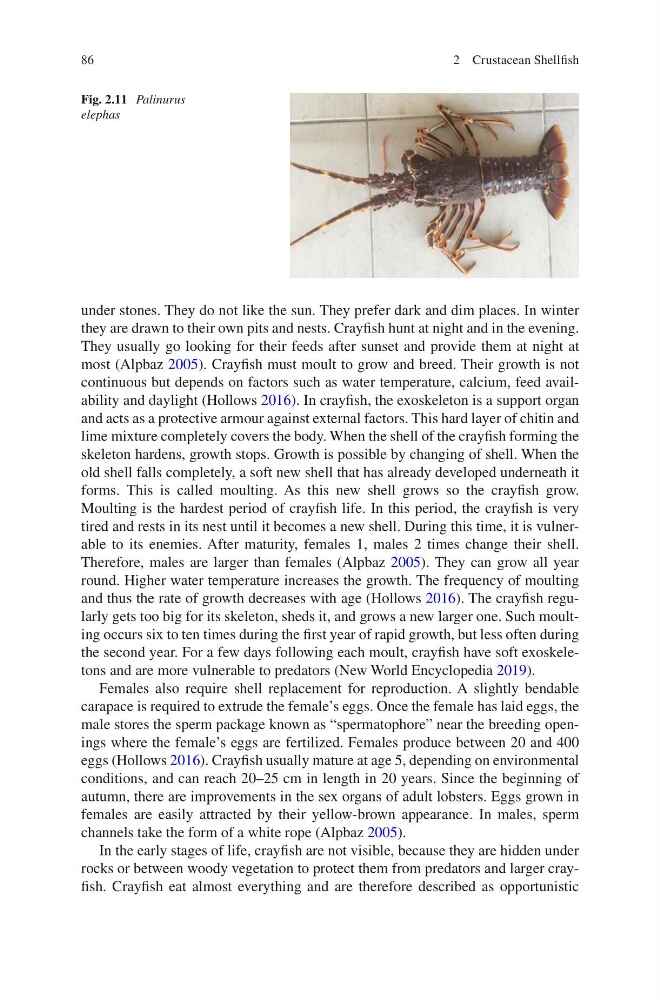
Fig. 2.11 Palinurus
elephas
2 Crustacean Shellfish
under stones. They do not like the sun. They prefer dark and dim places. In winter
they are drawn to their own pits and nests. Crayfish hunt at night and in the evening.
They usually go looking for their feeds after sunset and provide them at night at
most (Alpbaz 2005). Crayfish must moult to grow and breed. Their growth is not
continuous but depends on factors such as water temperature, calcium, feed availability and daylight (Hollows 2016). In crayfish, the exoskeleton is a support organ
and acts as a protective armour against external factors. This hard layer of chitin and
lime mixture completely covers the body. When the shell of the crayfish forming the
skeleton hardens, growth stops. Growth is possible by changing of shell. When the
old shell falls completely, a soft new shell that has already developed underneath it
forms. This is called moulting. As this new shell grows so the crayfish grow.
Moulting is the hardest period of crayfish life. In this period, the crayfish is very
tired and rests in its nest until it becomes a new shell. During this time, it is vulnerable to its enemies. After maturity, females 1, males 2 times change their shell.
Therefore, males are larger than females (Alpbaz 2005). They can grow all year
round. Higher water temperature increases the growth. The frequency of moulting
and thus the rate of growth decreases with age (Hollows 2016). The crayfish regularly gets too big for its skeleton, sheds it, and grows a new larger one. Such moulting occurs six to ten times during the first year of rapid growth, but less often during
the second year. For a few days following each moult, crayfish have soft exoskeletons and are more vulnerable to predators (New World Encyclopedia 2019).
Females also require shell replacement for reproduction. A slightly bendable
carapace is required to extrude the female’s eggs. Once the female has laid eggs, the
male stores the sperm package known as “spermatophore” near the breeding openings where the female’s eggs are fertilized. Females produce between 20 and 400
eggs (Hollows 2016). Crayfish usually mature at age 5, depending on environmental
conditions, and can reach 20–25 cm in length in 20 years. Since the beginning of
autumn, there are improvements in the sex organs of adult lobsters. Eggs grown in
females are easily attracted by their yellow-brown appearance. In males, sperm
channels take the form of a white rope (Alpbaz 2005).
In the early stages of life, crayfish are not visible, because they are hidden under
rocks or between woody vegetation to protect them from predators and larger crayfish. Crayfish eat almost everything and are therefore described as opportunistic
Fig. 2.11 Palinurus
elephas
2 Crustacean Shellfish