

60
2006), such as (i) lower soil protein levels, (ii) heterogeneity and spatiotemporal
variations of soil microorganisms, and (iii) the presence of soil enzymes and
humic colloids in soil (Nannipieri and Smalla 2006).
• Metaproteomics have promising applications in studying the microbial activity
and interactions in soil (Keiblinger et al. 2012), although protein extraction from
the soil is hard to achieve because of the inherent intricacy of soils. SDS-phenoland SDS-NaOH-mediated approaches are most often used for protein isolation
from soil (Keiblinger et al. 2012). Until now, we have had limited success in
linking the soil metaproteome to microbial gene expression patterns (Bastida
et al. 2009) along with the distinctive role of microbes in soil nutrient cycling
(Hettich et al. 2010). To resolve these issues, we need to address soil heterogeneity and hydrophobicity (Hettich et al. 2010), lower protein levels, microbial
richness, humic acid interference with protein isolation (Giagnoni et al. 2012),
and thus the difficulties in proper isolation of the whole soil proteome (Williams
and Taylor 2010). Overall, metaproteomics is a relatively young field of research
and also there is huge diversity among the microbial communities in their biochemistry and structural-functional complexity, and thus considerable research
efforts are needed for improvement, optimization, and standardization of sample
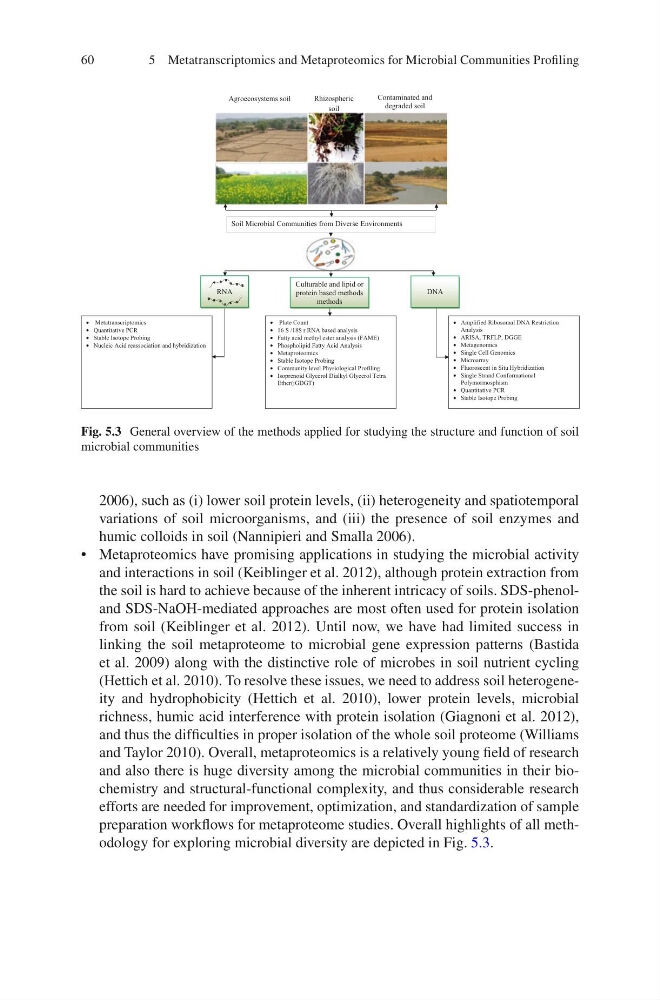
preparation workflows for metaproteome studies. Overall highlights of all methodology for exploring microbial diversity are depicted in Fig. 5.3.
Plate Count
16 S /18S r RNA based analysis
Fatty acid methyl ester analysis (FAME)
Phospholipid Fatty Acid Analysis
Metaproteomics
Stable Isotope Probing
Community level Physiological Profiling
Isoprenoid Glycerol Dialkyl Glycerol Tetra
Ether(iGDGT)
Contaminated and
degraded soil
Agroecosystems soil
Rhizospheric
soil
Soil Microbial Communities from Diverse Environments
RNA
Culturable and lipid or
protein based methods
methods
Metatranscriptomics
Quantitative PCR
Stable Isotope Probing
Nucleic Acid reassociation and hybridization
DNA
Amplified Ribosomal DNA Restriction
Analysis
ARISA, TRFLP, DGGE
Metagenomics
Single Cell Genomics
Microarray
Fluoroscent in Situ Hybridization
Single Strand Conformational
Polymormosphism
Quantitative PCR
Stable Isotope Probing
Fig. 5.3 General overview of the methods applied for studying the structure and function of soil
microbial communities
5 Metatranscriptomics and Metaproteomics for Microbial Communities Profiling
2006), such as (i) lower soil protein levels, (ii) heterogeneity and spatiotemporal
variations of soil microorganisms, and (iii) the presence of soil enzymes and
humic colloids in soil (Nannipieri and Smalla 2006).
• Metaproteomics have promising applications in studying the microbial activity
and interactions in soil (Keiblinger et al. 2012), although protein extraction from
the soil is hard to achieve because of the inherent intricacy of soils. SDS-phenoland SDS-NaOH-mediated approaches are most often used for protein isolation
from soil (Keiblinger et al. 2012). Until now, we have had limited success in
linking the soil metaproteome to microbial gene expression patterns (Bastida
et al. 2009) along with the distinctive role of microbes in soil nutrient cycling
(Hettich et al. 2010). To resolve these issues, we need to address soil heterogeneity and hydrophobicity (Hettich et al. 2010), lower protein levels, microbial
richness, humic acid interference with protein isolation (Giagnoni et al. 2012),
and thus the difficulties in proper isolation of the whole soil proteome (Williams
and Taylor 2010). Overall, metaproteomics is a relatively young field of research
and also there is huge diversity among the microbial communities in their biochemistry and structural-functional complexity, and thus considerable research
efforts are needed for improvement, optimization, and standardization of sample
preparation workflows for metaproteome studies. Overall highlights of all methodology for exploring microbial diversity are depicted in Fig. 5.3.
Plate Count
16 S /18S r RNA based analysis
Fatty acid methyl ester analysis (FAME)
Phospholipid Fatty Acid Analysis
Metaproteomics
Stable Isotope Probing
Community level Physiological Profiling
Isoprenoid Glycerol Dialkyl Glycerol Tetra
Ether(iGDGT)
Contaminated and
degraded soil
Agroecosystems soil
Rhizospheric
soil
Soil Microbial Communities from Diverse Environments
RNA
Culturable and lipid or
protein based methods
methods
Metatranscriptomics
Quantitative PCR
Stable Isotope Probing
Nucleic Acid reassociation and hybridization
DNA
Amplified Ribosomal DNA Restriction
Analysis
ARISA, TRFLP, DGGE
Metagenomics
Single Cell Genomics
Microarray
Fluoroscent in Situ Hybridization
Single Strand Conformational
Polymormosphism
Quantitative PCR
Stable Isotope Probing
Fig. 5.3 General overview of the methods applied for studying the structure and function of soil
microbial communities
5 Metatranscriptomics and Metaproteomics for Microbial Communities Profiling