

55
(Chauhan et al. 2014; Molina et al. 2012), acid mine drainage (Chen et al. 2015),
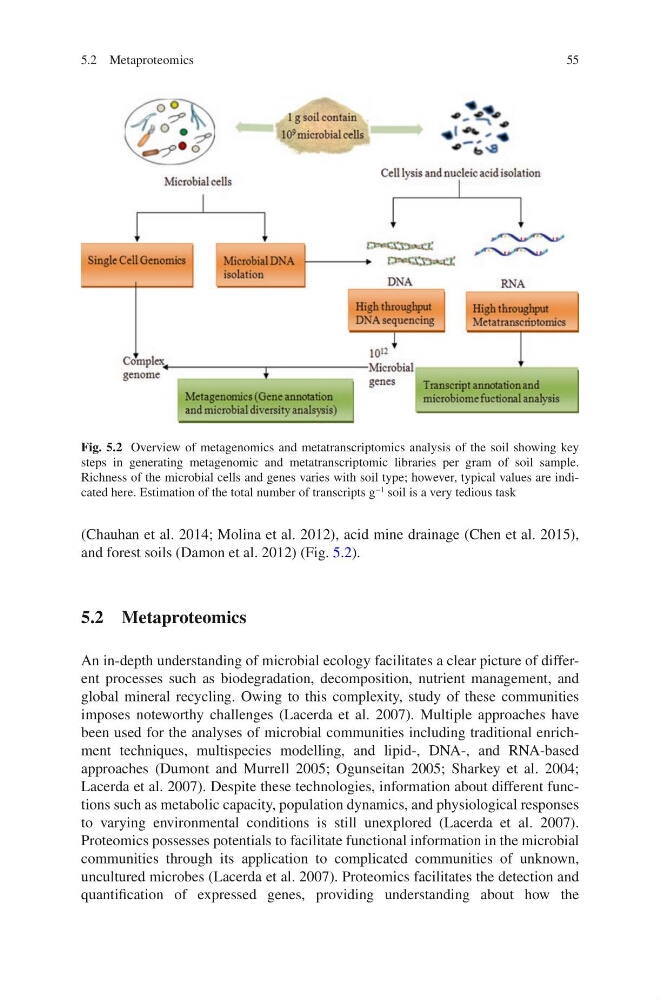
and forest soils (Damon et al. 2012) (Fig. 5.2).
5.2 Metaproteomics
An in-depth understanding of microbial ecology facilitates a clear picture of different processes such as biodegradation, decomposition, nutrient management, and
global mineral recycling. Owing to this complexity, study of these communities
imposes noteworthy challenges (Lacerda et al. 2007). Multiple approaches have
been used for the analyses of microbial communities including traditional enrichment techniques, multispecies modelling, and lipid-, DNA-, and RNA-based
approaches (Dumont and Murrell 2005; Ogunseitan 2005; Sharkey et al. 2004;
Lacerda et al. 2007). Despite these technologies, information about different functions such as metabolic capacity, population dynamics, and physiological responses
to varying environmental conditions is still unexplored (Lacerda et al. 2007).
Proteomics possesses potentials to facilitate functional information in the microbial
communities through its application to complicated communities of unknown,
uncultured microbes (Lacerda et al. 2007). Proteomics facilitates the detection and
quantification of expressed genes, providing understanding about how the
Fig. 5.2 Overview of metagenomics and metatranscriptomics analysis of the soil showing key
steps in generating metagenomic and metatranscriptomic libraries per gram of soil sample.
Richness of the microbial cells and genes varies with soil type; however, typical values are indicated here. Estimation of the total number of transcripts g
−1 soil is a very tedious task
5.2 Metaproteomics
(Chauhan et al. 2014; Molina et al. 2012), acid mine drainage (Chen et al. 2015),
and forest soils (Damon et al. 2012) (Fig. 5.2).
5.2 Metaproteomics
An in-depth understanding of microbial ecology facilitates a clear picture of different processes such as biodegradation, decomposition, nutrient management, and
global mineral recycling. Owing to this complexity, study of these communities
imposes noteworthy challenges (Lacerda et al. 2007). Multiple approaches have
been used for the analyses of microbial communities including traditional enrichment techniques, multispecies modelling, and lipid-, DNA-, and RNA-based
approaches (Dumont and Murrell 2005; Ogunseitan 2005; Sharkey et al. 2004;
Lacerda et al. 2007). Despite these technologies, information about different functions such as metabolic capacity, population dynamics, and physiological responses
to varying environmental conditions is still unexplored (Lacerda et al. 2007).
Proteomics possesses potentials to facilitate functional information in the microbial
communities through its application to complicated communities of unknown,
uncultured microbes (Lacerda et al. 2007). Proteomics facilitates the detection and
quantification of expressed genes, providing understanding about how the
Fig. 5.2 Overview of metagenomics and metatranscriptomics analysis of the soil showing key
steps in generating metagenomic and metatranscriptomic libraries per gram of soil sample.
Richness of the microbial cells and genes varies with soil type; however, typical values are indicated here. Estimation of the total number of transcripts g
−1 soil is a very tedious task
5.2 Metaproteomics