

52
Over the years, development of massively parallel sequencing platforms has led to
efficient transcriptome analysis that offers a wealth of information regarding gene
expressions of microbial community systems from diverse environments (Wang et al.
2009). Thus, metatranscriptome analyses support metagenomics data by revealing
accurately the genes which are transcribed (Franzosa et al. 2014) and allow analyzing
functions from a potential collection of microbes (Bashiardes et al. 2016a, b). From
these functional data, active metabolic pathways can be recognized and linked with
the microbial communities in any specific environmental conditions. Thus, metatranscriptomics reflects a more informative view, disclosing particulars about the population which are transcriptionally active rather than identifying only genetic composition.
This aspect is of extreme significance; it is elusive and clinically important to show
dissimilarities in different groups of the active bacteria that frequently occur among
human individuals (Franzosa et al. 2014; Bashiardes et al. 2016a, b). In this approach,
sequencing of the mRNA can be done without using any primer or probe. Total RNA
isolated from complex microbial samples from the soil is reverse transcribed into
complementary DNA without polymerase chain reaction (PCR) application or
molecular cloning. Consequently, pyrosequencing is done to produce various cDNA
and rRNA tags. Taxonomic profiling is performed using MEGAN software and a
specific rRNA reference database having sequences of small and large subunits of
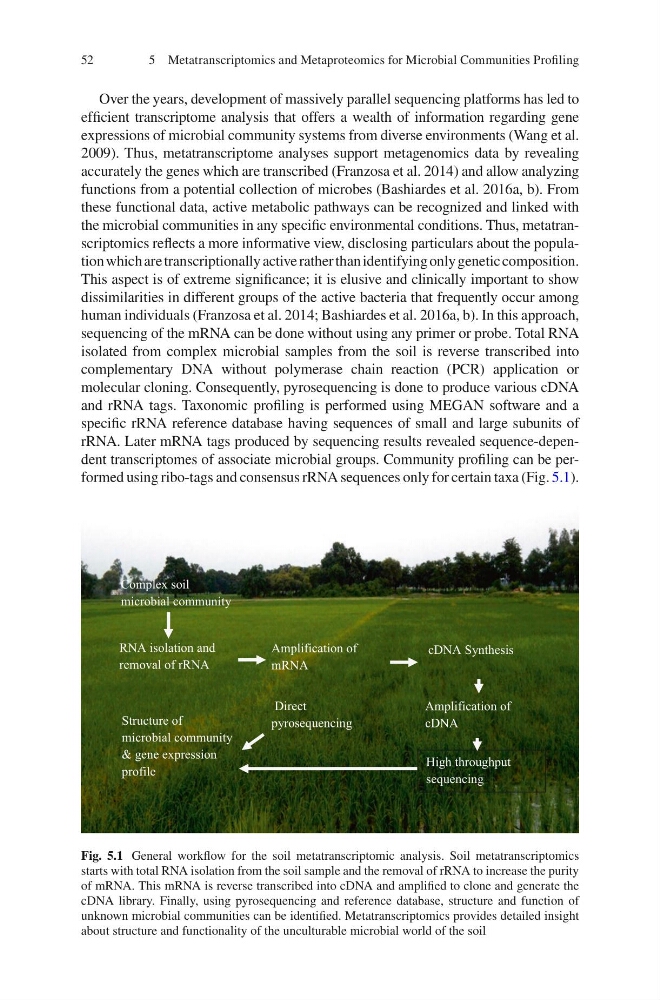
rRNA. Later mRNA tags produced by sequencing results revealed sequence-dependent transcriptomes of associate microbial groups. Community profiling can be performed using ribo-tags and consensus rRNA sequences only for certain taxa (Fig. 5.1).
RNA isolation and
removal of rRNA
Amplification of
mRNA
cDNA Synthesis
Amplification of
cDNA
High throughput
sequencing
Structure of
microbial community
& gene expression
profile
Complex soil
microbial community
Direct
pyrosequencing
Fig. 5.1 General workflow for the soil metatranscriptomic analysis. Soil metatranscriptomics
starts with total RNA isolation from the soil sample and the removal of rRNA to increase the purity
of mRNA. This mRNA is reverse transcribed into cDNA and amplified to clone and generate the
cDNA library. Finally, using pyrosequencing and reference database, structure and function of
unknown microbial communities can be identified. Metatranscriptomics provides detailed insight
about structure and functionality of the unculturable microbial world of the soil
5 Metatranscriptomics and Metaproteomics for Microbial Communities Profiling
Over the years, development of massively parallel sequencing platforms has led to
efficient transcriptome analysis that offers a wealth of information regarding gene
expressions of microbial community systems from diverse environments (Wang et al.
2009). Thus, metatranscriptome analyses support metagenomics data by revealing
accurately the genes which are transcribed (Franzosa et al. 2014) and allow analyzing
functions from a potential collection of microbes (Bashiardes et al. 2016a, b). From
these functional data, active metabolic pathways can be recognized and linked with
the microbial communities in any specific environmental conditions. Thus, metatranscriptomics reflects a more informative view, disclosing particulars about the population which are transcriptionally active rather than identifying only genetic composition.
This aspect is of extreme significance; it is elusive and clinically important to show
dissimilarities in different groups of the active bacteria that frequently occur among
human individuals (Franzosa et al. 2014; Bashiardes et al. 2016a, b). In this approach,
sequencing of the mRNA can be done without using any primer or probe. Total RNA
isolated from complex microbial samples from the soil is reverse transcribed into
complementary DNA without polymerase chain reaction (PCR) application or
molecular cloning. Consequently, pyrosequencing is done to produce various cDNA
and rRNA tags. Taxonomic profiling is performed using MEGAN software and a
specific rRNA reference database having sequences of small and large subunits of
rRNA. Later mRNA tags produced by sequencing results revealed sequence-dependent transcriptomes of associate microbial groups. Community profiling can be performed using ribo-tags and consensus rRNA sequences only for certain taxa (Fig. 5.1).
RNA isolation and
removal of rRNA
Amplification of
mRNA
cDNA Synthesis
Amplification of
cDNA
High throughput
sequencing
Structure of
microbial community
& gene expression
profile
Complex soil
microbial community
Direct
pyrosequencing
Fig. 5.1 General workflow for the soil metatranscriptomic analysis. Soil metatranscriptomics
starts with total RNA isolation from the soil sample and the removal of rRNA to increase the purity
of mRNA. This mRNA is reverse transcribed into cDNA and amplified to clone and generate the
cDNA library. Finally, using pyrosequencing and reference database, structure and function of
unknown microbial communities can be identified. Metatranscriptomics provides detailed insight
about structure and functionality of the unculturable microbial world of the soil
5 Metatranscriptomics and Metaproteomics for Microbial Communities Profiling