

36
every step needs cautious inspection when performing single-cell experiments
(Gawad et al. 2016; Kalisky and Quake 2011). A brief description of the different
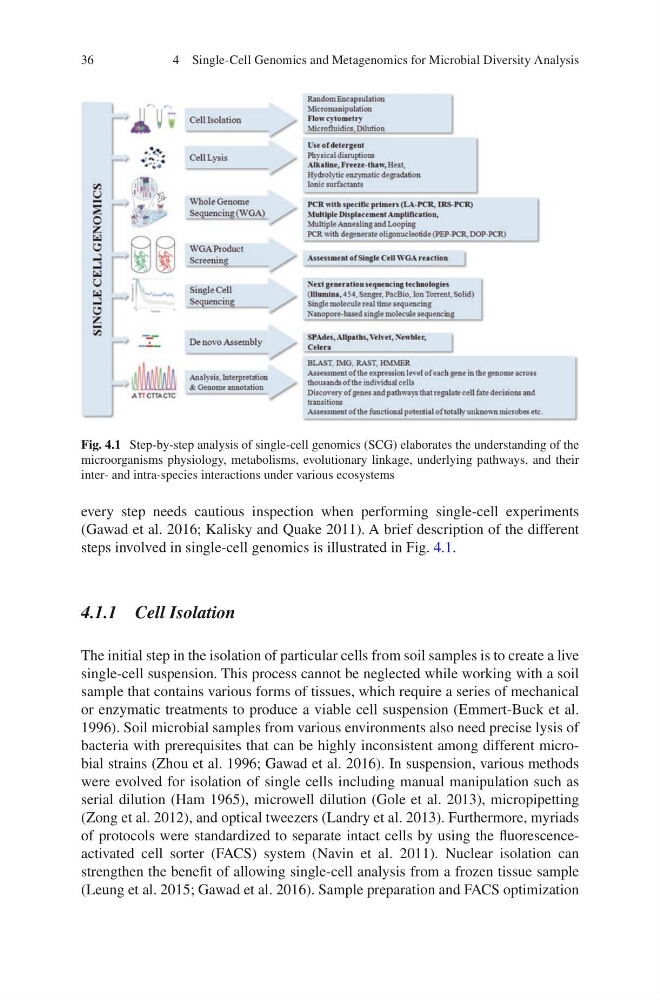
steps involved in single-cell genomics is illustrated in Fig. 4.1.
4.1.1 Cell Isolation
The initial step in the isolation of particular cells from soil samples is to create a live
single-cell suspension. This process cannot be neglected while working with a soil
sample that contains various forms of tissues, which require a series of mechanical
or enzymatic treatments to produce a viable cell suspension (Emmert-Buck et al.
1996). Soil microbial samples from various environments also need precise lysis of
bacteria with prerequisites that can be highly inconsistent among different microbial strains (Zhou et al. 1996; Gawad et al. 2016). In suspension, various methods
were evolved for isolation of single cells including manual manipulation such as
serial dilution (Ham 1965), microwell dilution (Gole et al. 2013), micropipetting
(Zong et al. 2012), and optical tweezers (Landry et al. 2013). Furthermore, myriads
of protocols were standardized to separate intact cells by using the fluorescenceactivated cell sorter (FACS) system (Navin et al. 2011). Nuclear isolation can
strengthen the benefit of allowing single-cell analysis from a frozen tissue sample
(Leung et al. 2015; Gawad et al. 2016). Sample preparation and FACS optimization
Fig. 4.1 Step-by-step analysis of single-cell genomics (SCG) elaborates the understanding of the
microorganisms physiology, metabolisms, evolutionary linkage, underlying pathways, and their
inter- and intra-species interactions under various ecosystems
4 Single-Cell Genomics and Metagenomics for Microbial Diversity Analysis
every step needs cautious inspection when performing single-cell experiments
(Gawad et al. 2016; Kalisky and Quake 2011). A brief description of the different
steps involved in single-cell genomics is illustrated in Fig. 4.1.
4.1.1 Cell Isolation
The initial step in the isolation of particular cells from soil samples is to create a live
single-cell suspension. This process cannot be neglected while working with a soil
sample that contains various forms of tissues, which require a series of mechanical
or enzymatic treatments to produce a viable cell suspension (Emmert-Buck et al.
1996). Soil microbial samples from various environments also need precise lysis of
bacteria with prerequisites that can be highly inconsistent among different microbial strains (Zhou et al. 1996; Gawad et al. 2016). In suspension, various methods
were evolved for isolation of single cells including manual manipulation such as
serial dilution (Ham 1965), microwell dilution (Gole et al. 2013), micropipetting
(Zong et al. 2012), and optical tweezers (Landry et al. 2013). Furthermore, myriads
of protocols were standardized to separate intact cells by using the fluorescenceactivated cell sorter (FACS) system (Navin et al. 2011). Nuclear isolation can
strengthen the benefit of allowing single-cell analysis from a frozen tissue sample
(Leung et al. 2015; Gawad et al. 2016). Sample preparation and FACS optimization
Fig. 4.1 Step-by-step analysis of single-cell genomics (SCG) elaborates the understanding of the
microorganisms physiology, metabolisms, evolutionary linkage, underlying pathways, and their
inter- and intra-species interactions under various ecosystems
4 Single-Cell Genomics and Metagenomics for Microbial Diversity Analysis