

24
3.1 Phospholipid Fatty Acid Analysis (PLFA)
The fingerprinting technique does not relies on nucleic acid analysis; rather, it characterizes chemically diverse and abundant phospholipids as major constituents of
the cell membrane to establish diversity in communities (Drenovsky et al. 2010).
Some lipids (fatty acids) are the signature of specific groups of microorganisms
(Zelles 1999; Ben-David et al. 2004; Kaur et al. 2005). The phospholipids consist of
a polar head group and an ester-linked fatty acyl chain. The nature of the phospholipid varies in composition among eukaryotes and prokaryotes and even within different prokaryotic groups (Ben-David et al. 2011). Diversity in lipid composition
across microorganisms and rapid degradation of phospholipids after their death
make phospholipids suitable to analyse microbial diversity in nature (Zelles 1999).
First, phospholipids are extracted from soil samples. The isolated phospholipids are
then subjected to methanolysis for conversion to fatty acid methyl esters (FAME),
which are explored by gas chromatography–mass spectrometry (GC-MS) for further identification. The total amount of phospholipid fatty acids obtained equals the
viable amount of microbial biomass present in the soil. The different phospholipids
obtained constitute different microbial groups, thus depicting the microbial community structure of the soils (Franzmann et al. 1996). PLFA analysis could also help
in identifying the physiological stress in bacterial species (Kaur et al. 2005). This
attribute of PLFA could be exploited while comparing the physiological status of
the microbial community of different geographic locations (Wilkinson et al. 2002).
In extreme arid conditions, phospholipids of the cellular remains of dead microorganisms also contribute to the phospholipid of viable microorganisms. Thus, results
Isolation of microorganisms from
soil sample containing complex
microbial diversity
Morphological, biochemical and
molecular characterization of
isolated microbes
Microbial diversity structural and
functional characterization
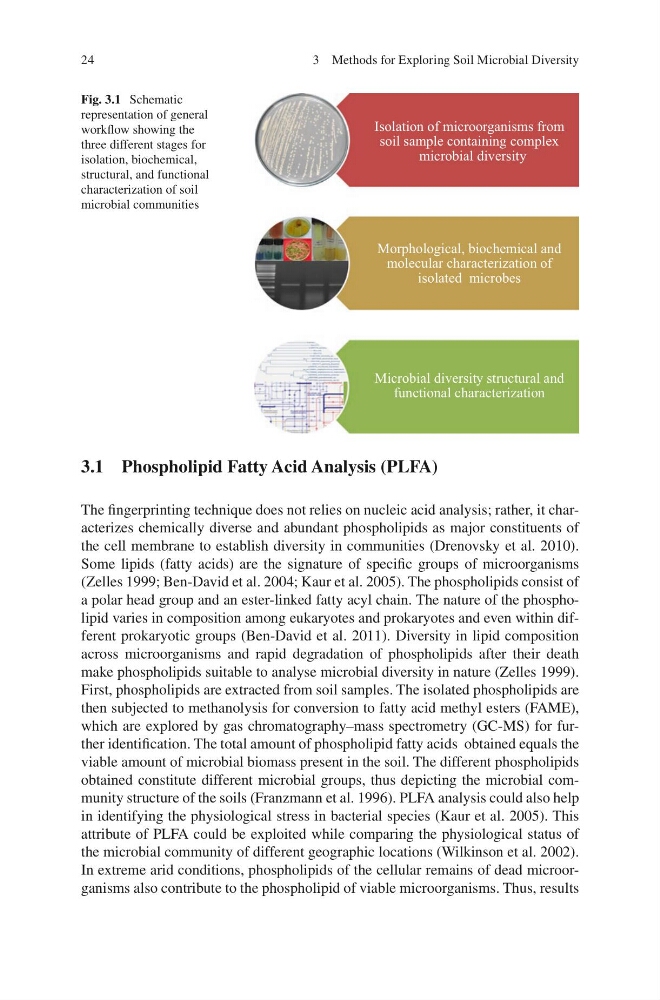
Fig. 3.1 Schematic
representation of general
workflow showing the
three different stages for
isolation, biochemical,
structural, and functional
characterization of soil
microbial communities
3 Methods for Exploring Soil Microbial Diversity
3.1 Phospholipid Fatty Acid Analysis (PLFA)
The fingerprinting technique does not relies on nucleic acid analysis; rather, it characterizes chemically diverse and abundant phospholipids as major constituents of
the cell membrane to establish diversity in communities (Drenovsky et al. 2010).
Some lipids (fatty acids) are the signature of specific groups of microorganisms
(Zelles 1999; Ben-David et al. 2004; Kaur et al. 2005). The phospholipids consist of
a polar head group and an ester-linked fatty acyl chain. The nature of the phospholipid varies in composition among eukaryotes and prokaryotes and even within different prokaryotic groups (Ben-David et al. 2011). Diversity in lipid composition
across microorganisms and rapid degradation of phospholipids after their death
make phospholipids suitable to analyse microbial diversity in nature (Zelles 1999).
First, phospholipids are extracted from soil samples. The isolated phospholipids are
then subjected to methanolysis for conversion to fatty acid methyl esters (FAME),
which are explored by gas chromatography–mass spectrometry (GC-MS) for further identification. The total amount of phospholipid fatty acids obtained equals the
viable amount of microbial biomass present in the soil. The different phospholipids
obtained constitute different microbial groups, thus depicting the microbial community structure of the soils (Franzmann et al. 1996). PLFA analysis could also help
in identifying the physiological stress in bacterial species (Kaur et al. 2005). This
attribute of PLFA could be exploited while comparing the physiological status of
the microbial community of different geographic locations (Wilkinson et al. 2002).
In extreme arid conditions, phospholipids of the cellular remains of dead microorganisms also contribute to the phospholipid of viable microorganisms. Thus, results
Isolation of microorganisms from
soil sample containing complex
microbial diversity
Morphological, biochemical and
molecular characterization of
isolated microbes
Microbial diversity structural and
functional characterization
Fig. 3.1 Schematic
representation of general
workflow showing the
three different stages for
isolation, biochemical,
structural, and functional
characterization of soil
microbial communities
3 Methods for Exploring Soil Microbial Diversity