

3
low nutrient use-efficiency, and only a small fraction of the applied nutrients are
assimilated by the plants (Adesemoye and Kloepper 2009). Therefore, it is imperative to seek effective and enduring solutions for providing food security through
sustainable and environmentally friendly biological options based on the establishment of natural agro-ecological ways. Thus, the purposeful utilization of beneficial
soil microbes for plant growth promotion and biocontrol in agriculture, remediation
and restoration of degraded lands, production of biomass, and bioenergy feedstock
could be attractive options to address the worldwide problems arising from use of
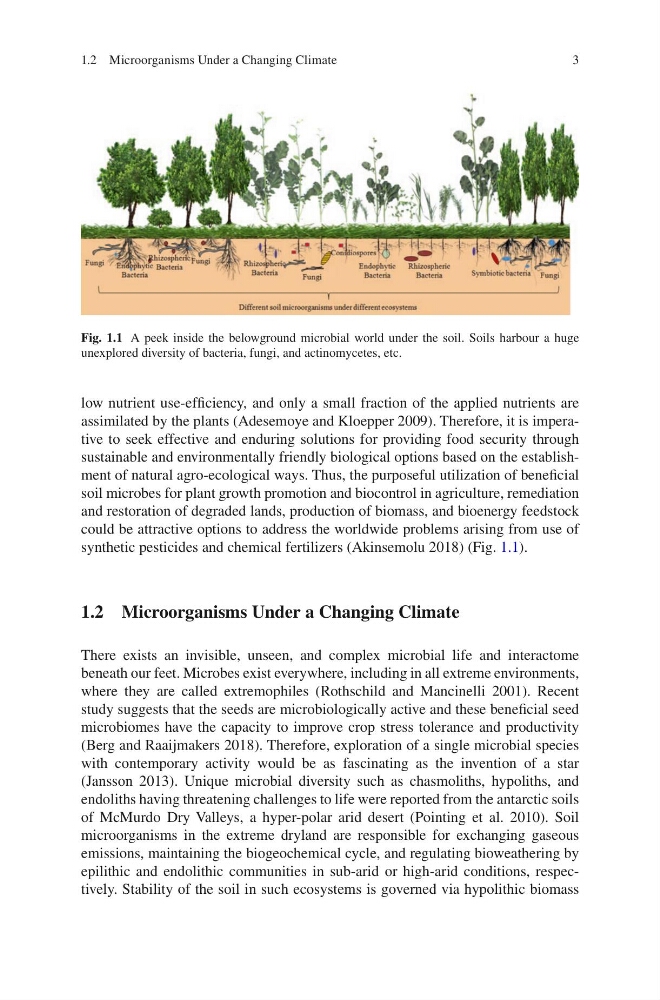
synthetic pesticides and chemical fertilizers (Akinsemolu 2018) (Fig. 1.1).
1.2 Microorganisms Under a Changing Climate
There exists an invisible, unseen, and complex microbial life and interactome
beneath our feet. Microbes exist everywhere, including in all extreme environments,
where they are called extremophiles (Rothschild and Mancinelli 2001). Recent
study suggests that the seeds are microbiologically active and these beneficial seed
microbiomes have the capacity to improve crop stress tolerance and productivity
(Berg and Raaijmakers 2018). Therefore, exploration of a single microbial species
with contemporary activity would be as fascinating as the invention of a star
(Jansson 2013). Unique microbial diversity such as chasmoliths, hypoliths, and
endoliths having threatening challenges to life were reported from the antarctic soils
of McMurdo Dry Valleys, a hyper-polar arid desert (Pointing et al. 2010). Soil
microorganisms in the extreme dryland are responsible for exchanging gaseous
emissions, maintaining the biogeochemical cycle, and regulating bioweathering by
epilithic and endolithic communities in sub-arid or high-arid conditions, respectively. Stability of the soil in such ecosystems is governed via hypolithic biomass
Fig. 1.1 A peek inside the belowground microbial world under the soil. Soils harbour a huge
unexplored diversity of bacteria, fungi, and actinomycetes, etc.
1.2 Microorganisms Under a Changing Climate
low nutrient use-efficiency, and only a small fraction of the applied nutrients are
assimilated by the plants (Adesemoye and Kloepper 2009). Therefore, it is imperative to seek effective and enduring solutions for providing food security through
sustainable and environmentally friendly biological options based on the establishment of natural agro-ecological ways. Thus, the purposeful utilization of beneficial
soil microbes for plant growth promotion and biocontrol in agriculture, remediation
and restoration of degraded lands, production of biomass, and bioenergy feedstock
could be attractive options to address the worldwide problems arising from use of
synthetic pesticides and chemical fertilizers (Akinsemolu 2018) (Fig. 1.1).
1.2 Microorganisms Under a Changing Climate
There exists an invisible, unseen, and complex microbial life and interactome
beneath our feet. Microbes exist everywhere, including in all extreme environments,
where they are called extremophiles (Rothschild and Mancinelli 2001). Recent
study suggests that the seeds are microbiologically active and these beneficial seed
microbiomes have the capacity to improve crop stress tolerance and productivity
(Berg and Raaijmakers 2018). Therefore, exploration of a single microbial species
with contemporary activity would be as fascinating as the invention of a star
(Jansson 2013). Unique microbial diversity such as chasmoliths, hypoliths, and
endoliths having threatening challenges to life were reported from the antarctic soils
of McMurdo Dry Valleys, a hyper-polar arid desert (Pointing et al. 2010). Soil
microorganisms in the extreme dryland are responsible for exchanging gaseous
emissions, maintaining the biogeochemical cycle, and regulating bioweathering by
epilithic and endolithic communities in sub-arid or high-arid conditions, respectively. Stability of the soil in such ecosystems is governed via hypolithic biomass
Fig. 1.1 A peek inside the belowground microbial world under the soil. Soils harbour a huge
unexplored diversity of bacteria, fungi, and actinomycetes, etc.
1.2 Microorganisms Under a Changing Climate