

two-step model (see Fig. 1). Notably, the analogous non-activated methyl ester
bound only reversibly to the enzyme. Key compound 83b showed high activity in
the enzymatic assay (IC 50 ¼ 8 nM; k inact /K I ¼ 2.1 Â 10
4 M
À1 s
À1 ) and in human
whole blood (IC 50 ¼ 13 nM) while being selective against other PI3K isoforms
(ca. three orders of magnitude against PI3Kα/β/γ) and in a larger kinase panel. A
clean chemoproteomic profile was shown for an analogous azide-labeled probe.
Exclusive labeling of Lys779 was further demonstrated by MS analysis and X-ray
crystallography (see Fig. 31a). The inhibitor also showed a selectivity window in
which PI3Kδ was covalently inhibited while PI3Kα and β engagement was
reversible.
Michael-acceptor chemistry was used by Anscombe et al. to obtain an irreversible
CDK2 inhibitor [139]. Starting from non-covalently binding sulfonamide NU6102
(84a, Fig. 29b), replacement of this functional group by an electrophilic vinyl
sulfone furnished covalent analog NU6300 (84b). In this context, it is worth
mentioning that previous model experiments by Dahal et al. demonstrated vinyl
sulfones and vinyl sulfonamides to have a certain preference to react with lysine over
cysteine [9, 140]. Covalent binding of compound 84b to Lys89 located in the front
region of the ATP pocket was suggested by MS experiments and confirmed by X-ray
crystallography (PDB: 5CYI). The inhibitor, however, featured only moderate
reversible binding affinity (K i ¼ 1.31 μM) and showed relatively slow inactivation
kinetics, presumably due to the solvent-exposed nature of the target lysine favoring
the protonated state.
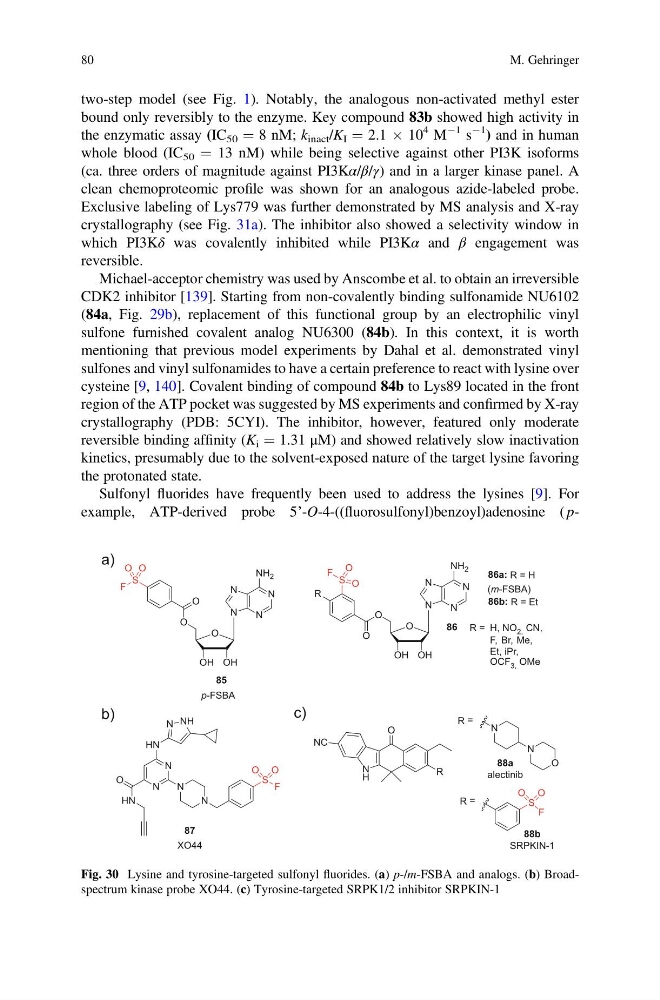
Sulfonyl fluorides have frequently been used to address the lysines [9]. For
example, ATP-derived probe 5’-O-4-((fluorosulfonyl)benzoyl)adenosine ( pa)
N
N
N
N
NH 2
O
OH
O
OH
O
86a: R = H
S
F
O
O
R
H, NO 2, CN,
F, Br, Me,
Et, iPr,
OCF 3, OMe
R =
86
(m-FSBA)
86b: R = Et
N
N
N
N
NH 2
O
OH
O
OH
O
85
O O
F
S
p-FSBA
N
N
N
N
S F
O O
HN
HN
O
NH
N
87
XO44
b)
c)
N
H
NC
O
R
88a
alectinib
N
N
O
F
O
O
S
R =
88b
SRPKIN-1
R =
Fig. 30 Lysine and tyrosine-targeted sulfonyl fluorides. (a) p-/m-FSBA and analogs. (b) Broadspectrum kinase probe XO44. (c) Tyrosine-targeted SRPK1/2 inhibitor SRPKIN-1
80
M. Gehringer
bound only reversibly to the enzyme. Key compound 83b showed high activity in
the enzymatic assay (IC 50 ¼ 8 nM; k inact /K I ¼ 2.1 Â 10
4 M
À1 s
À1 ) and in human
whole blood (IC 50 ¼ 13 nM) while being selective against other PI3K isoforms
(ca. three orders of magnitude against PI3Kα/β/γ) and in a larger kinase panel. A
clean chemoproteomic profile was shown for an analogous azide-labeled probe.
Exclusive labeling of Lys779 was further demonstrated by MS analysis and X-ray
crystallography (see Fig. 31a). The inhibitor also showed a selectivity window in
which PI3Kδ was covalently inhibited while PI3Kα and β engagement was
reversible.
Michael-acceptor chemistry was used by Anscombe et al. to obtain an irreversible
CDK2 inhibitor [139]. Starting from non-covalently binding sulfonamide NU6102
(84a, Fig. 29b), replacement of this functional group by an electrophilic vinyl
sulfone furnished covalent analog NU6300 (84b). In this context, it is worth
mentioning that previous model experiments by Dahal et al. demonstrated vinyl
sulfones and vinyl sulfonamides to have a certain preference to react with lysine over
cysteine [9, 140]. Covalent binding of compound 84b to Lys89 located in the front
region of the ATP pocket was suggested by MS experiments and confirmed by X-ray
crystallography (PDB: 5CYI). The inhibitor, however, featured only moderate
reversible binding affinity (K i ¼ 1.31 μM) and showed relatively slow inactivation
kinetics, presumably due to the solvent-exposed nature of the target lysine favoring
the protonated state.
Sulfonyl fluorides have frequently been used to address the lysines [9]. For
example, ATP-derived probe 5’-O-4-((fluorosulfonyl)benzoyl)adenosine ( pa)
N
N
N
N
NH 2
O
OH
O
OH
O
86a: R = H
S
F
O
O
R
H, NO 2, CN,
F, Br, Me,
Et, iPr,
OCF 3, OMe
R =
86
(m-FSBA)
86b: R = Et
N
N
N
N
NH 2
O
OH
O
OH
O
85
O O
F
S
p-FSBA
N
N
N
N
S F
O O
HN
HN
O
NH
N
87
XO44
b)
c)
N
H
NC
O
R
88a
alectinib
N
N
O
F
O
O
S
R =
88b
SRPKIN-1
R =
Fig. 30 Lysine and tyrosine-targeted sulfonyl fluorides. (a) p-/m-FSBA and analogs. (b) Broadspectrum kinase probe XO44. (c) Tyrosine-targeted SRPK1/2 inhibitor SRPKIN-1
80
M. Gehringer