

activation segment’s O3 subsite, frequently two residues after the phosphorylation
site. Further accessible cysteines are located in the activation loop. Examples are
Cys178 and 179 in IKKα and β, which have been identified as the target of natural
products and endogenous ligands like PGA1 (vide supra) [5]. However, proper
assignment of the activation loop cysteines is impeded by the highly plastic nature
and the variable length of this region [5].
A cysteine located at O2 (Cys296, DFG + 2 position) in the protein kinases B
(PKBs, also known as AKTs) is addressed by allosteric inhibitors (vide infra) and
presumably also by pyranonaphthoquinones (vide supra) while many kinases with a
D1 cysteine are targeted by the aforementioned resorcylic acid lactones like
hypothemycin, LL-Z1640-2, and analogs thereof (see Fig. 6), albeit with limited
specificity. D1 cysteine residues have also been tackled by rational design efforts.
Although there are many kinases (% 10% of the kinome) featuring such a cysteine,
these targets are distributed over almost all kinase families suggesting that distinct
structural features may readily be exploited as additional selectivity filters. For
example, Ward and co-workers from AstraZeneca reported on covalent ERK1/2
inhibitors derived from several reversible inhibitor classes using a structure-based
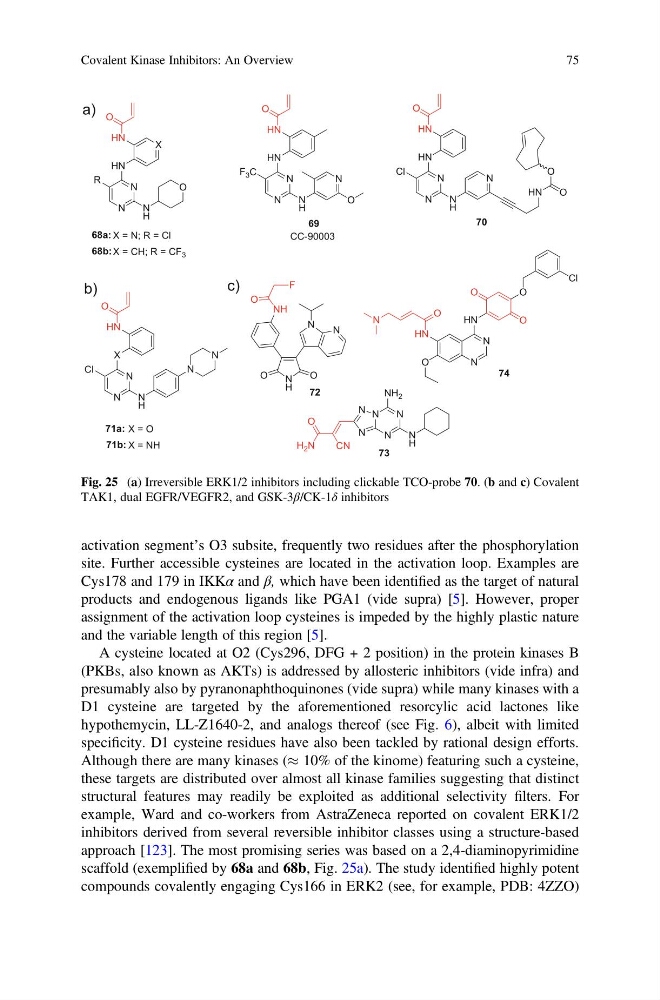
approach [123]. The most promising series was based on a 2,4-diaminopyrimidine
scaffold (exemplified by 68a and 68b, Fig. 25a). The study identified highly potent
compounds covalently engaging Cys166 in ERK2 (see, for example, PDB: 4ZZO)
68a:
N
N
R
N
H
O
X
HN
O
X = N; R = Cl
68b: X = CH; R = CF 3
N
N
Cl
N
H
X
N
N
HN
O
71a: X = O
71b: X = NH
N
N
Cl
N
H
HN
N
HN
O
HN
O
O
70
b)
N
H
O
O
N
N
NH
O
F
72
c)
N
N
N
N
H
NH 2
N
N
CN
H 2 N
O
73
N
N
F 3 C
N
H
HN
N
HN
O
O
69
CC-90003
N
O
HN
O
N
N
HN
O
O
O
Cl
74
a)
HN
Fig. 25 (a) Irreversible ERK1/2 inhibitors including clickable TCO-probe 70. (b and c) Covalent
TAK1, dual EGFR/VEGFR2, and GSK-3β/CK-1δ inhibitors
Covalent Kinase Inhibitors: An Overview
75
site. Further accessible cysteines are located in the activation loop. Examples are
Cys178 and 179 in IKKα and β, which have been identified as the target of natural
products and endogenous ligands like PGA1 (vide supra) [5]. However, proper
assignment of the activation loop cysteines is impeded by the highly plastic nature
and the variable length of this region [5].
A cysteine located at O2 (Cys296, DFG + 2 position) in the protein kinases B
(PKBs, also known as AKTs) is addressed by allosteric inhibitors (vide infra) and
presumably also by pyranonaphthoquinones (vide supra) while many kinases with a
D1 cysteine are targeted by the aforementioned resorcylic acid lactones like
hypothemycin, LL-Z1640-2, and analogs thereof (see Fig. 6), albeit with limited
specificity. D1 cysteine residues have also been tackled by rational design efforts.
Although there are many kinases (% 10% of the kinome) featuring such a cysteine,
these targets are distributed over almost all kinase families suggesting that distinct
structural features may readily be exploited as additional selectivity filters. For
example, Ward and co-workers from AstraZeneca reported on covalent ERK1/2
inhibitors derived from several reversible inhibitor classes using a structure-based
approach [123]. The most promising series was based on a 2,4-diaminopyrimidine
scaffold (exemplified by 68a and 68b, Fig. 25a). The study identified highly potent
compounds covalently engaging Cys166 in ERK2 (see, for example, PDB: 4ZZO)
68a:
N
N
R
N
H
O
X
HN
O
X = N; R = Cl
68b: X = CH; R = CF 3
N
N
Cl
N
H
X
N
N
HN
O
71a: X = O
71b: X = NH
N
N
Cl
N
H
HN
N
HN
O
HN
O
O
70
b)
N
H
O
O
N
N
NH
O
F
72
c)
N
N
N
N
H
NH 2
N
N
CN
H 2 N
O
73
N
N
F 3 C
N
H
HN
N
HN
O
O
69
CC-90003
N
O
HN
O
N
N
HN
O
O
O
Cl
74
a)
HN
Fig. 25 (a) Irreversible ERK1/2 inhibitors including clickable TCO-probe 70. (b and c) Covalent
TAK1, dual EGFR/VEGFR2, and GSK-3β/CK-1δ inhibitors
Covalent Kinase Inhibitors: An Overview
75