

with an excellent selectivity in the kinome and reasonable cellular potency. Covalent
modification of Cys154 (JNK3 numbering) was shown for some close analogs by
MS and X-ray crystallography (see PDB: 3V6R and 3V6S).
Structurally distinct pyridinylimidazole-derived covalent JNK inhibitors (e.g.,
42a and b, Fig. 16a) were developed from reversible p38α MAP kinase inhibitors
in the groups of Koch and Laufer using a structure-based approach [98]. Both
compounds potently block JNK3 enzymatic activity with IC 50 values bordering
the picomolar range. The inhibitors covalently labeled JNK3 as confirmed by MS
experiments while leaving the C154A mutant unmodified. However, while the tetrasubstituted imidazole 42a retained significant (reversible) inhibitory activity on p38α
(IC 50 ¼ 36 nM), N-desmethyl analog 42b displayed an approx. 1,000-fold selectivity
window over the latter enzyme. Both compounds showed a relatively clean profile in
a panel of 410 kinases. More detailed information on covalent and non-covalent JNK
inhibitors can be found in a dedicated chapter of this book and in recent reviews
[99, 100].
2.4.3 Inhibitors Targeting the F1 and the F4 Position
Further cysteines in the front region of protein kinases that have proven amenable to
covalent targeting are located at the F1 (αD À 2) and the F4 (αD + 6) positions.
According to the underlying analysis, an F1 cysteine occurs in the three kinases
EphB3, LKB1, and PINK1 but it has only been addressed in the EphB3 receptor
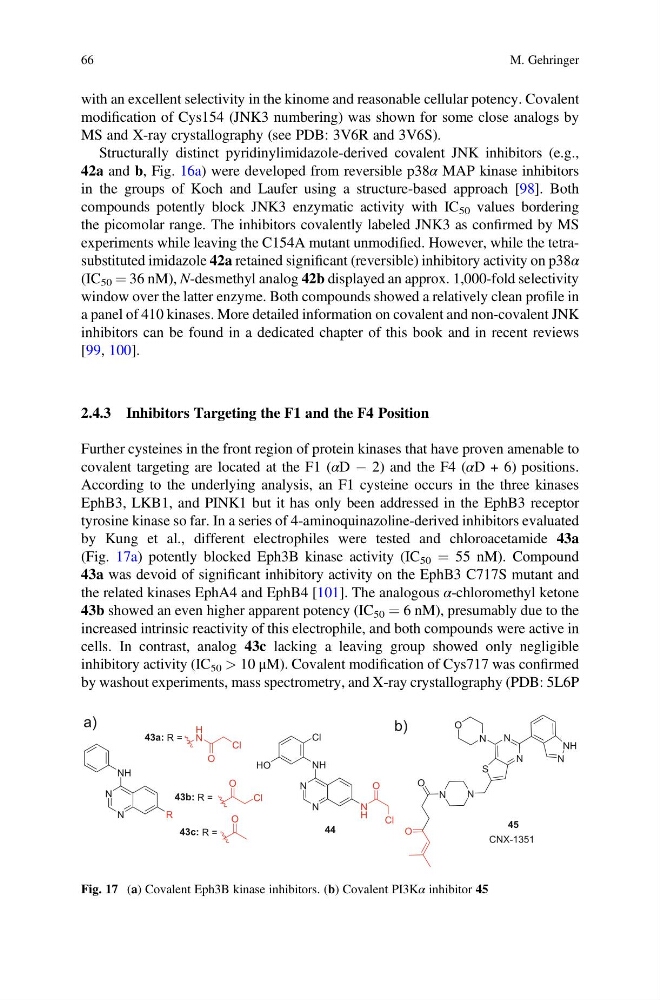
tyrosine kinase so far. In a series of 4-aminoquinazoline-derived inhibitors evaluated
by Kung et al., different electrophiles were tested and chloroacetamide 43a
(Fig. 17a) potently blocked Eph3B kinase activity (IC 50 ¼ 55 nM). Compound
43a was devoid of significant inhibitory activity on the EphB3 C717S mutant and
the related kinases EphA4 and EphB4 [101]. The analogous α-chloromethyl ketone
43b showed an even higher apparent potency (IC 50 ¼ 6 nM), presumably due to the
increased intrinsic reactivity of this electrophile, and both compounds were active in
cells. In contrast, analog 43c lacking a leaving group showed only negligible
inhibitory activity (IC 50 > 10 μM). Covalent modification of Cys717 was confirmed
by washout experiments, mass spectrometry, and X-ray crystallography (PDB: 5L6P
a)
b)
N
N
NH
R
43c: R =
O
43b: R =
O
Cl
43a: R =
H
N
O
Cl
N
N
NH
N
H
Cl
HO
O
Cl
S
N
N
N
N
O
N
NH
N
O
O
CNX-1351
45
44
Fig. 17 (a) Covalent Eph3B kinase inhibitors. (b) Covalent PI3Kα inhibitor 45
66
M. Gehringer
modification of Cys154 (JNK3 numbering) was shown for some close analogs by
MS and X-ray crystallography (see PDB: 3V6R and 3V6S).
Structurally distinct pyridinylimidazole-derived covalent JNK inhibitors (e.g.,
42a and b, Fig. 16a) were developed from reversible p38α MAP kinase inhibitors
in the groups of Koch and Laufer using a structure-based approach [98]. Both
compounds potently block JNK3 enzymatic activity with IC 50 values bordering
the picomolar range. The inhibitors covalently labeled JNK3 as confirmed by MS
experiments while leaving the C154A mutant unmodified. However, while the tetrasubstituted imidazole 42a retained significant (reversible) inhibitory activity on p38α
(IC 50 ¼ 36 nM), N-desmethyl analog 42b displayed an approx. 1,000-fold selectivity
window over the latter enzyme. Both compounds showed a relatively clean profile in
a panel of 410 kinases. More detailed information on covalent and non-covalent JNK
inhibitors can be found in a dedicated chapter of this book and in recent reviews
[99, 100].
2.4.3 Inhibitors Targeting the F1 and the F4 Position
Further cysteines in the front region of protein kinases that have proven amenable to
covalent targeting are located at the F1 (αD À 2) and the F4 (αD + 6) positions.
According to the underlying analysis, an F1 cysteine occurs in the three kinases
EphB3, LKB1, and PINK1 but it has only been addressed in the EphB3 receptor
tyrosine kinase so far. In a series of 4-aminoquinazoline-derived inhibitors evaluated
by Kung et al., different electrophiles were tested and chloroacetamide 43a
(Fig. 17a) potently blocked Eph3B kinase activity (IC 50 ¼ 55 nM). Compound
43a was devoid of significant inhibitory activity on the EphB3 C717S mutant and
the related kinases EphA4 and EphB4 [101]. The analogous α-chloromethyl ketone
43b showed an even higher apparent potency (IC 50 ¼ 6 nM), presumably due to the
increased intrinsic reactivity of this electrophile, and both compounds were active in
cells. In contrast, analog 43c lacking a leaving group showed only negligible
inhibitory activity (IC 50 > 10 μM). Covalent modification of Cys717 was confirmed
by washout experiments, mass spectrometry, and X-ray crystallography (PDB: 5L6P
a)
b)
N
N
NH
R
43c: R =
O
43b: R =
O
Cl
43a: R =
H
N
O
Cl
N
N
NH
N
H
Cl
HO
O
Cl
S
N
N
N
N
O
N
NH
N
O
O
CNX-1351
45
44
Fig. 17 (a) Covalent Eph3B kinase inhibitors. (b) Covalent PI3Kα inhibitor 45
66
M. Gehringer