

modelling encompasses all methods, theoretical and computational, used to model or
mimic the behavior of molecules.” The art of modeling is to include all those factors
which are needed to gain correct results and not those which are not affecting the
outcome. In early 2000 many scientists used to think that all that was needed to
model kinase inhibitor binding and biological activity was a proper knowledge of the
kinase binding cavity structure and a good scoring function. Unfortunately, kinase
life (like protein life in general) is more complicated, and several findings have
forced us to rethink what is important. As an example, the first-generation Raf
inhibitors turned out to be both kinase inhibitors and activators at the same time
[4]. This paradoxical finding cannot be explained simply by binding interactions or
structural data based on protein kinase X-ray structures but requires considering
kinase dimerization and allosteric effects between kinase domains [5]. Another
classical example, shown by Wood et al. [6], demonstrates how three kinase
inhibitors, lapatinib (Tykerb, GlaxoSmithKline: GW572916), gefitinib (Iressa,
AstraZeneca: ZD-1839), and erlotinib (Tarceva, OSI: OSI-774) all bind the EGFR
kinase domain with almost equal IC 50 values but yet a dramatically different effect
on cell cultures. As it turned out, these compounds have big differences in target
residence times. So, simple IC 50 or binding affinity in the form of pK i is not the
dictating factor for biological activity, but, instead, dynamic properties are critical. A
third example demonstrates how solvent effects do explain kinase inhibitors’
structure-activity relationships. Direct interactions between cyclin G-associated
kinase (GAK) and a library of 4-anilinoquin(az)olines were not able to explain
structure-activity relationships (SAR). Instead, desolvation energies, reflecting
enthalpy and entropy of individual water molecules within the GAK binding site,
were critical for building a systematic SAR model. This example clearly indicates
that water should not be neglected during kinase modeling [7]. Although these
examples may seem to be quite unique, there is one common factor combining all
the cases. To gain useful modeling results, we must consider the protein including
solvent and dynamic aspects of the whole molecular system.
So, should we model protein kinases alone or inhibitor-kinase systems in general?
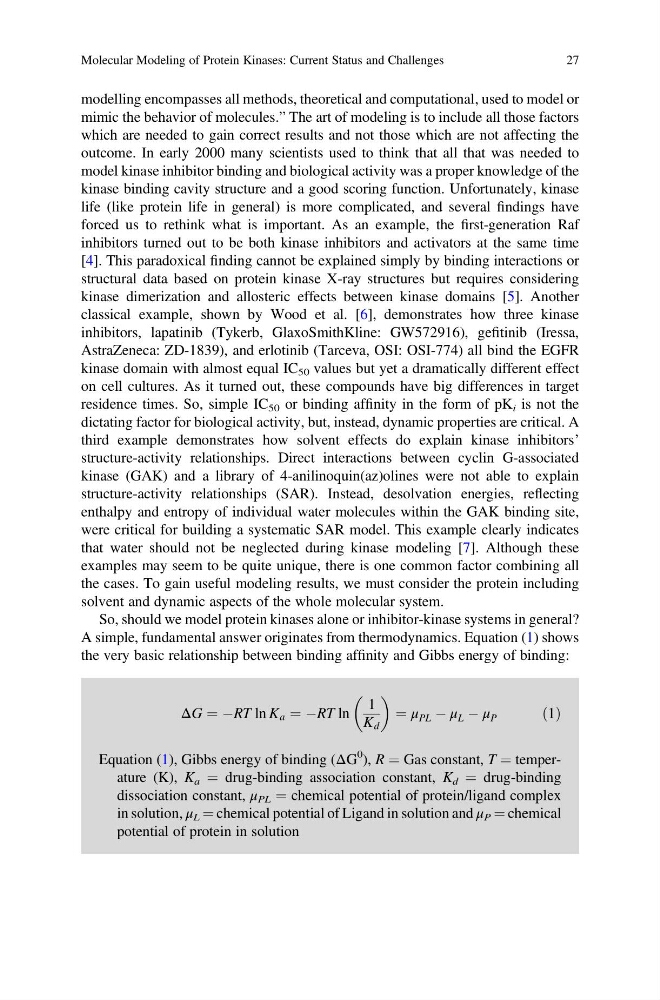
A simple, fundamental answer originates from thermodynamics. Equation (1) shows
the very basic relationship between binding affinity and Gibbs energy of binding:
ΔG ¼ ÀRT ln K a ¼ ÀRT ln
1
K d
¼ μ PL À μ L À μ P
ð1Þ
Equation (1), Gibbs energy of binding (ΔG
0 ), R ¼ Gas constant, T ¼ temperature (K), K a ¼ drug-binding association constant, K d ¼ drug-binding
dissociation constant, μ PL ¼ chemical potential of protein/ligand complex
in solution, μ L ¼ chemical potential of Ligand in solution and μ P ¼ chemical
potential of protein in solution
Molecular Modeling of Protein Kinases: Current Status and Challenges
27
mimic the behavior of molecules.” The art of modeling is to include all those factors
which are needed to gain correct results and not those which are not affecting the
outcome. In early 2000 many scientists used to think that all that was needed to
model kinase inhibitor binding and biological activity was a proper knowledge of the
kinase binding cavity structure and a good scoring function. Unfortunately, kinase
life (like protein life in general) is more complicated, and several findings have
forced us to rethink what is important. As an example, the first-generation Raf
inhibitors turned out to be both kinase inhibitors and activators at the same time
[4]. This paradoxical finding cannot be explained simply by binding interactions or
structural data based on protein kinase X-ray structures but requires considering
kinase dimerization and allosteric effects between kinase domains [5]. Another
classical example, shown by Wood et al. [6], demonstrates how three kinase
inhibitors, lapatinib (Tykerb, GlaxoSmithKline: GW572916), gefitinib (Iressa,
AstraZeneca: ZD-1839), and erlotinib (Tarceva, OSI: OSI-774) all bind the EGFR
kinase domain with almost equal IC 50 values but yet a dramatically different effect
on cell cultures. As it turned out, these compounds have big differences in target
residence times. So, simple IC 50 or binding affinity in the form of pK i is not the
dictating factor for biological activity, but, instead, dynamic properties are critical. A
third example demonstrates how solvent effects do explain kinase inhibitors’
structure-activity relationships. Direct interactions between cyclin G-associated
kinase (GAK) and a library of 4-anilinoquin(az)olines were not able to explain
structure-activity relationships (SAR). Instead, desolvation energies, reflecting
enthalpy and entropy of individual water molecules within the GAK binding site,
were critical for building a systematic SAR model. This example clearly indicates
that water should not be neglected during kinase modeling [7]. Although these
examples may seem to be quite unique, there is one common factor combining all
the cases. To gain useful modeling results, we must consider the protein including
solvent and dynamic aspects of the whole molecular system.
So, should we model protein kinases alone or inhibitor-kinase systems in general?
A simple, fundamental answer originates from thermodynamics. Equation (1) shows
the very basic relationship between binding affinity and Gibbs energy of binding:
ΔG ¼ ÀRT ln K a ¼ ÀRT ln
1
K d
¼ μ PL À μ L À μ P
ð1Þ
Equation (1), Gibbs energy of binding (ΔG
0 ), R ¼ Gas constant, T ¼ temperature (K), K a ¼ drug-binding association constant, K d ¼ drug-binding
dissociation constant, μ PL ¼ chemical potential of protein/ligand complex
in solution, μ L ¼ chemical potential of Ligand in solution and μ P ¼ chemical
potential of protein in solution
Molecular Modeling of Protein Kinases: Current Status and Challenges
27