

folded P-loop conformations are usually characterized with significantly narrower
selectivity profiles [107].
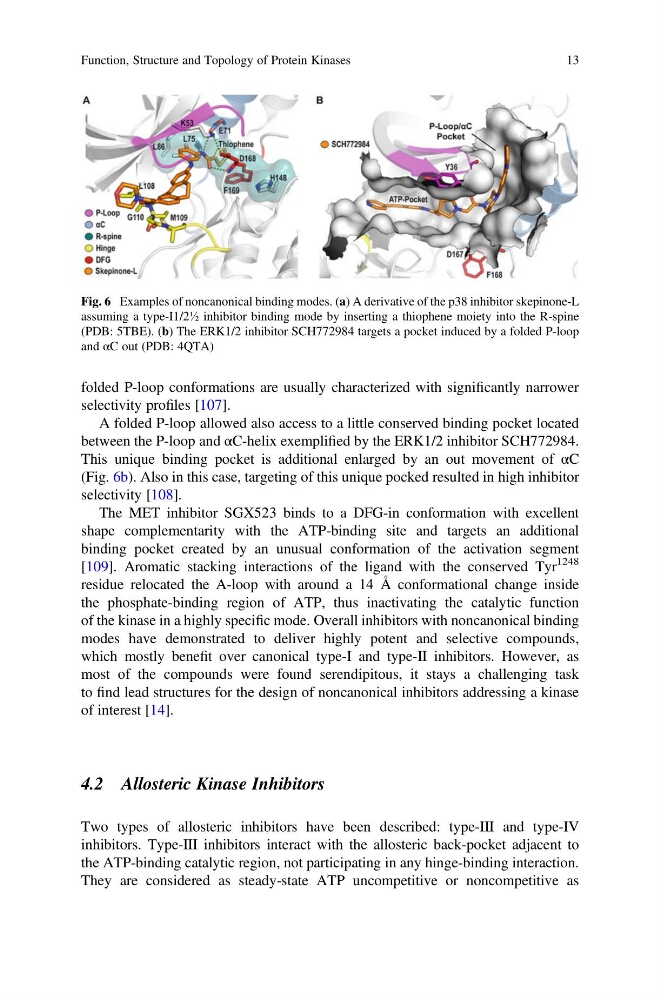
A folded P-loop allowed also access to a little conserved binding pocket located
between the P-loop and αC-helix exemplified by the ERK1/2 inhibitor SCH772984.
This unique binding pocket is additional enlarged by an out movement of αC
(Fig. 6b). Also in this case, targeting of this unique pocked resulted in high inhibitor
selectivity [108].
The MET inhibitor SGX523 binds to a DFG-in conformation with excellent
shape complementarity with the ATP-binding site and targets an additional
binding pocket created by an unusual conformation of the activation segment
[109]. Aromatic stacking interactions of the ligand with the conserved Tyr
1248
residue relocated the A-loop with around a 14 Å conformational change inside
the phosphate-binding region of ATP, thus inactivating the catalytic function
of the kinase in a highly specific mode. Overall inhibitors with noncanonical binding
modes have demonstrated to deliver highly potent and selective compounds,
which mostly benefit over canonical type-I and type-II inhibitors. However, as
most of the compounds were found serendipitous, it stays a challenging task
to find lead structures for the design of noncanonical inhibitors addressing a kinase
of interest [14].
4.2 Allosteric Kinase Inhibitors
Two types of allosteric inhibitors have been described: type-III and type-IV
inhibitors. Type-III inhibitors interact with the allosteric back-pocket adjacent to
the ATP-binding catalytic region, not participating in any hinge-binding interaction.
They are considered as steady-state ATP uncompetitive or noncompetitive as
Fig. 6 Examples of noncanonical binding modes. (a) A derivative of the p38 inhibitor skepinone-L
assuming a type-I1/2½ inhibitor binding mode by inserting a thiophene moiety into the R-spine
(PDB: 5TBE). (b) The ERK1/2 inhibitor SCH772984 targets a pocket induced by a folded P-loop
and αC out (PDB: 4QTA)
Function, Structure and Topology of Protein Kinases
13
selectivity profiles [107].
A folded P-loop allowed also access to a little conserved binding pocket located
between the P-loop and αC-helix exemplified by the ERK1/2 inhibitor SCH772984.
This unique binding pocket is additional enlarged by an out movement of αC
(Fig. 6b). Also in this case, targeting of this unique pocked resulted in high inhibitor
selectivity [108].
The MET inhibitor SGX523 binds to a DFG-in conformation with excellent
shape complementarity with the ATP-binding site and targets an additional
binding pocket created by an unusual conformation of the activation segment
[109]. Aromatic stacking interactions of the ligand with the conserved Tyr
1248
residue relocated the A-loop with around a 14 Å conformational change inside
the phosphate-binding region of ATP, thus inactivating the catalytic function
of the kinase in a highly specific mode. Overall inhibitors with noncanonical binding
modes have demonstrated to deliver highly potent and selective compounds,
which mostly benefit over canonical type-I and type-II inhibitors. However, as
most of the compounds were found serendipitous, it stays a challenging task
to find lead structures for the design of noncanonical inhibitors addressing a kinase
of interest [14].
4.2 Allosteric Kinase Inhibitors
Two types of allosteric inhibitors have been described: type-III and type-IV
inhibitors. Type-III inhibitors interact with the allosteric back-pocket adjacent to
the ATP-binding catalytic region, not participating in any hinge-binding interaction.
They are considered as steady-state ATP uncompetitive or noncompetitive as
Fig. 6 Examples of noncanonical binding modes. (a) A derivative of the p38 inhibitor skepinone-L
assuming a type-I1/2½ inhibitor binding mode by inserting a thiophene moiety into the R-spine
(PDB: 5TBE). (b) The ERK1/2 inhibitor SCH772984 targets a pocket induced by a folded P-loop
and αC out (PDB: 4QTA)
Function, Structure and Topology of Protein Kinases
13