

Despite the well-described biochemical results indicating that crenolanib (63)
acts as a type I inhibitor, up to now no co-crystallized structure of this prototype with
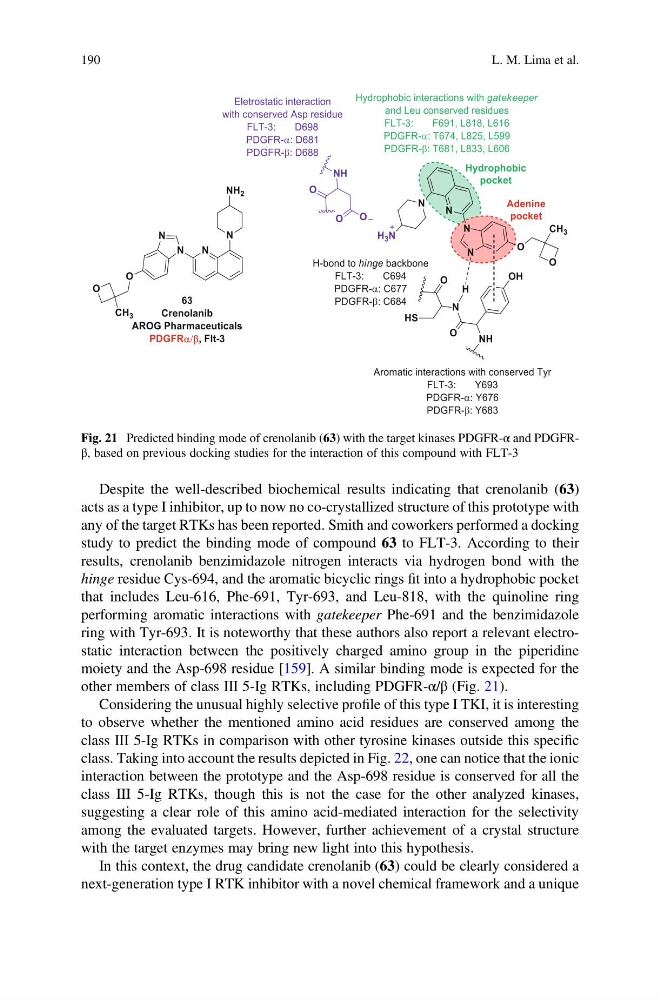
any of the target RTKs has been reported. Smith and coworkers performed a docking
study to predict the binding mode of compound 63 to FLT-3. According to their
results, crenolanib benzimidazole nitrogen interacts via hydrogen bond with the
hinge residue Cys-694, and the aromatic bicyclic rings fit into a hydrophobic pocket
that includes Leu-616, Phe-691, Tyr-693, and Leu-818, with the quinoline ring
performing aromatic interactions with gatekeeper Phe-691 and the benzimidazole
ring with Tyr-693. It is noteworthy that these authors also report a relevant electrostatic interaction between the positively charged amino group in the piperidine
moiety and the Asp-698 residue [159]. A similar binding mode is expected for the
other members of class III 5-Ig RTKs, including PDGFR-α/β (Fig. 21).
Considering the unusual highly selective profile of this type I TKI, it is interesting
to observe whether the mentioned amino acid residues are conserved among the
class III 5-Ig RTKs in comparison with other tyrosine kinases outside this specific
class. Taking into account the results depicted in Fig. 22, one can notice that the ionic
interaction between the prototype and the Asp-698 residue is conserved for all the
class III 5-Ig RTKs, though this is not the case for the other analyzed kinases,
suggesting a clear role of this amino acid-mediated interaction for the selectivity
among the evaluated targets. However, further achievement of a crystal structure
with the target enzymes may bring new light into this hypothesis.
In this context, the drug candidate crenolanib (63) could be clearly considered a
next-generation type I RTK inhibitor with a novel chemical framework and a unique
Fig. 21 Predicted binding mode of crenolanib (63) with the target kinases PDGFR-α and PDGFRβ, based on previous docking studies for the interaction of this compound with FLT-3
190
L. M. Lima et al.
acts as a type I inhibitor, up to now no co-crystallized structure of this prototype with
any of the target RTKs has been reported. Smith and coworkers performed a docking
study to predict the binding mode of compound 63 to FLT-3. According to their
results, crenolanib benzimidazole nitrogen interacts via hydrogen bond with the
hinge residue Cys-694, and the aromatic bicyclic rings fit into a hydrophobic pocket
that includes Leu-616, Phe-691, Tyr-693, and Leu-818, with the quinoline ring
performing aromatic interactions with gatekeeper Phe-691 and the benzimidazole
ring with Tyr-693. It is noteworthy that these authors also report a relevant electrostatic interaction between the positively charged amino group in the piperidine
moiety and the Asp-698 residue [159]. A similar binding mode is expected for the
other members of class III 5-Ig RTKs, including PDGFR-α/β (Fig. 21).
Considering the unusual highly selective profile of this type I TKI, it is interesting
to observe whether the mentioned amino acid residues are conserved among the
class III 5-Ig RTKs in comparison with other tyrosine kinases outside this specific
class. Taking into account the results depicted in Fig. 22, one can notice that the ionic
interaction between the prototype and the Asp-698 residue is conserved for all the
class III 5-Ig RTKs, though this is not the case for the other analyzed kinases,
suggesting a clear role of this amino acid-mediated interaction for the selectivity
among the evaluated targets. However, further achievement of a crystal structure
with the target enzymes may bring new light into this hypothesis.
In this context, the drug candidate crenolanib (63) could be clearly considered a
next-generation type I RTK inhibitor with a novel chemical framework and a unique
Fig. 21 Predicted binding mode of crenolanib (63) with the target kinases PDGFR-α and PDGFRβ, based on previous docking studies for the interaction of this compound with FLT-3
190
L. M. Lima et al.