

cells, which also overexpress EGFR to a lower extent; and the SW620 cell line. The
inhibitory potency against SW620 tumor cells, with no alteration in EGFR and
HER-2 expression rates, was used as a cytotoxic selectivity parameter [81]. For
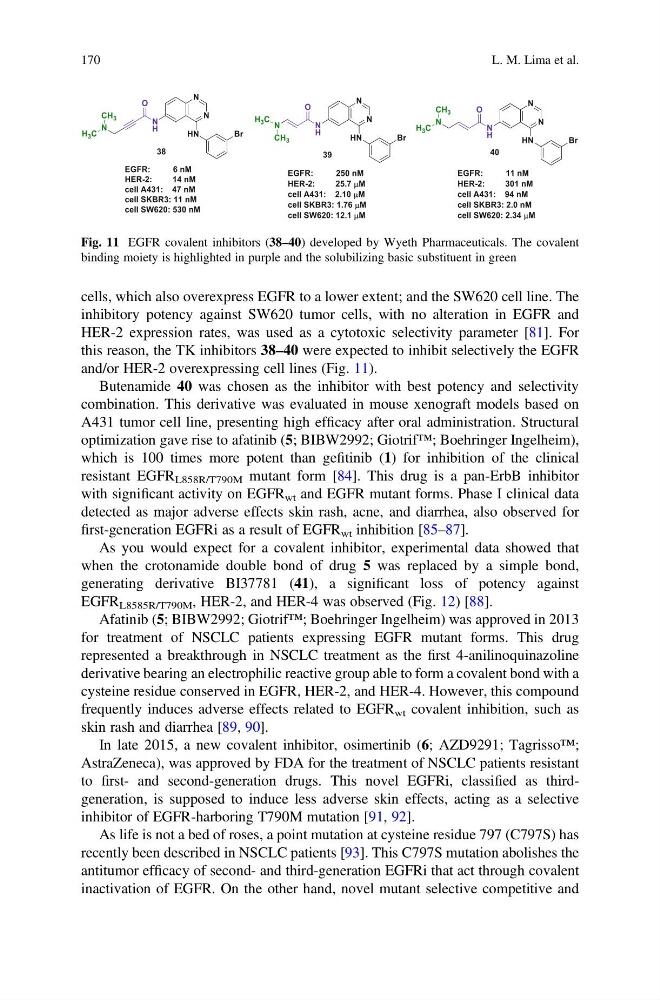
this reason, the TK inhibitors 38–40 were expected to inhibit selectively the EGFR
and/or HER-2 overexpressing cell lines (Fig. 11).
Butenamide 40 was chosen as the inhibitor with best potency and selectivity
combination. This derivative was evaluated in mouse xenograft models based on
A431 tumor cell line, presenting high efficacy after oral administration. Structural
optimization gave rise to afatinib (5; BIBW2992; Giotrif™; Boehringer Ingelheim),
which is 100 times more potent than gefitinib (1) for inhibition of the clinical
resistant EGFR L858R/T790M mutant form [84]. This drug is a pan-ErbB inhibitor
with significant activity on EGFR wt and EGFR mutant forms. Phase I clinical data
detected as major adverse effects skin rash, acne, and diarrhea, also observed for
first-generation EGFRi as a result of EGFR wt inhibition [85–87].
As you would expect for a covalent inhibitor, experimental data showed that
when the crotonamide double bond of drug 5 was replaced by a simple bond,
generating derivative BI37781 (41), a significant loss of potency against
EGFR L8585R/T790M , HER-2, and HER-4 was observed (Fig. 12) [88].
Afatinib (5; BIBW2992; Giotrif™; Boehringer Ingelheim) was approved in 2013
for treatment of NSCLC patients expressing EGFR mutant forms. This drug
represented a breakthrough in NSCLC treatment as the first 4-anilinoquinazoline
derivative bearing an electrophilic reactive group able to form a covalent bond with a
cysteine residue conserved in EGFR, HER-2, and HER-4. However, this compound
frequently induces adverse effects related to EGFR wt covalent inhibition, such as
skin rash and diarrhea [89, 90].
In late 2015, a new covalent inhibitor, osimertinib (6; AZD9291; Tagrisso™;
AstraZeneca), was approved by FDA for the treatment of NSCLC patients resistant
to first- and second-generation drugs. This novel EGFRi, classified as thirdgeneration, is supposed to induce less adverse skin effects, acting as a selective
inhibitor of EGFR-harboring T790M mutation [91, 92].
As life is not a bed of roses, a point mutation at cysteine residue 797 (C797S) has
recently been described in NSCLC patients [93]. This C797S mutation abolishes the
antitumor efficacy of second- and third-generation EGFRi that act through covalent
inactivation of EGFR. On the other hand, novel mutant selective competitive and
Fig. 11 EGFR covalent inhibitors (38–40) developed by Wyeth Pharmaceuticals. The covalent
binding moiety is highlighted in purple and the solubilizing basic substituent in green
170
L. M. Lima et al.
inhibitory potency against SW620 tumor cells, with no alteration in EGFR and
HER-2 expression rates, was used as a cytotoxic selectivity parameter [81]. For
this reason, the TK inhibitors 38–40 were expected to inhibit selectively the EGFR
and/or HER-2 overexpressing cell lines (Fig. 11).
Butenamide 40 was chosen as the inhibitor with best potency and selectivity
combination. This derivative was evaluated in mouse xenograft models based on
A431 tumor cell line, presenting high efficacy after oral administration. Structural
optimization gave rise to afatinib (5; BIBW2992; Giotrif™; Boehringer Ingelheim),
which is 100 times more potent than gefitinib (1) for inhibition of the clinical
resistant EGFR L858R/T790M mutant form [84]. This drug is a pan-ErbB inhibitor
with significant activity on EGFR wt and EGFR mutant forms. Phase I clinical data
detected as major adverse effects skin rash, acne, and diarrhea, also observed for
first-generation EGFRi as a result of EGFR wt inhibition [85–87].
As you would expect for a covalent inhibitor, experimental data showed that
when the crotonamide double bond of drug 5 was replaced by a simple bond,
generating derivative BI37781 (41), a significant loss of potency against
EGFR L8585R/T790M , HER-2, and HER-4 was observed (Fig. 12) [88].
Afatinib (5; BIBW2992; Giotrif™; Boehringer Ingelheim) was approved in 2013
for treatment of NSCLC patients expressing EGFR mutant forms. This drug
represented a breakthrough in NSCLC treatment as the first 4-anilinoquinazoline
derivative bearing an electrophilic reactive group able to form a covalent bond with a
cysteine residue conserved in EGFR, HER-2, and HER-4. However, this compound
frequently induces adverse effects related to EGFR wt covalent inhibition, such as
skin rash and diarrhea [89, 90].
In late 2015, a new covalent inhibitor, osimertinib (6; AZD9291; Tagrisso™;
AstraZeneca), was approved by FDA for the treatment of NSCLC patients resistant
to first- and second-generation drugs. This novel EGFRi, classified as thirdgeneration, is supposed to induce less adverse skin effects, acting as a selective
inhibitor of EGFR-harboring T790M mutation [91, 92].
As life is not a bed of roses, a point mutation at cysteine residue 797 (C797S) has
recently been described in NSCLC patients [93]. This C797S mutation abolishes the
antitumor efficacy of second- and third-generation EGFRi that act through covalent
inactivation of EGFR. On the other hand, novel mutant selective competitive and
Fig. 11 EGFR covalent inhibitors (38–40) developed by Wyeth Pharmaceuticals. The covalent
binding moiety is highlighted in purple and the solubilizing basic substituent in green
170
L. M. Lima et al.