

2.3 EGFR Inhibitors for Non-small Cell Lung Cancer
(NSCLC) Treatment
The 4-anilinoquinazoline EGFRi gefitinib (1) and erlotinib (2) represented an
impressive innovation in NSCLC therapy. However, clinical responses differ significantly among the treated patients. Over the last years, clinical data have demonstrated a clear connection between therapy responsiveness to first-generation EGFRi
and the existence of mutations in this protein [54].
EGFR mutations may be beneficial for treatment when associated with enhanced
response rates and antitumor efficacy but may also be deleterious when related to
drug resistance and clinical inefficacy [55]. For this reason, genetic diagnostic
testing has become an important tool for the identification of patients tending to be
more responsive to a specific EGFRi [56, 57].
Among NSCLC patients, only 10–20% respond to EGFRi first-generation drugs.
The most common EGFR genetic alterations associated with a better clinical outcome are the point mutation L858R in exon 21, with the change of a leucine for an
arginine residue, and the amino acid deletion 746–750 in exon 19 [55, 58]. Firstgeneration EGFRi present higher affinity for EGFR L858R and EGFR del747-750 than for
EGFR wild-type (EGFR wt ), and NSCLC patients harboring these mutations consequently show a better treatment response to these drugs [59, 60].
Moreover, after 10–14 months of treatment, initially responsive patients usually
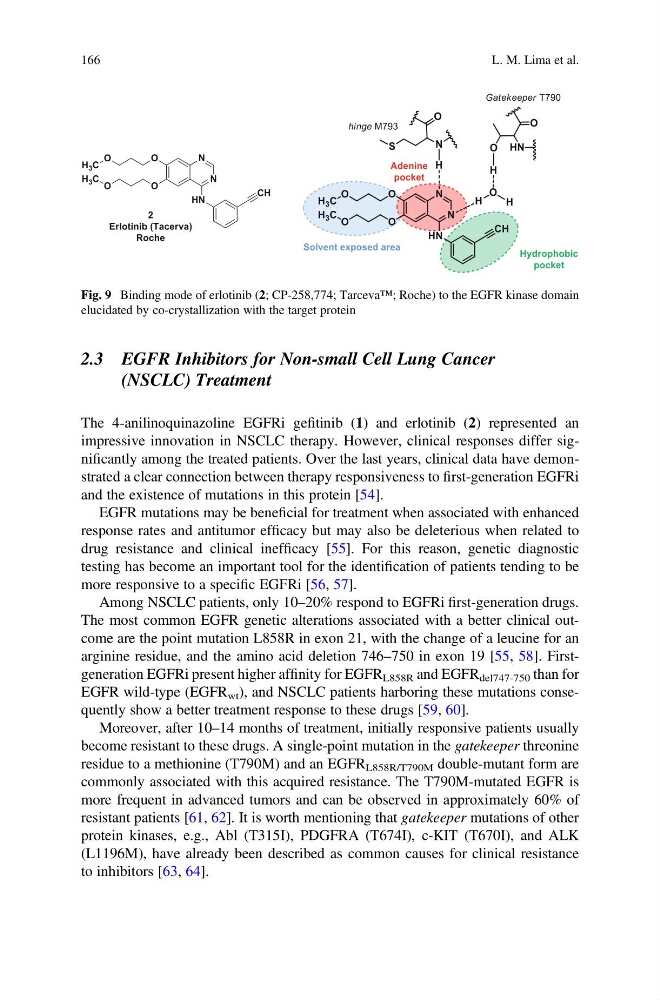
become resistant to these drugs. A single-point mutation in the gatekeeper threonine
residue to a methionine (T790M) and an EGFR L858R/T790M double-mutant form are
commonly associated with this acquired resistance. The T790M-mutated EGFR is
more frequent in advanced tumors and can be observed in approximately 60% of
resistant patients [61, 62]. It is worth mentioning that gatekeeper mutations of other
protein kinases, e.g., Abl (T315I), PDGFRA (T674I), c-KIT (T670I), and ALK
(L1196M), have already been described as common causes for clinical resistance
to inhibitors [63, 64].
Fig. 9 Binding mode of erlotinib (2; CP-258,774; Tarceva™; Roche) to the EGFR kinase domain
elucidated by co-crystallization with the target protein
166
L. M. Lima et al.
(NSCLC) Treatment
The 4-anilinoquinazoline EGFRi gefitinib (1) and erlotinib (2) represented an
impressive innovation in NSCLC therapy. However, clinical responses differ significantly among the treated patients. Over the last years, clinical data have demonstrated a clear connection between therapy responsiveness to first-generation EGFRi
and the existence of mutations in this protein [54].
EGFR mutations may be beneficial for treatment when associated with enhanced
response rates and antitumor efficacy but may also be deleterious when related to
drug resistance and clinical inefficacy [55]. For this reason, genetic diagnostic
testing has become an important tool for the identification of patients tending to be
more responsive to a specific EGFRi [56, 57].
Among NSCLC patients, only 10–20% respond to EGFRi first-generation drugs.
The most common EGFR genetic alterations associated with a better clinical outcome are the point mutation L858R in exon 21, with the change of a leucine for an
arginine residue, and the amino acid deletion 746–750 in exon 19 [55, 58]. Firstgeneration EGFRi present higher affinity for EGFR L858R and EGFR del747-750 than for
EGFR wild-type (EGFR wt ), and NSCLC patients harboring these mutations consequently show a better treatment response to these drugs [59, 60].
Moreover, after 10–14 months of treatment, initially responsive patients usually
become resistant to these drugs. A single-point mutation in the gatekeeper threonine
residue to a methionine (T790M) and an EGFR L858R/T790M double-mutant form are
commonly associated with this acquired resistance. The T790M-mutated EGFR is
more frequent in advanced tumors and can be observed in approximately 60% of
resistant patients [61, 62]. It is worth mentioning that gatekeeper mutations of other
protein kinases, e.g., Abl (T315I), PDGFRA (T674I), c-KIT (T670I), and ALK
(L1196M), have already been described as common causes for clinical resistance
to inhibitors [63, 64].
Fig. 9 Binding mode of erlotinib (2; CP-258,774; Tarceva™; Roche) to the EGFR kinase domain
elucidated by co-crystallization with the target protein
166
L. M. Lima et al.