

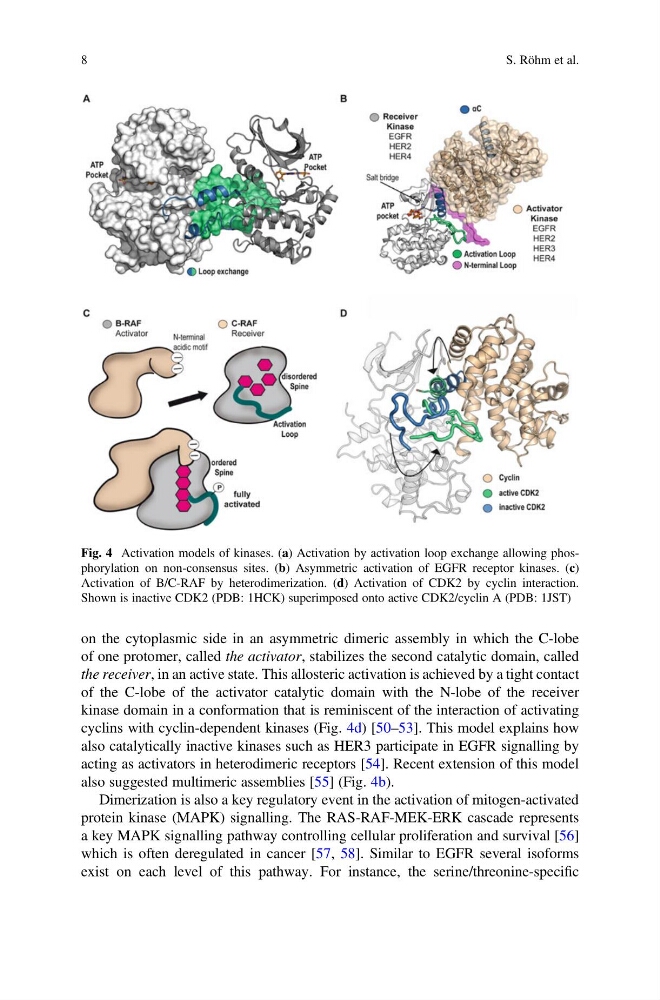
on the cytoplasmic side in an asymmetric dimeric assembly in which the C-lobe
of one protomer, called the activator, stabilizes the second catalytic domain, called
the receiver, in an active state. This allosteric activation is achieved by a tight contact
of the C-lobe of the activator catalytic domain with the N-lobe of the receiver
kinase domain in a conformation that is reminiscent of the interaction of activating
cyclins with cyclin-dependent kinases (Fig. 4d) [50–53]. This model explains how
also catalytically inactive kinases such as HER3 participate in EGFR signalling by
acting as activators in heterodimeric receptors [54]. Recent extension of this model
also suggested multimeric assemblies [55] (Fig. 4b).
Dimerization is also a key regulatory event in the activation of mitogen-activated
protein kinase (MAPK) signalling. The RAS-RAF-MEK-ERK cascade represents
a key MAPK signalling pathway controlling cellular proliferation and survival [56]
which is often deregulated in cancer [57, 58]. Similar to EGFR several isoforms
exist on each level of this pathway. For instance, the serine/threonine-specific
Fig. 4 Activation models of kinases. (a) Activation by activation loop exchange allowing phosphorylation on non-consensus sites. (b) Asymmetric activation of EGFR receptor kinases. (c)
Activation of B/C-RAF by heterodimerization. (d) Activation of CDK2 by cyclin interaction.
Shown is inactive CDK2 (PDB: 1HCK) superimposed onto active CDK2/cyclin A (PDB: 1JST)
8
S. Röhm et al.
of one protomer, called the activator, stabilizes the second catalytic domain, called
the receiver, in an active state. This allosteric activation is achieved by a tight contact
of the C-lobe of the activator catalytic domain with the N-lobe of the receiver
kinase domain in a conformation that is reminiscent of the interaction of activating
cyclins with cyclin-dependent kinases (Fig. 4d) [50–53]. This model explains how
also catalytically inactive kinases such as HER3 participate in EGFR signalling by
acting as activators in heterodimeric receptors [54]. Recent extension of this model
also suggested multimeric assemblies [55] (Fig. 4b).
Dimerization is also a key regulatory event in the activation of mitogen-activated
protein kinase (MAPK) signalling. The RAS-RAF-MEK-ERK cascade represents
a key MAPK signalling pathway controlling cellular proliferation and survival [56]
which is often deregulated in cancer [57, 58]. Similar to EGFR several isoforms
exist on each level of this pathway. For instance, the serine/threonine-specific
Fig. 4 Activation models of kinases. (a) Activation by activation loop exchange allowing phosphorylation on non-consensus sites. (b) Asymmetric activation of EGFR receptor kinases. (c)
Activation of B/C-RAF by heterodimerization. (d) Activation of CDK2 by cyclin interaction.
Shown is inactive CDK2 (PDB: 1HCK) superimposed onto active CDK2/cyclin A (PDB: 1JST)
8
S. Röhm et al.