

of angiogenic signaling in cancer. These multikinase inhibitors were initially
approved for the treatment of advanced renal cell carcinoma. The pivotal phase-III
study TARGET resulted in significantly prolonged progression-free survival time of
patients with resistant, advanced renal cell carcinoma when treated with sorafenib.
Sunitinib showed similar results in the randomized phase-III trial, where it was
compared as first-line treatment to subcutaneous injection of interferon-α for treatment of metastatic RCC. Patients of sunitinib group showed improvement in median
progression-free survival and objective response rate [69–72]. Sorafenib and
sunitinib have been also accepted by FDA for treatment of HCC and advanced
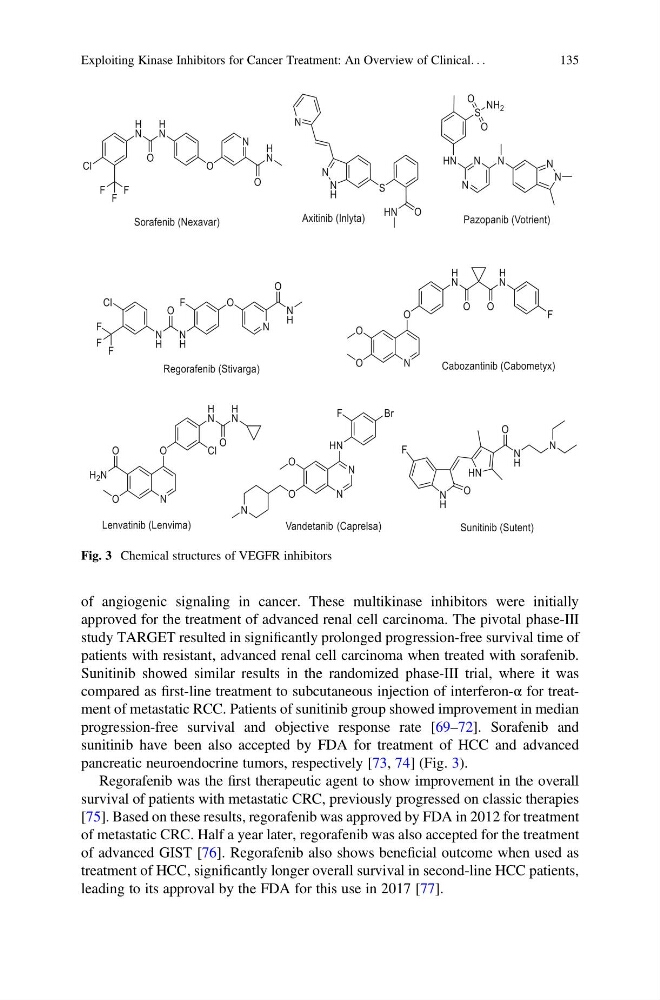
pancreatic neuroendocrine tumors, respectively [73, 74] (Fig. 3).
Regorafenib was the first therapeutic agent to show improvement in the overall
survival of patients with metastatic CRC, previously progressed on classic therapies
[75]. Based on these results, regorafenib was approved by FDA in 2012 for treatment
of metastatic CRC. Half a year later, regorafenib was also accepted for the treatment
of advanced GIST [76]. Regorafenib also shows beneficial outcome when used as
treatment of HCC, significantly longer overall survival in second-line HCC patients,
leading to its approval by the FDA for this use in 2017 [77].
Fig. 3 Chemical structures of VEGFR inhibitors
Exploiting Kinase Inhibitors for Cancer Treatment: An Overview of Clinical. . .
135
approved for the treatment of advanced renal cell carcinoma. The pivotal phase-III
study TARGET resulted in significantly prolonged progression-free survival time of
patients with resistant, advanced renal cell carcinoma when treated with sorafenib.
Sunitinib showed similar results in the randomized phase-III trial, where it was
compared as first-line treatment to subcutaneous injection of interferon-α for treatment of metastatic RCC. Patients of sunitinib group showed improvement in median
progression-free survival and objective response rate [69–72]. Sorafenib and
sunitinib have been also accepted by FDA for treatment of HCC and advanced
pancreatic neuroendocrine tumors, respectively [73, 74] (Fig. 3).
Regorafenib was the first therapeutic agent to show improvement in the overall
survival of patients with metastatic CRC, previously progressed on classic therapies
[75]. Based on these results, regorafenib was approved by FDA in 2012 for treatment
of metastatic CRC. Half a year later, regorafenib was also accepted for the treatment
of advanced GIST [76]. Regorafenib also shows beneficial outcome when used as
treatment of HCC, significantly longer overall survival in second-line HCC patients,
leading to its approval by the FDA for this use in 2017 [77].
Fig. 3 Chemical structures of VEGFR inhibitors
Exploiting Kinase Inhibitors for Cancer Treatment: An Overview of Clinical. . .
135