

echinoderm microtubule-associated protein-like 4 (EML4) gene is fused to ALK
gene. This inversion of chromosome 2 results in the expression of the fusion protein
EML4-ALK consisting of the N-terminal region of EML4 and the intracellular/
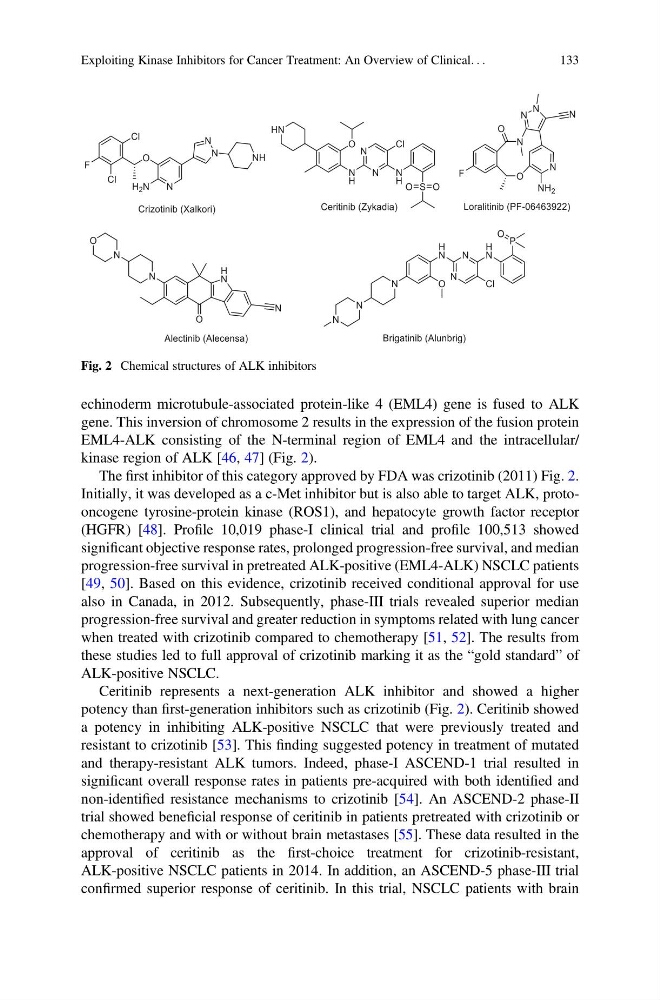
kinase region of ALK [46, 47] (Fig. 2).
The first inhibitor of this category approved by FDA was crizotinib (2011) Fig. 2.
Initially, it was developed as a c-Met inhibitor but is also able to target ALK, protooncogene tyrosine-protein kinase (ROS1), and hepatocyte growth factor receptor
(HGFR) [48]. Profile 10,019 phase-I clinical trial and profile 100,513 showed
significant objective response rates, prolonged progression-free survival, and median
progression-free survival in pretreated ALK-positive (EML4-ALK) NSCLC patients
[49, 50]. Based on this evidence, crizotinib received conditional approval for use
also in Canada, in 2012. Subsequently, phase-III trials revealed superior median
progression-free survival and greater reduction in symptoms related with lung cancer
when treated with crizotinib compared to chemotherapy [51, 52]. The results from
these studies led to full approval of crizotinib marking it as the “gold standard” of
ALK-positive NSCLC.
Ceritinib represents a next-generation ALK inhibitor and showed a higher
potency than first-generation inhibitors such as crizotinib (Fig. 2). Ceritinib showed
a potency in inhibiting ALK-positive NSCLC that were previously treated and
resistant to crizotinib [53]. This finding suggested potency in treatment of mutated
and therapy-resistant ALK tumors. Indeed, phase-I ASCEND-1 trial resulted in
significant overall response rates in patients pre-acquired with both identified and
non-identified resistance mechanisms to crizotinib [54]. An ASCEND-2 phase-II
trial showed beneficial response of ceritinib in patients pretreated with crizotinib or
chemotherapy and with or without brain metastases [55]. These data resulted in the
approval of ceritinib as the first-choice treatment for crizotinib-resistant,
ALK-positive NSCLC patients in 2014. In addition, an ASCEND-5 phase-III trial
confirmed superior response of ceritinib. In this trial, NSCLC patients with brain
Fig. 2 Chemical structures of ALK inhibitors
Exploiting Kinase Inhibitors for Cancer Treatment: An Overview of Clinical. . .
133
gene. This inversion of chromosome 2 results in the expression of the fusion protein
EML4-ALK consisting of the N-terminal region of EML4 and the intracellular/
kinase region of ALK [46, 47] (Fig. 2).
The first inhibitor of this category approved by FDA was crizotinib (2011) Fig. 2.
Initially, it was developed as a c-Met inhibitor but is also able to target ALK, protooncogene tyrosine-protein kinase (ROS1), and hepatocyte growth factor receptor
(HGFR) [48]. Profile 10,019 phase-I clinical trial and profile 100,513 showed
significant objective response rates, prolonged progression-free survival, and median
progression-free survival in pretreated ALK-positive (EML4-ALK) NSCLC patients
[49, 50]. Based on this evidence, crizotinib received conditional approval for use
also in Canada, in 2012. Subsequently, phase-III trials revealed superior median
progression-free survival and greater reduction in symptoms related with lung cancer
when treated with crizotinib compared to chemotherapy [51, 52]. The results from
these studies led to full approval of crizotinib marking it as the “gold standard” of
ALK-positive NSCLC.
Ceritinib represents a next-generation ALK inhibitor and showed a higher
potency than first-generation inhibitors such as crizotinib (Fig. 2). Ceritinib showed
a potency in inhibiting ALK-positive NSCLC that were previously treated and
resistant to crizotinib [53]. This finding suggested potency in treatment of mutated
and therapy-resistant ALK tumors. Indeed, phase-I ASCEND-1 trial resulted in
significant overall response rates in patients pre-acquired with both identified and
non-identified resistance mechanisms to crizotinib [54]. An ASCEND-2 phase-II
trial showed beneficial response of ceritinib in patients pretreated with crizotinib or
chemotherapy and with or without brain metastases [55]. These data resulted in the
approval of ceritinib as the first-choice treatment for crizotinib-resistant,
ALK-positive NSCLC patients in 2014. In addition, an ASCEND-5 phase-III trial
confirmed superior response of ceritinib. In this trial, NSCLC patients with brain
Fig. 2 Chemical structures of ALK inhibitors
Exploiting Kinase Inhibitors for Cancer Treatment: An Overview of Clinical. . .
133