

enzymes. In addition, more serine/threonine kinases (420) than tyrosine kinases
(90) were found in the human kinome. In the future, the use of different development
strategies along with alternative targeting domains might extend the numbers of
FDA-approved inhibitors [13, 14].
2 EGFR Inhibitors
The epidermal growth factor receptor (EGFR) is a transmembrane protein that acts
as a receptor for ligands of the epidermal growth factor (EGF) family [15]. The
EGFR gene is located at chromosome 7, and the encoding protein product encompasses 1,210 amino acids. EGFR is a member of the ErbB family, which is a family
of four similar receptors with tyrosine kinase activity. The family consists of EGFR
or HER1, HER2, HER3, and HER4. EGFR is a cell surface receptor and represents
the starting point of signal transduction mechanisms controlling diverse cellular
responses such as cell proliferation, migration, survival, and apoptosis [16]. Mutations and amplification of the EGFR gene can lead to overexpression of the receptor.
This results in constant kinase activity and uncontrolled activation of downstream
pathways. In breast cancer patients, the incidence of overexpressed EGFR is approximately 10–30% [17]. Apart from breast cancer, upregulated EGFR can also be
found in several other epithelial tumor entities such as lung cancer, prostate cancer,
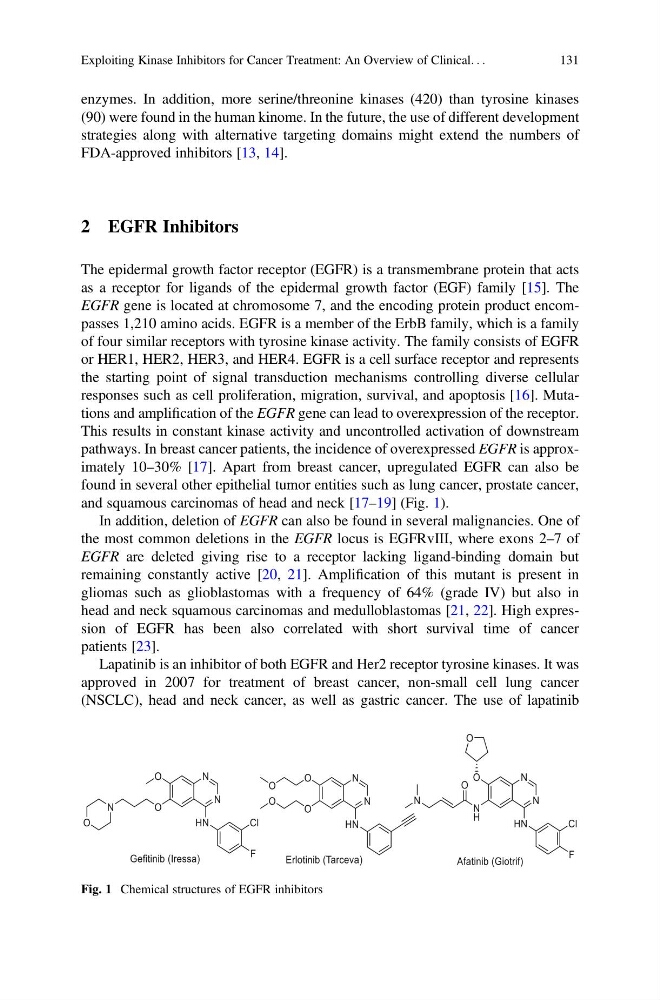
and squamous carcinomas of head and neck [17–19] (Fig. 1).
In addition, deletion of EGFR can also be found in several malignancies. One of
the most common deletions in the EGFR locus is EGFRvIII, where exons 2–7 of
EGFR are deleted giving rise to a receptor lacking ligand-binding domain but
remaining constantly active [20, 21]. Amplification of this mutant is present in
gliomas such as glioblastomas with a frequency of 64% (grade IV) but also in
head and neck squamous carcinomas and medulloblastomas [21, 22]. High expression of EGFR has been also correlated with short survival time of cancer
patients [23].
Lapatinib is an inhibitor of both EGFR and Her2 receptor tyrosine kinases. It was
approved in 2007 for treatment of breast cancer, non-small cell lung cancer
(NSCLC), head and neck cancer, as well as gastric cancer. The use of lapatinib
Fig. 1 Chemical structures of EGFR inhibitors
Exploiting Kinase Inhibitors for Cancer Treatment: An Overview of Clinical. . .
131
(90) were found in the human kinome. In the future, the use of different development
strategies along with alternative targeting domains might extend the numbers of
FDA-approved inhibitors [13, 14].
2 EGFR Inhibitors
The epidermal growth factor receptor (EGFR) is a transmembrane protein that acts
as a receptor for ligands of the epidermal growth factor (EGF) family [15]. The
EGFR gene is located at chromosome 7, and the encoding protein product encompasses 1,210 amino acids. EGFR is a member of the ErbB family, which is a family
of four similar receptors with tyrosine kinase activity. The family consists of EGFR
or HER1, HER2, HER3, and HER4. EGFR is a cell surface receptor and represents
the starting point of signal transduction mechanisms controlling diverse cellular
responses such as cell proliferation, migration, survival, and apoptosis [16]. Mutations and amplification of the EGFR gene can lead to overexpression of the receptor.
This results in constant kinase activity and uncontrolled activation of downstream
pathways. In breast cancer patients, the incidence of overexpressed EGFR is approximately 10–30% [17]. Apart from breast cancer, upregulated EGFR can also be
found in several other epithelial tumor entities such as lung cancer, prostate cancer,
and squamous carcinomas of head and neck [17–19] (Fig. 1).
In addition, deletion of EGFR can also be found in several malignancies. One of
the most common deletions in the EGFR locus is EGFRvIII, where exons 2–7 of
EGFR are deleted giving rise to a receptor lacking ligand-binding domain but
remaining constantly active [20, 21]. Amplification of this mutant is present in
gliomas such as glioblastomas with a frequency of 64% (grade IV) but also in
head and neck squamous carcinomas and medulloblastomas [21, 22]. High expression of EGFR has been also correlated with short survival time of cancer
patients [23].
Lapatinib is an inhibitor of both EGFR and Her2 receptor tyrosine kinases. It was
approved in 2007 for treatment of breast cancer, non-small cell lung cancer
(NSCLC), head and neck cancer, as well as gastric cancer. The use of lapatinib
Fig. 1 Chemical structures of EGFR inhibitors
Exploiting Kinase Inhibitors for Cancer Treatment: An Overview of Clinical. . .
131