

methyl-benzimidazole moiety to bind in the created selectivity pocket delineated on
the other hand by another conserved residue, namely, Trp760. However limited
aqueous solubility and modest on-target potency precluded further development of
compound 23 which chemically evolved then towards the more active but still
poorly water-soluble pyrrolidine derivative 24 (Scheme 7). Improvement of potency
on PI3Kβ for 24 was translated into potent pAkt inhibition in PTEN-deficient PC3
cell line, superior to 23 (IC 50 ¼ 15 nM vs 65 nM). The indoline 24 structure is
associated with a moderate experimental logP (1.4); therefore, the lack of solubility
in the thermodynamic conditions tested was attributed to potentially high-energy
packing forces in its solid form in line with the high melting point value measured
with the produced batch (mp ¼ 285
C).
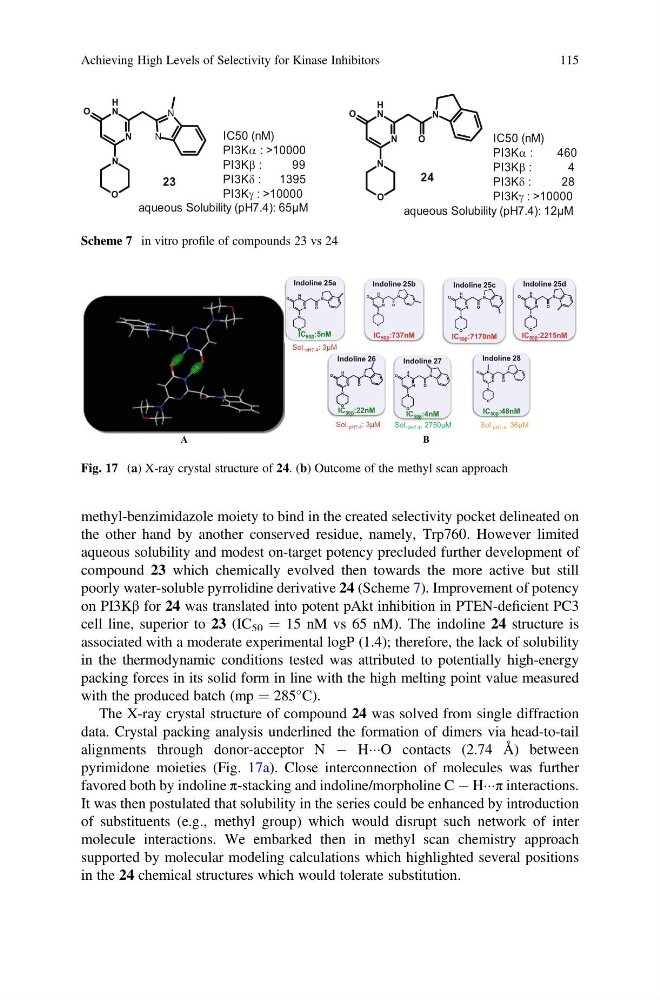
The X-ray crystal structure of compound 24 was solved from single diffraction
data. Crystal packing analysis underlined the formation of dimers via head-to-tail
alignments through donor-acceptor N À HÁÁÁO contacts (2.74 Å) between
pyrimidone moieties (Fig. 17a). Close interconnection of molecules was further
favored both by indoline π-stacking and indoline/morpholine C À HÁÁÁπ interactions.
It was then postulated that solubility in the series could be enhanced by introduction
of substituents (e.g., methyl group) which would disrupt such network of inter
molecule interactions. We embarked then in methyl scan chemistry approach
supported by molecular modeling calculations which highlighted several positions
in the 24 chemical structures which would tolerate substitution.
23
IC50 (nM)
PI3Kα : >10000
PI3Kβ :
99
PI3Kδ :
1395
PI3Kγ : >10000
IC50 (nM)
PI3Kα :
460
PI3Kβ :
4
PI3Kδ :
28
PI3Kγ : >10000
24
aqueous Solubility (pH7.4): 65µM
aqueous Solubility (pH7.4): 12µM
N
O
O
N
H
N
N
O
N
N
O
N
H
N
N
O
Scheme 7 in vitro profile of compounds 23 vs 24
A
B
Indoline 28
IC 50β :48nM
Indoline 25d
IC 50β :2215nM
Indoline 25c
IC 50β :7170nM
Indoline 25b
IC 50β :737nM
Indoline 25a
IC 50β :5nM
Indoline 27
IC 50β :4nM
N
O
N
N
H
O
N
O
N
O
N
N
H
O
N
O
N
O
N
N
H
O
N
O
N
O
N
N
H
O
N
O
N
N
O
N
O
N
O
N
O
N
N
H
O
N
O
Indoline 26
IC 50β :22nM
N
O
N
N
H
O
N
O
Sol. pH7.4 : 3µM
Sol. pH7.4 : 3µM
Sol. pH7.4 : 36µM
Sol. pH7.4 : 2750µM
Fig. 17 (a) X-ray crystal structure of 24. (b) Outcome of the methyl scan approach
Achieving High Levels of Selectivity for Kinase Inhibitors
115
the other hand by another conserved residue, namely, Trp760. However limited
aqueous solubility and modest on-target potency precluded further development of
compound 23 which chemically evolved then towards the more active but still
poorly water-soluble pyrrolidine derivative 24 (Scheme 7). Improvement of potency
on PI3Kβ for 24 was translated into potent pAkt inhibition in PTEN-deficient PC3
cell line, superior to 23 (IC 50 ¼ 15 nM vs 65 nM). The indoline 24 structure is
associated with a moderate experimental logP (1.4); therefore, the lack of solubility
in the thermodynamic conditions tested was attributed to potentially high-energy
packing forces in its solid form in line with the high melting point value measured
with the produced batch (mp ¼ 285
C).
The X-ray crystal structure of compound 24 was solved from single diffraction
data. Crystal packing analysis underlined the formation of dimers via head-to-tail
alignments through donor-acceptor N À HÁÁÁO contacts (2.74 Å) between
pyrimidone moieties (Fig. 17a). Close interconnection of molecules was further
favored both by indoline π-stacking and indoline/morpholine C À HÁÁÁπ interactions.
It was then postulated that solubility in the series could be enhanced by introduction
of substituents (e.g., methyl group) which would disrupt such network of inter
molecule interactions. We embarked then in methyl scan chemistry approach
supported by molecular modeling calculations which highlighted several positions
in the 24 chemical structures which would tolerate substitution.
23
IC50 (nM)
PI3Kα : >10000
PI3Kβ :
99
PI3Kδ :
1395
PI3Kγ : >10000
IC50 (nM)
PI3Kα :
460
PI3Kβ :
4
PI3Kδ :
28
PI3Kγ : >10000
24
aqueous Solubility (pH7.4): 65µM
aqueous Solubility (pH7.4): 12µM
N
O
O
N
H
N
N
O
N
N
O
N
H
N
N
O
Scheme 7 in vitro profile of compounds 23 vs 24
A
B
Indoline 28
IC 50β :48nM
Indoline 25d
IC 50β :2215nM
Indoline 25c
IC 50β :7170nM
Indoline 25b
IC 50β :737nM
Indoline 25a
IC 50β :5nM
Indoline 27
IC 50β :4nM
N
O
N
N
H
O
N
O
N
O
N
N
H
O
N
O
N
O
N
N
H
O
N
O
N
O
N
N
H
O
N
O
N
N
O
N
O
N
O
N
O
N
N
H
O
N
O
Indoline 26
IC 50β :22nM
N
O
N
N
H
O
N
O
Sol. pH7.4 : 3µM
Sol. pH7.4 : 3µM
Sol. pH7.4 : 36µM
Sol. pH7.4 : 2750µM
Fig. 17 (a) X-ray crystal structure of 24. (b) Outcome of the methyl scan approach
Achieving High Levels of Selectivity for Kinase Inhibitors
115