

4.5 Other Nanomaterials and Hydrogen Sulfide Decomposition
45
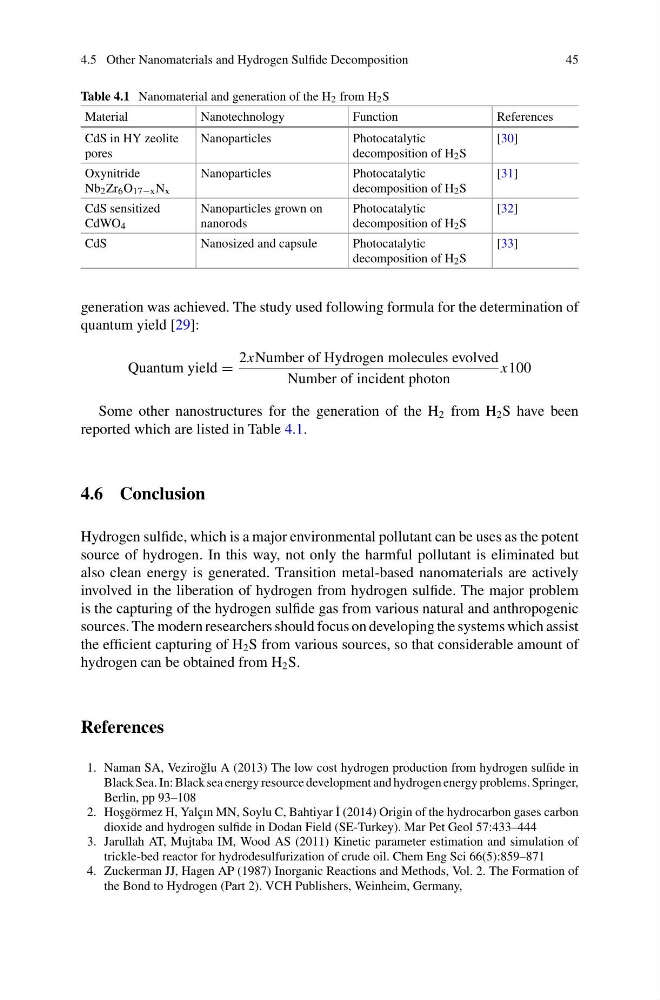
Table 4.1 Nanomaterial and generation of the H 2 from H 2 S
Material
Nanotechnology
Function
References
CdS in HY zeolite
pores
Nanoparticles
Photocatalytic
decomposition of H 2 S
[30]
Oxynitride
Nb 2 Zr 6 O 17−x N x
Nanoparticles
Photocatalytic
decomposition of H 2 S
[31]
CdS sensitized
CdWO 4
Nanoparticles grown on
nanorods
Photocatalytic
decomposition of H 2 S
[32]
CdS
Nanosized and capsule
Photocatalytic
decomposition of H 2 S
[33]
generation was achieved. The study used following formula for the determination of
quantum yield [29]:
Quantum yield =
2xNumber of Hydrogen molecules evolved
Number of incident photon
x100
Some other nanostructures for the generation of the H 2 from H 2 S have been
reported which are listed in Table 4.1.
4.6 Conclusion
Hydrogen sulfide, which is a major environmental pollutant can be uses as the potent
source of hydrogen. In this way, not only the harmful pollutant is eliminated but
also clean energy is generated. Transition metal-based nanomaterials are actively
involved in the liberation of hydrogen from hydrogen sulfide. The major problem
is the capturing of the hydrogen sulfide gas from various natural and anthropogenic
sources. The modern researchers should focus on developing the systems which assist
the efficient capturing of H 2 S from various sources, so that considerable amount of
hydrogen can be obtained from H 2 S.
References
1. Naman SA, Veziro˘ glu A (2013) The low cost hydrogen production from hydrogen sulfide in
Black Sea. In: Black sea energy resource development and hydrogen energy problems. Springer,
Berlin, pp 93–108
2. Ho¸ sgörmez H, Yalçın MN, Soylu C, Bahtiyar ˙ I (2014) Origin of the hydrocarbon gases carbon
dioxide and hydrogen sulfide in Dodan Field (SE-Turkey). Mar Pet Geol 57:433–444
3. Jarullah AT, Mujtaba IM, Wood AS (2011) Kinetic parameter estimation and simulation of
trickle-bed reactor for hydrodesulfurization of crude oil. Chem Eng Sci 66(5):859–871
4. Zuckerman JJ, Hagen AP (1987) Inorganic Reactions and Methods, Vol. 2. The Formation of
the Bond to Hydrogen (Part 2). VCH Publishers, Weinheim, Germany,
45
Table 4.1 Nanomaterial and generation of the H 2 from H 2 S
Material
Nanotechnology
Function
References
CdS in HY zeolite
pores
Nanoparticles
Photocatalytic
decomposition of H 2 S
[30]
Oxynitride
Nb 2 Zr 6 O 17−x N x
Nanoparticles
Photocatalytic
decomposition of H 2 S
[31]
CdS sensitized
CdWO 4
Nanoparticles grown on
nanorods
Photocatalytic
decomposition of H 2 S
[32]
CdS
Nanosized and capsule
Photocatalytic
decomposition of H 2 S
[33]
generation was achieved. The study used following formula for the determination of
quantum yield [29]:
Quantum yield =
2xNumber of Hydrogen molecules evolved
Number of incident photon
x100
Some other nanostructures for the generation of the H 2 from H 2 S have been
reported which are listed in Table 4.1.
4.6 Conclusion
Hydrogen sulfide, which is a major environmental pollutant can be uses as the potent
source of hydrogen. In this way, not only the harmful pollutant is eliminated but
also clean energy is generated. Transition metal-based nanomaterials are actively
involved in the liberation of hydrogen from hydrogen sulfide. The major problem
is the capturing of the hydrogen sulfide gas from various natural and anthropogenic
sources. The modern researchers should focus on developing the systems which assist
the efficient capturing of H 2 S from various sources, so that considerable amount of
hydrogen can be obtained from H 2 S.
References
1. Naman SA, Veziro˘ glu A (2013) The low cost hydrogen production from hydrogen sulfide in
Black Sea. In: Black sea energy resource development and hydrogen energy problems. Springer,
Berlin, pp 93–108
2. Ho¸ sgörmez H, Yalçın MN, Soylu C, Bahtiyar ˙ I (2014) Origin of the hydrocarbon gases carbon
dioxide and hydrogen sulfide in Dodan Field (SE-Turkey). Mar Pet Geol 57:433–444
3. Jarullah AT, Mujtaba IM, Wood AS (2011) Kinetic parameter estimation and simulation of
trickle-bed reactor for hydrodesulfurization of crude oil. Chem Eng Sci 66(5):859–871
4. Zuckerman JJ, Hagen AP (1987) Inorganic Reactions and Methods, Vol. 2. The Formation of
the Bond to Hydrogen (Part 2). VCH Publishers, Weinheim, Germany,