

38
4 Hydrogen Sulfide Decomposition and Nanotechnology
Photocatalytic dissociation of H 2 S liberates the hydrogen, in the presence of some
suitable photocatalyst and light. The photodissociation of H 2 S normally occurred
in liquid phase. The particular photocatalysts stimulate the substrate molecule by
attracting the near-UV light of the spectrum. This stimulation involves the photoinduced transfer of charge in photocatalysts, which generated dynamic electrondeficient species which extract the proton from H 2 S molecule leading to the
production of H 2 molecule and other products. The chemical reactions of H 2 S
photodissociation in aqueous medium can be given as.
H 2 S + OH ↔ SH
−
+ H 2 O.
H 2 S + 2OH
−
↔ S
2−
+ 2H 2 O.
2SH
−
→ S2
2−
+ 2H
+
2H
+
+ 2e
−
→ H 2 .
Thermolysis is another technique for the decomposition of hydrogen sulfide. This
technique is commonly employed due to its simplicity and easy operational conditions. In this technique, the decomposition of H 2 S is carried out at high temperatures.
The thermal decomposition of H 2 S occurs at varying temperatures depending upon
the applied pressure and initial concentration of the substrate [8]. The digramatic
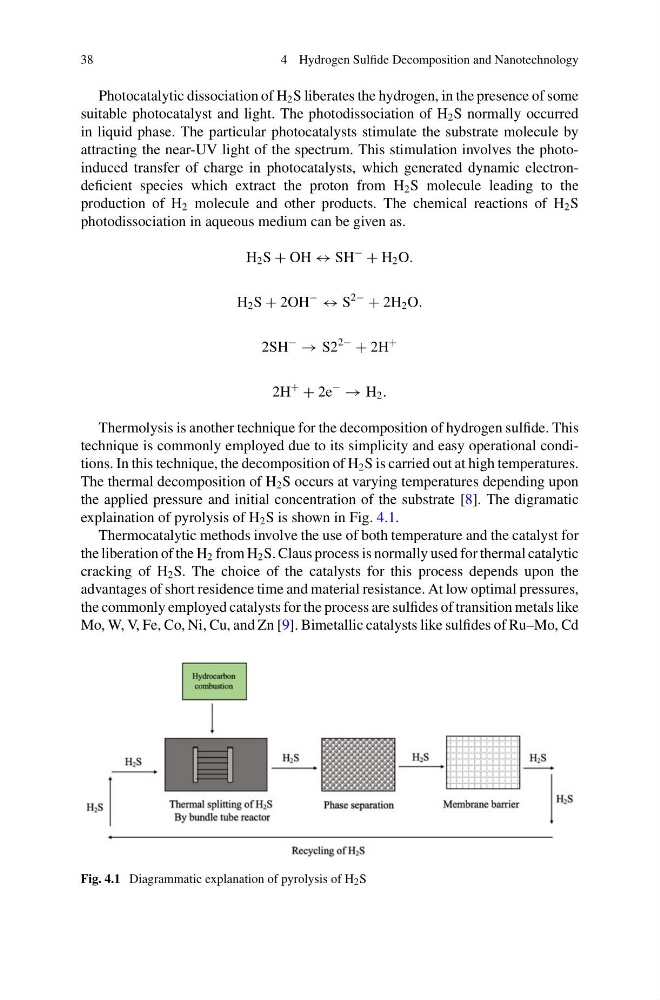
explaination of pyrolysis of H 2 S is shown in Fig. 4.1.
Thermocatalytic methods involve the use of both temperature and the catalyst for
the liberation of the H 2 from H 2 S. Claus process is normally used for thermal catalytic
cracking of H 2 S. The choice of the catalysts for this process depends upon the
advantages of short residence time and material resistance. At low optimal pressures,
the commonly employed catalysts for the process are sulfides of transition metals like
Mo, W, V, Fe, Co, Ni, Cu, and Zn [9]. Bimetallic catalysts like sulfides of Ru–Mo, Cd
Fig. 4.1 Diagrammatic explanation of pyrolysis of H 2 S
4 Hydrogen Sulfide Decomposition and Nanotechnology
Photocatalytic dissociation of H 2 S liberates the hydrogen, in the presence of some
suitable photocatalyst and light. The photodissociation of H 2 S normally occurred
in liquid phase. The particular photocatalysts stimulate the substrate molecule by
attracting the near-UV light of the spectrum. This stimulation involves the photoinduced transfer of charge in photocatalysts, which generated dynamic electrondeficient species which extract the proton from H 2 S molecule leading to the
production of H 2 molecule and other products. The chemical reactions of H 2 S
photodissociation in aqueous medium can be given as.
H 2 S + OH ↔ SH
−
+ H 2 O.
H 2 S + 2OH
−
↔ S
2−
+ 2H 2 O.
2SH
−
→ S2
2−
+ 2H
+
2H
+
+ 2e
−
→ H 2 .
Thermolysis is another technique for the decomposition of hydrogen sulfide. This
technique is commonly employed due to its simplicity and easy operational conditions. In this technique, the decomposition of H 2 S is carried out at high temperatures.
The thermal decomposition of H 2 S occurs at varying temperatures depending upon
the applied pressure and initial concentration of the substrate [8]. The digramatic
explaination of pyrolysis of H 2 S is shown in Fig. 4.1.
Thermocatalytic methods involve the use of both temperature and the catalyst for
the liberation of the H 2 from H 2 S. Claus process is normally used for thermal catalytic
cracking of H 2 S. The choice of the catalysts for this process depends upon the
advantages of short residence time and material resistance. At low optimal pressures,
the commonly employed catalysts for the process are sulfides of transition metals like
Mo, W, V, Fe, Co, Ni, Cu, and Zn [9]. Bimetallic catalysts like sulfides of Ru–Mo, Cd
Fig. 4.1 Diagrammatic explanation of pyrolysis of H 2 S