

6
1 Introduction
as the extraction processes of petrochemical and oil liberates H 2 S in large amounts
[22, 23].
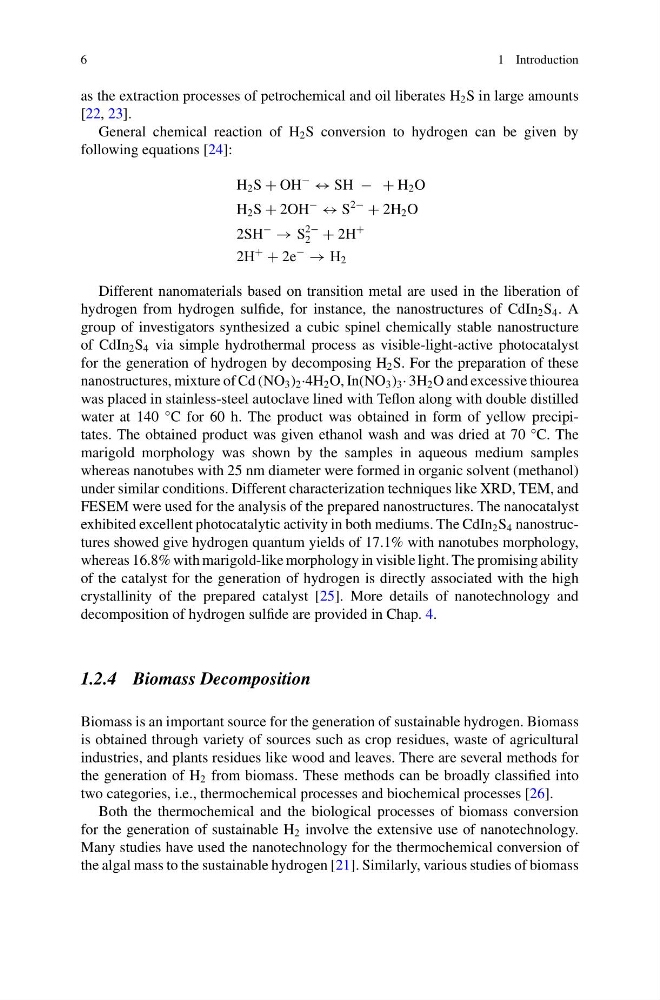
General chemical reaction of H 2 S conversion to hydrogen can be given by
following equations [24]:
H 2 S + OH
−
↔ SH − + H 2 O
H 2 S + 2OH
−
↔ S
2−
+ 2H 2 O
2SH
−
→ S
2−
2 + 2H
+
2H
+
+ 2e
−
→ H 2
Different nanomaterials based on transition metal are used in the liberation of
hydrogen from hydrogen sulfide, for instance, the nanostructures of CdIn 2 S 4 . A
group of investigators synthesized a cubic spinel chemically stable nanostructure
of CdIn 2 S 4 via simple hydrothermal process as visible-light-active photocatalyst
for the generation of hydrogen by decomposing H 2 S. For the preparation of these
nanostructures, mixture of Cd (NO 3 ) 2 ·4H 2 O, In(NO 3 ) 3 · 3H 2 O and excessive thiourea
was placed in stainless-steel autoclave lined with Teflon along with double distilled
water at 140 °C for 60 h. The product was obtained in form of yellow precipitates. The obtained product was given ethanol wash and was dried at 70 °C. The
marigold morphology was shown by the samples in aqueous medium samples
whereas nanotubes with 25 nm diameter were formed in organic solvent (methanol)
under similar conditions. Different characterization techniques like XRD, TEM, and
FESEM were used for the analysis of the prepared nanostructures. The nanocatalyst
exhibited excellent photocatalytic activity in both mediums. The CdIn 2 S 4 nanostructures showed give hydrogen quantum yields of 17.1% with nanotubes morphology,
whereas 16.8% with marigold-like morphology in visible light. The promising ability
of the catalyst for the generation of hydrogen is directly associated with the high
crystallinity of the prepared catalyst [25]. More details of nanotechnology and
decomposition of hydrogen sulfide are provided in Chap. 4.
1.2.4 Biomass Decomposition
Biomass is an important source for the generation of sustainable hydrogen. Biomass
is obtained through variety of sources such as crop residues, waste of agricultural
industries, and plants residues like wood and leaves. There are several methods for
the generation of H 2 from biomass. These methods can be broadly classified into
two categories, i.e., thermochemical processes and biochemical processes [26].
Both the thermochemical and the biological processes of biomass conversion
for the generation of sustainable H 2 involve the extensive use of nanotechnology.
Many studies have used the nanotechnology for the thermochemical conversion of
the algal mass to the sustainable hydrogen [21]. Similarly, various studies of biomass
1 Introduction
as the extraction processes of petrochemical and oil liberates H 2 S in large amounts
[22, 23].
General chemical reaction of H 2 S conversion to hydrogen can be given by
following equations [24]:
H 2 S + OH
−
↔ SH − + H 2 O
H 2 S + 2OH
−
↔ S
2−
+ 2H 2 O
2SH
−
→ S
2−
2 + 2H
+
2H
+
+ 2e
−
→ H 2
Different nanomaterials based on transition metal are used in the liberation of
hydrogen from hydrogen sulfide, for instance, the nanostructures of CdIn 2 S 4 . A
group of investigators synthesized a cubic spinel chemically stable nanostructure
of CdIn 2 S 4 via simple hydrothermal process as visible-light-active photocatalyst
for the generation of hydrogen by decomposing H 2 S. For the preparation of these
nanostructures, mixture of Cd (NO 3 ) 2 ·4H 2 O, In(NO 3 ) 3 · 3H 2 O and excessive thiourea
was placed in stainless-steel autoclave lined with Teflon along with double distilled
water at 140 °C for 60 h. The product was obtained in form of yellow precipitates. The obtained product was given ethanol wash and was dried at 70 °C. The
marigold morphology was shown by the samples in aqueous medium samples
whereas nanotubes with 25 nm diameter were formed in organic solvent (methanol)
under similar conditions. Different characterization techniques like XRD, TEM, and
FESEM were used for the analysis of the prepared nanostructures. The nanocatalyst
exhibited excellent photocatalytic activity in both mediums. The CdIn 2 S 4 nanostructures showed give hydrogen quantum yields of 17.1% with nanotubes morphology,
whereas 16.8% with marigold-like morphology in visible light. The promising ability
of the catalyst for the generation of hydrogen is directly associated with the high
crystallinity of the prepared catalyst [25]. More details of nanotechnology and
decomposition of hydrogen sulfide are provided in Chap. 4.
1.2.4 Biomass Decomposition
Biomass is an important source for the generation of sustainable hydrogen. Biomass
is obtained through variety of sources such as crop residues, waste of agricultural
industries, and plants residues like wood and leaves. There are several methods for
the generation of H 2 from biomass. These methods can be broadly classified into
two categories, i.e., thermochemical processes and biochemical processes [26].
Both the thermochemical and the biological processes of biomass conversion
for the generation of sustainable H 2 involve the extensive use of nanotechnology.
Many studies have used the nanotechnology for the thermochemical conversion of
the algal mass to the sustainable hydrogen [21]. Similarly, various studies of biomass