

2
1 Introduction
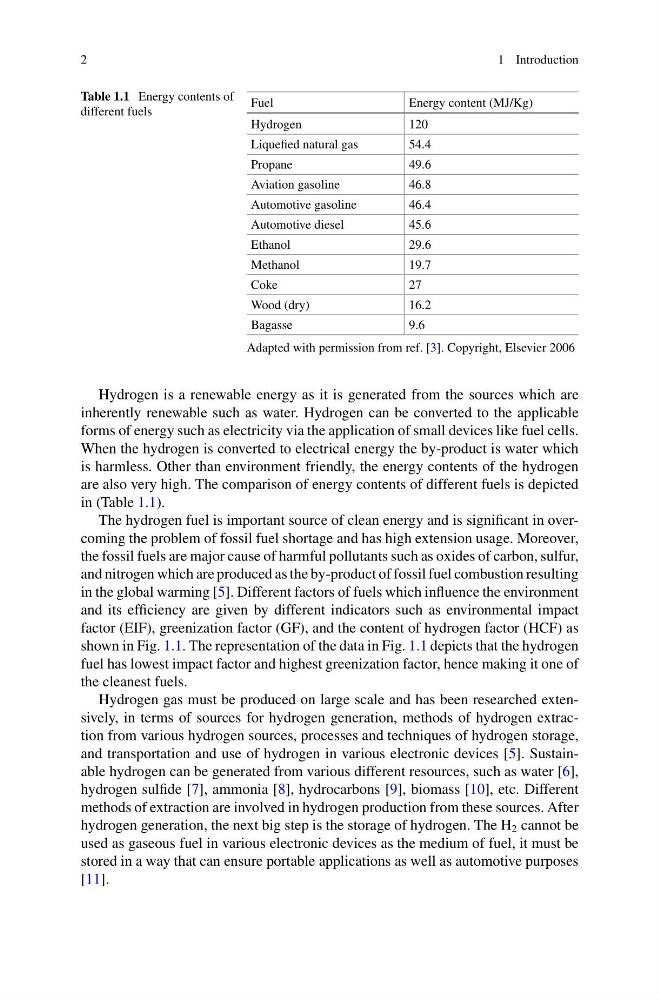
Table 1.1 Energy contents of
different fuels
Fuel
Energy content (MJ/Kg)
Hydrogen
120
Liquefied natural gas
54.4
Propane
49.6
Aviation gasoline
46.8
Automotive gasoline
46.4
Automotive diesel
45.6
Ethanol
29.6
Methanol
19.7
Coke
27
Wood (dry)
16.2
Bagasse
9.6
Adapted with permission from ref. [3]. Copyright, Elsevier 2006
Hydrogen is a renewable energy as it is generated from the sources which are
inherently renewable such as water. Hydrogen can be converted to the applicable
forms of energy such as electricity via the application of small devices like fuel cells.
When the hydrogen is converted to electrical energy the by-product is water which
is harmless. Other than environment friendly, the energy contents of the hydrogen
are also very high. The comparison of energy contents of different fuels is depicted
in (Table 1.1).
The hydrogen fuel is important source of clean energy and is significant in overcoming the problem of fossil fuel shortage and has high extension usage. Moreover,
the fossil fuels are major cause of harmful pollutants such as oxides of carbon, sulfur,
and nitrogen which are produced as the by-product of fossil fuel combustion resulting
in the global warming [5]. Different factors of fuels which influence the environment
and its efficiency are given by different indicators such as environmental impact
factor (EIF), greenization factor (GF), and the content of hydrogen factor (HCF) as
shown in Fig. 1.1. The representation of the data in Fig. 1.1 depicts that the hydrogen
fuel has lowest impact factor and highest greenization factor, hence making it one of
the cleanest fuels.
Hydrogen gas must be produced on large scale and has been researched extensively, in terms of sources for hydrogen generation, methods of hydrogen extraction from various hydrogen sources, processes and techniques of hydrogen storage,
and transportation and use of hydrogen in various electronic devices [5]. Sustainable hydrogen can be generated from various different resources, such as water [6],
hydrogen sulfide [7], ammonia [8], hydrocarbons [9], biomass [10], etc. Different
methods of extraction are involved in hydrogen production from these sources. After
hydrogen generation, the next big step is the storage of hydrogen. The H 2 cannot be
used as gaseous fuel in various electronic devices as the medium of fuel, it must be
stored in a way that can ensure portable applications as well as automotive purposes
[11].
1 Introduction
Table 1.1 Energy contents of
different fuels
Fuel
Energy content (MJ/Kg)
Hydrogen
120
Liquefied natural gas
54.4
Propane
49.6
Aviation gasoline
46.8
Automotive gasoline
46.4
Automotive diesel
45.6
Ethanol
29.6
Methanol
19.7
Coke
27
Wood (dry)
16.2
Bagasse
9.6
Adapted with permission from ref. [3]. Copyright, Elsevier 2006
Hydrogen is a renewable energy as it is generated from the sources which are
inherently renewable such as water. Hydrogen can be converted to the applicable
forms of energy such as electricity via the application of small devices like fuel cells.
When the hydrogen is converted to electrical energy the by-product is water which
is harmless. Other than environment friendly, the energy contents of the hydrogen
are also very high. The comparison of energy contents of different fuels is depicted
in (Table 1.1).
The hydrogen fuel is important source of clean energy and is significant in overcoming the problem of fossil fuel shortage and has high extension usage. Moreover,
the fossil fuels are major cause of harmful pollutants such as oxides of carbon, sulfur,
and nitrogen which are produced as the by-product of fossil fuel combustion resulting
in the global warming [5]. Different factors of fuels which influence the environment
and its efficiency are given by different indicators such as environmental impact
factor (EIF), greenization factor (GF), and the content of hydrogen factor (HCF) as
shown in Fig. 1.1. The representation of the data in Fig. 1.1 depicts that the hydrogen
fuel has lowest impact factor and highest greenization factor, hence making it one of
the cleanest fuels.
Hydrogen gas must be produced on large scale and has been researched extensively, in terms of sources for hydrogen generation, methods of hydrogen extraction from various hydrogen sources, processes and techniques of hydrogen storage,
and transportation and use of hydrogen in various electronic devices [5]. Sustainable hydrogen can be generated from various different resources, such as water [6],
hydrogen sulfide [7], ammonia [8], hydrocarbons [9], biomass [10], etc. Different
methods of extraction are involved in hydrogen production from these sources. After
hydrogen generation, the next big step is the storage of hydrogen. The H 2 cannot be
used as gaseous fuel in various electronic devices as the medium of fuel, it must be
stored in a way that can ensure portable applications as well as automotive purposes
[11].