

96
9 Hydrogen Fuel Cells and Nanotechnology
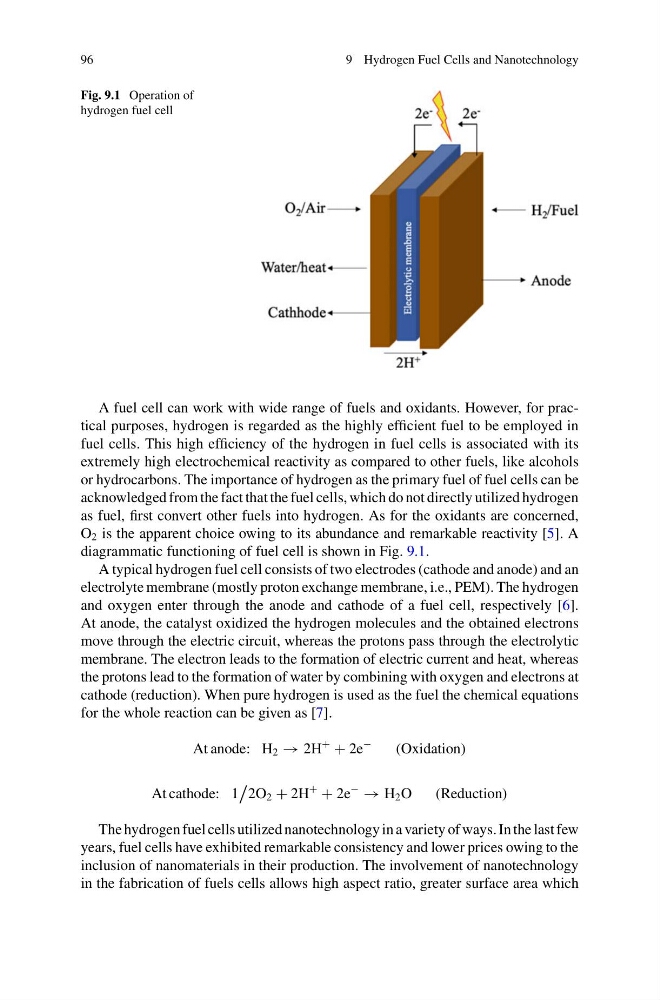
Fig. 9.1 Operation of
hydrogen fuel cell
A fuel cell can work with wide range of fuels and oxidants. However, for practical purposes, hydrogen is regarded as the highly efficient fuel to be employed in
fuel cells. This high efficiency of the hydrogen in fuel cells is associated with its
extremely high electrochemical reactivity as compared to other fuels, like alcohols
or hydrocarbons. The importance of hydrogen as the primary fuel of fuel cells can be
acknowledged from the fact that the fuel cells, which do not directly utilized hydrogen
as fuel, first convert other fuels into hydrogen. As for the oxidants are concerned,
O 2 is the apparent choice owing to its abundance and remarkable reactivity [5]. A
diagrammatic functioning of fuel cell is shown in Fig. 9.1.
A typical hydrogen fuel cell consists of two electrodes (cathode and anode) and an
electrolyte membrane (mostly proton exchange membrane, i.e., PEM). The hydrogen
and oxygen enter through the anode and cathode of a fuel cell, respectively [6].
At anode, the catalyst oxidized the hydrogen molecules and the obtained electrons
move through the electric circuit, whereas the protons pass through the electrolytic
membrane. The electron leads to the formation of electric current and heat, whereas
the protons lead to the formation of water by combining with oxygen and electrons at
cathode (reduction). When pure hydrogen is used as the fuel the chemical equations
for the whole reaction can be given as [7].
At anode: H 2 → 2H
+
+ 2e
−
(Oxidation)
At cathode: 1
2O 2 + 2H
+
+ 2e
−
→ H 2 O
(Reduction)
The hydrogen fuel cells utilized nanotechnology in a variety of ways. In the last few
years, fuel cells have exhibited remarkable consistency and lower prices owing to the
inclusion of nanomaterials in their production. The involvement of nanotechnology
in the fabrication of fuels cells allows high aspect ratio, greater surface area which
9 Hydrogen Fuel Cells and Nanotechnology
Fig. 9.1 Operation of
hydrogen fuel cell
A fuel cell can work with wide range of fuels and oxidants. However, for practical purposes, hydrogen is regarded as the highly efficient fuel to be employed in
fuel cells. This high efficiency of the hydrogen in fuel cells is associated with its
extremely high electrochemical reactivity as compared to other fuels, like alcohols
or hydrocarbons. The importance of hydrogen as the primary fuel of fuel cells can be
acknowledged from the fact that the fuel cells, which do not directly utilized hydrogen
as fuel, first convert other fuels into hydrogen. As for the oxidants are concerned,
O 2 is the apparent choice owing to its abundance and remarkable reactivity [5]. A
diagrammatic functioning of fuel cell is shown in Fig. 9.1.
A typical hydrogen fuel cell consists of two electrodes (cathode and anode) and an
electrolyte membrane (mostly proton exchange membrane, i.e., PEM). The hydrogen
and oxygen enter through the anode and cathode of a fuel cell, respectively [6].
At anode, the catalyst oxidized the hydrogen molecules and the obtained electrons
move through the electric circuit, whereas the protons pass through the electrolytic
membrane. The electron leads to the formation of electric current and heat, whereas
the protons lead to the formation of water by combining with oxygen and electrons at
cathode (reduction). When pure hydrogen is used as the fuel the chemical equations
for the whole reaction can be given as [7].
At anode: H 2 → 2H
+
+ 2e
−
(Oxidation)
At cathode: 1
2O 2 + 2H
+
+ 2e
−
→ H 2 O
(Reduction)
The hydrogen fuel cells utilized nanotechnology in a variety of ways. In the last few
years, fuel cells have exhibited remarkable consistency and lower prices owing to the
inclusion of nanomaterials in their production. The involvement of nanotechnology
in the fabrication of fuels cells allows high aspect ratio, greater surface area which