

term missions of interest to the solid-Earth sciences. Within the decade, current
or planned NASA or international missions will provide the following:
• Surface topography, gravity, and magnetic field data of unprecedented
resolution for the terrestrial planets and for some satellites: For example,
the Messenger Orbiter will define Mercury’s gravity field and Cassini
flybys will refine the gravitational parameters of some Saturnian
satellites. High-resolution geophysical observations, such as those
collected by the Mars Global Surveyor (MGS) mission, are critical for
identifying and understanding the geologic processes that shape solid
planets. While much is known regarding these processes on Earth,
existing data leave little doubt that conditions on other planets and
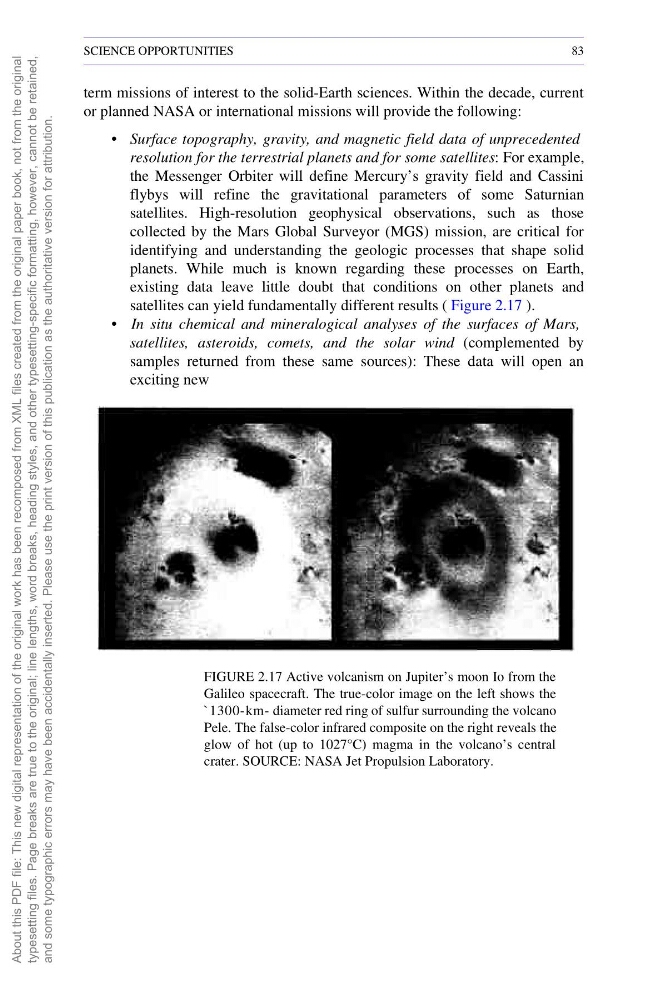
satellites can yield fundamentally different results ( Figure 2.17 ).
• In situ chemical and mineralogical analyses of the surfaces of Mars,
satellites, asteroids, comets, and the solar wind (complemented by
samples returned from these same sources): These data will open an
exciting new
FIGURE 2.17 Active volcanism on Jupiter’s moon Io from the
Galileo spacecraft. The true-color image on the left shows the
`1300-km- diameter red ring of sulfur surrounding the volcano
Pele. The false-color infrared composite on the right reveals the
glow of hot (up to 1027°C) magma in the volcano’s central
crater. SOURCE: NASA Jet Propulsion Laboratory.
SCIENCE OPPORTUNITIES
83
About this PDF file: This new digital representation of the
original work has been recomposed from XML files created
from the original paper book, not from the original
typesetting files. Page breaks are true to the original; line lengths,
word breaks, heading styles, and other typesetting-specific
formatting, however, cannot be retained,
and some typographic errors may have been accidentally inserted.
Please use the print version of this publication as the authoritative
version for attribution.
or planned NASA or international missions will provide the following:
• Surface topography, gravity, and magnetic field data of unprecedented
resolution for the terrestrial planets and for some satellites: For example,
the Messenger Orbiter will define Mercury’s gravity field and Cassini
flybys will refine the gravitational parameters of some Saturnian
satellites. High-resolution geophysical observations, such as those
collected by the Mars Global Surveyor (MGS) mission, are critical for
identifying and understanding the geologic processes that shape solid
planets. While much is known regarding these processes on Earth,
existing data leave little doubt that conditions on other planets and
satellites can yield fundamentally different results ( Figure 2.17 ).
• In situ chemical and mineralogical analyses of the surfaces of Mars,
satellites, asteroids, comets, and the solar wind (complemented by
samples returned from these same sources): These data will open an
exciting new
FIGURE 2.17 Active volcanism on Jupiter’s moon Io from the
Galileo spacecraft. The true-color image on the left shows the
`1300-km- diameter red ring of sulfur surrounding the volcano
Pele. The false-color infrared composite on the right reveals the
glow of hot (up to 1027°C) magma in the volcano’s central
crater. SOURCE: NASA Jet Propulsion Laboratory.
SCIENCE OPPORTUNITIES
83
About this PDF file: This new digital representation of the
original work has been recomposed from XML files created
from the original paper book, not from the original
typesetting files. Page breaks are true to the original; line lengths,
word breaks, heading styles, and other typesetting-specific
formatting, however, cannot be retained,
and some typographic errors may have been accidentally inserted.
Please use the print version of this publication as the authoritative
version for attribution.