

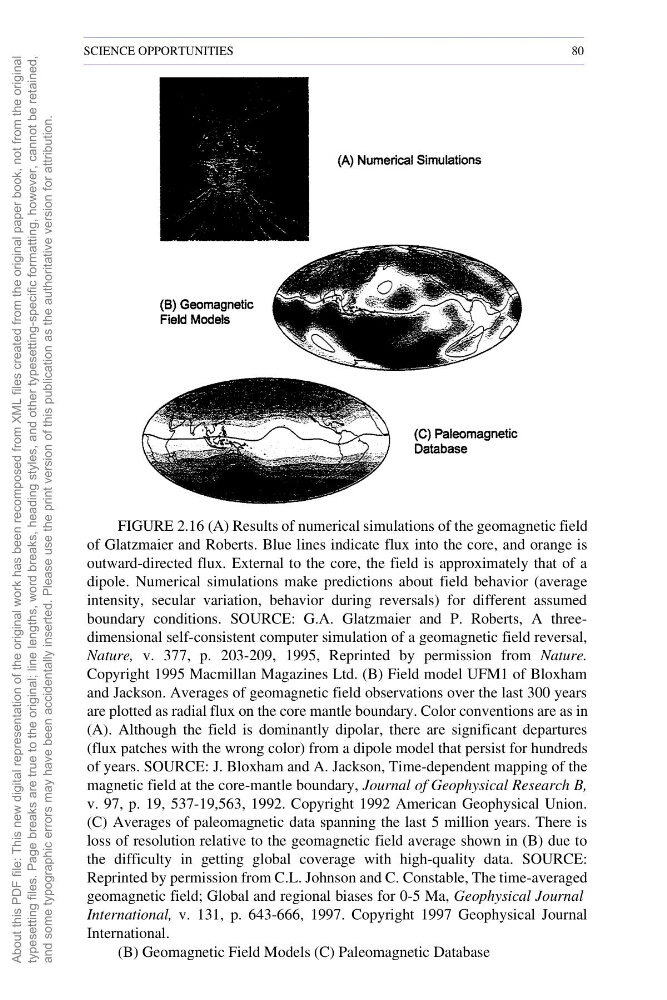
FIGURE 2.16 (A) Results of numerical simulations of the geomagnetic field
of Glatzmaier and Roberts. Blue lines indicate flux into the core, and orange is
outward-directed flux. External to the core, the field is approximately that of a
dipole. Numerical simulations make predictions about field behavior (average
intensity, secular variation, behavior during reversals) for different assumed
boundary conditions. SOURCE: G.A. Glatzmaier and P. Roberts, A threedimensional self-consistent computer simulation of a geomagnetic field reversal,
Nature, v. 377, p. 203-209, 1995, Reprinted by permission from Nature.
Copyright 1995 Macmillan Magazines Ltd. (B) Field model UFM1 of Bloxham
and Jackson. Averages of geomagnetic field observations over the last 300 years
are plotted as radial flux on the core mantle boundary. Color conventions are as in
(A). Although the field is dominantly dipolar, there are significant departures
(flux patches with the wrong color) from a dipole model that persist for hundreds
of years. SOURCE: J. Bloxham and A. Jackson, Time-dependent mapping of the
magnetic field at the core-mantle boundary, Journal of Geophysical Research B,
v. 97, p. 19, 537-19,563, 1992. Copyright 1992 American Geophysical Union.
(C) Averages of paleomagnetic data spanning the last 5 million years. There is
loss of resolution relative to the geomagnetic field average shown in (B) due to
the difficulty in getting global coverage with high-quality data. SOURCE:
Reprinted by permission from C.L. Johnson and C. Constable, The time-averaged
geomagnetic field; Global and regional biases for 0-5 Ma, Geophysical Journal
International, v. 131, p. 643-666, 1997. Copyright 1997 Geophysical Journal
International.
(B) Geomagnetic Field Models (C) Paleomagnetic Database
SCIENCE OPPORTUNITIES
80
About this PDF file: This new digital representation of the
original work has been recomposed from XML files created
from the original
paper book, not from the original
typesetting files. Page breaks are true to the original; line lengths,
word breaks, heading styles, and other typesetting-specific
formatting, however, cannot be retained,
and some typographic errors may have been accidentally
inserted. Please use the print version of this publication
as the authoritative
version for attribution.
of Glatzmaier and Roberts. Blue lines indicate flux into the core, and orange is
outward-directed flux. External to the core, the field is approximately that of a
dipole. Numerical simulations make predictions about field behavior (average
intensity, secular variation, behavior during reversals) for different assumed
boundary conditions. SOURCE: G.A. Glatzmaier and P. Roberts, A threedimensional self-consistent computer simulation of a geomagnetic field reversal,
Nature, v. 377, p. 203-209, 1995, Reprinted by permission from Nature.
Copyright 1995 Macmillan Magazines Ltd. (B) Field model UFM1 of Bloxham
and Jackson. Averages of geomagnetic field observations over the last 300 years
are plotted as radial flux on the core mantle boundary. Color conventions are as in
(A). Although the field is dominantly dipolar, there are significant departures
(flux patches with the wrong color) from a dipole model that persist for hundreds
of years. SOURCE: J. Bloxham and A. Jackson, Time-dependent mapping of the
magnetic field at the core-mantle boundary, Journal of Geophysical Research B,
v. 97, p. 19, 537-19,563, 1992. Copyright 1992 American Geophysical Union.
(C) Averages of paleomagnetic data spanning the last 5 million years. There is
loss of resolution relative to the geomagnetic field average shown in (B) due to
the difficulty in getting global coverage with high-quality data. SOURCE:
Reprinted by permission from C.L. Johnson and C. Constable, The time-averaged
geomagnetic field; Global and regional biases for 0-5 Ma, Geophysical Journal
International, v. 131, p. 643-666, 1997. Copyright 1997 Geophysical Journal
International.
(B) Geomagnetic Field Models (C) Paleomagnetic Database
SCIENCE OPPORTUNITIES
80
About this PDF file: This new digital representation of the
original work has been recomposed from XML files created
from the original
paper book, not from the original
typesetting files. Page breaks are true to the original; line lengths,
word breaks, heading styles, and other typesetting-specific
formatting, however, cannot be retained,
and some typographic errors may have been accidentally
inserted. Please use the print version of this publication
as the authoritative
version for attribution.