

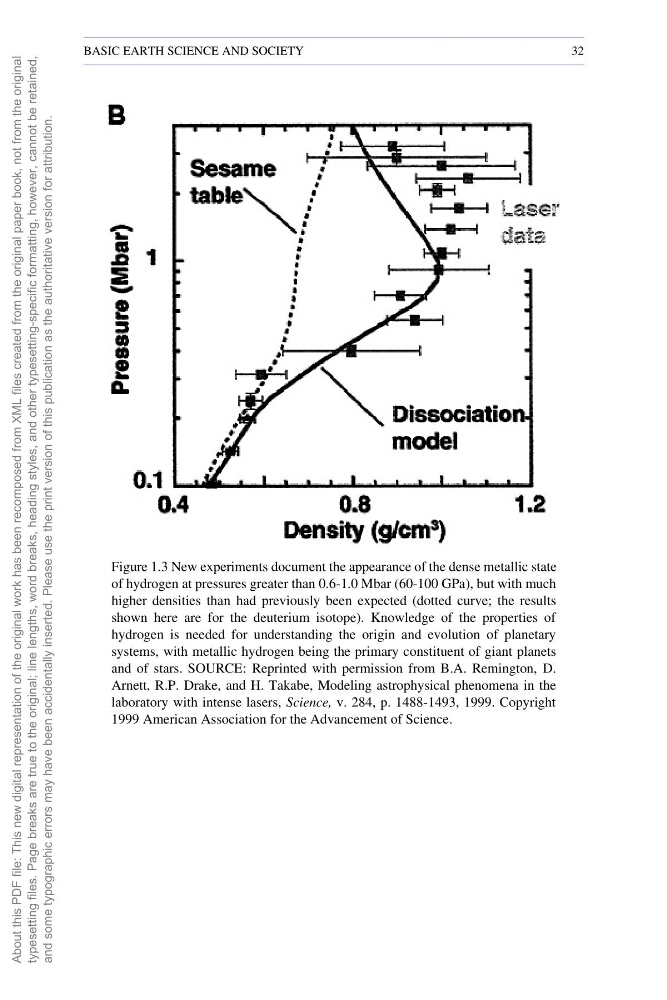
Figure 1.3 New experiments document the appearance of the dense metallic state
of hydrogen at pressures greater than 0.6-1.0 Mbar (60-100 GPa), but with much
higher densities than had previously been expected (dotted curve; the results
shown here are for the deuterium isotope). Knowledge of the properties of
hydrogen is needed for understanding the origin and evolution of planetary
systems, with metallic hydrogen being the primary constituent of giant planets
and of stars. SOURCE: Reprinted with permission from B.A. Remington, D.
Arnett, R.P. Drake, and H. Takabe, Modeling astrophysical phenomena in the
laboratory with intense lasers, Science, v. 284, p. 1488-1493, 1999. Copyright
1999 American Association for the Advancement of Science.
BASIC EARTH SCIENCE AND SOCIETY
32
About this PDF file: This new digital representation of the
original work has been recomposed from XML files created
from the original paper book, not from the original
typesetting files. Page breaks are true to the original; line lengths,
word breaks, heading styles, and other typesetting-specific
formatting, however, cannot be retained,
and some typographic errors may have been accidentally inserted.
Please use the print version of this publication as the authoritative
version for attribution.
of hydrogen at pressures greater than 0.6-1.0 Mbar (60-100 GPa), but with much
higher densities than had previously been expected (dotted curve; the results
shown here are for the deuterium isotope). Knowledge of the properties of
hydrogen is needed for understanding the origin and evolution of planetary
systems, with metallic hydrogen being the primary constituent of giant planets
and of stars. SOURCE: Reprinted with permission from B.A. Remington, D.
Arnett, R.P. Drake, and H. Takabe, Modeling astrophysical phenomena in the
laboratory with intense lasers, Science, v. 284, p. 1488-1493, 1999. Copyright
1999 American Association for the Advancement of Science.
BASIC EARTH SCIENCE AND SOCIETY
32
About this PDF file: This new digital representation of the
original work has been recomposed from XML files created
from the original paper book, not from the original
typesetting files. Page breaks are true to the original; line lengths,
word breaks, heading styles, and other typesetting-specific
formatting, however, cannot be retained,
and some typographic errors may have been accidentally inserted.
Please use the print version of this publication as the authoritative
version for attribution.