

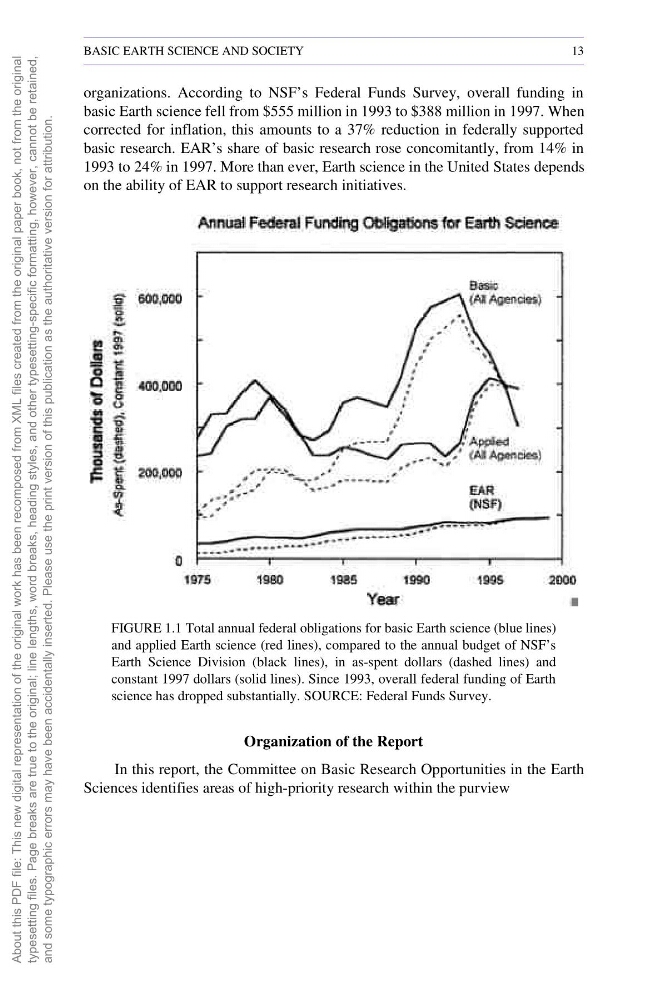
organizations. According to NSF’s Federal Funds Survey, overall funding in
basic Earth science fell from $555 million in 1993 to $388 million in 1997. When
corrected for inflation, this amounts to a 37% reduction in federally supported
basic research. EAR’s share of basic research rose concomitantly, from 14% in
1993 to 24% in 1997. More than ever, Earth science in the United States depends
on the ability of EAR to support research initiatives.
FIGURE 1.1 Total annual federal obligations for basic Earth science (blue lines)
and applied Earth science (red lines), compared to the annual budget of NSF’s
Earth Science Division (black lines), in as-spent dollars (dashed lines) and
constant 1997 dollars (solid lines). Since 1993, overall federal funding of Earth
science has dropped substantially. SOURCE: Federal Funds Survey.
Organization of the Report
In this report, the Committee on Basic Research Opportunities in the Earth
Sciences identifies areas of high-priority research within the purview
BASIC EARTH SCIENCE AND SOCIETY
13
About this PDF file: This new digital representation of the
original work has been recomposed from XML files created
from the original paper book, not from the original
typesetting files. Page breaks are true to the original; line lengths,
word breaks, heading styles, and other typesetting-specific
formatting, however, cannot be retained,
and some typographic errors may have been accidentally inserted.
Please use the print version of this publication as the authoritative
version for attribution.
basic Earth science fell from $555 million in 1993 to $388 million in 1997. When
corrected for inflation, this amounts to a 37% reduction in federally supported
basic research. EAR’s share of basic research rose concomitantly, from 14% in
1993 to 24% in 1997. More than ever, Earth science in the United States depends
on the ability of EAR to support research initiatives.
FIGURE 1.1 Total annual federal obligations for basic Earth science (blue lines)
and applied Earth science (red lines), compared to the annual budget of NSF’s
Earth Science Division (black lines), in as-spent dollars (dashed lines) and
constant 1997 dollars (solid lines). Since 1993, overall federal funding of Earth
science has dropped substantially. SOURCE: Federal Funds Survey.
Organization of the Report
In this report, the Committee on Basic Research Opportunities in the Earth
Sciences identifies areas of high-priority research within the purview
BASIC EARTH SCIENCE AND SOCIETY
13
About this PDF file: This new digital representation of the
original work has been recomposed from XML files created
from the original paper book, not from the original
typesetting files. Page breaks are true to the original; line lengths,
word breaks, heading styles, and other typesetting-specific
formatting, however, cannot be retained,
and some typographic errors may have been accidentally inserted.
Please use the print version of this publication as the authoritative
version for attribution.