

multidivision or NSF-wide programs in research, education, and science and
technology centers (see Box A.2 , Table A.1 ). Most of these programs are
partially funded by other divisions of NSF or other federal agencies (see “EAR
Collaboration with Other Agencies” below).
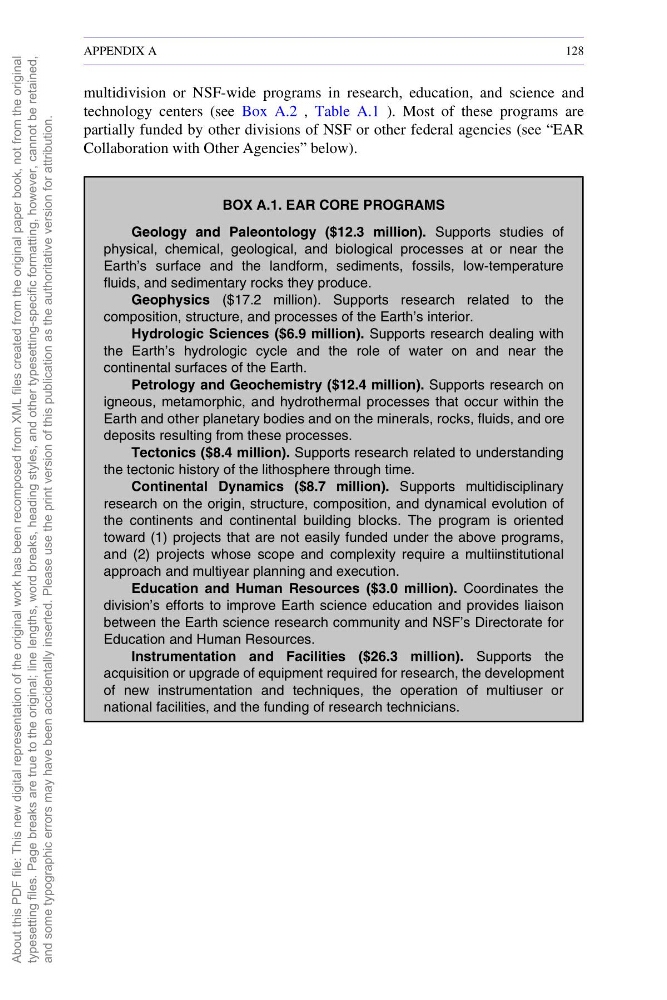
BOX A.1. EAR CORE PROGRAMS
Geology and Paleontology ($12.3 million). Supports studies of
physical, chemical, geological, and biological processes at or near the
Earth’s surface and the landform, sediments, fossils, low-temperature
fluids, and sedimentary rocks they produce.
Geophysics ($17.2 million). Supports research related to the
composition, structure, and processes of the Earth’s interior.
Hydrologic Sciences ($6.9 million). Supports research dealing with
the Earth’s hydrologic cycle and the role of water on and near the
continental surfaces of the Earth.
Petrology and Geochemistry ($12.4 million). Supports research on
igneous, metamorphic, and hydrothermal processes that occur within the
Earth and other planetary bodies and on the minerals, rocks, fluids, and ore
deposits resulting from these processes.
Tectonics ($8.4 million). Supports research related to understanding
the tectonic history of the lithosphere through time.
Continental Dynamics ($8.7 million). Supports multidisciplinary
research on the origin, structure, composition, and dynamical evolution of
the continents and continental building blocks. The program is oriented
toward (1) projects that are not easily funded under the above programs,
and (2) projects whose scope and complexity require a multiinstitutional
approach and multiyear planning and execution.
Education and Human Resources ($3.0 million). Coordinates the
division’s efforts to improve Earth science education and provides liaison
between the Earth science research community and NSF’s Directorate for
Education and Human Resources.
Instrumentation and Facilities ($26.3 million). Supports the
acquisition or upgrade of equipment required for research, the development
of new instrumentation and techniques, the operation of multiuser or
national facilities, and the funding of research technicians.
APPENDIX A
128
About this PDF file: This new digital representation of the
original work has been recomposed from XML files created
from the original paper book, not from the original
typesetting files. Page breaks are true to the original; line lengths,
word breaks, heading styles, and other typesetting-specific
formatting, however, cannot be retained,
and some typographic errors may have been accidentally inserted.
Please use the print version of this publication as the authoritative
version for attribution.
technology centers (see Box A.2 , Table A.1 ). Most of these programs are
partially funded by other divisions of NSF or other federal agencies (see “EAR
Collaboration with Other Agencies” below).
BOX A.1. EAR CORE PROGRAMS
Geology and Paleontology ($12.3 million). Supports studies of
physical, chemical, geological, and biological processes at or near the
Earth’s surface and the landform, sediments, fossils, low-temperature
fluids, and sedimentary rocks they produce.
Geophysics ($17.2 million). Supports research related to the
composition, structure, and processes of the Earth’s interior.
Hydrologic Sciences ($6.9 million). Supports research dealing with
the Earth’s hydrologic cycle and the role of water on and near the
continental surfaces of the Earth.
Petrology and Geochemistry ($12.4 million). Supports research on
igneous, metamorphic, and hydrothermal processes that occur within the
Earth and other planetary bodies and on the minerals, rocks, fluids, and ore
deposits resulting from these processes.
Tectonics ($8.4 million). Supports research related to understanding
the tectonic history of the lithosphere through time.
Continental Dynamics ($8.7 million). Supports multidisciplinary
research on the origin, structure, composition, and dynamical evolution of
the continents and continental building blocks. The program is oriented
toward (1) projects that are not easily funded under the above programs,
and (2) projects whose scope and complexity require a multiinstitutional
approach and multiyear planning and execution.
Education and Human Resources ($3.0 million). Coordinates the
division’s efforts to improve Earth science education and provides liaison
between the Earth science research community and NSF’s Directorate for
Education and Human Resources.
Instrumentation and Facilities ($26.3 million). Supports the
acquisition or upgrade of equipment required for research, the development
of new instrumentation and techniques, the operation of multiuser or
national facilities, and the funding of research technicians.
APPENDIX A
128
About this PDF file: This new digital representation of the
original work has been recomposed from XML files created
from the original paper book, not from the original
typesetting files. Page breaks are true to the original; line lengths,
word breaks, heading styles, and other typesetting-specific
formatting, however, cannot be retained,
and some typographic errors may have been accidentally inserted.
Please use the print version of this publication as the authoritative
version for attribution.