

need to investigate the samples for a tremendous diversity of purposes, place a
new and extremely strict requirement for high-efficiency analyses. In addition,
many types of analyses will require extremely high spatial resolution. For a
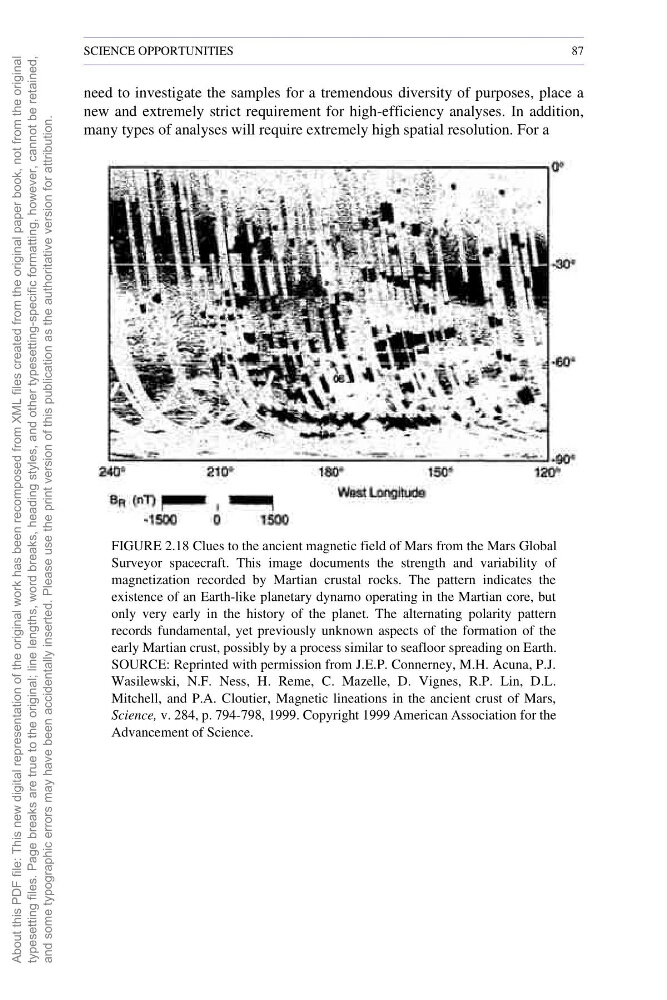
FIGURE 2.18 Clues to the ancient magnetic field of Mars from the Mars Global
Surveyor spacecraft. This image documents the strength and variability of
magnetization recorded by Martian crustal rocks. The pattern indicates the
existence of an Earth-like planetary dynamo operating in the Martian core, but
only very early in the history of the planet. The alternating polarity pattern
records fundamental, yet previously unknown aspects of the formation of the
early Martian crust, possibly by a process similar to seafloor spreading on Earth.
SOURCE: Reprinted with permission from J.E.P. Connerney, M.H. Acuna, P.J.
Wasilewski, N.F. Ness, H. Reme, C. Mazelle, D. Vignes, R.P. Lin, D.L.
Mitchell, and P.A. Cloutier, Magnetic lineations in the ancient crust of Mars,
Science, v. 284, p. 794-798, 1999. Copyright 1999 American Association for the
Advancement of Science.
SCIENCE OPPORTUNITIES
87
About this PDF file: This new digital representation of the
original work has been recomposed from XML files created
from the original paper book, not from the original
typesetting files. Page breaks are true to the original; line lengths,
word breaks, heading styles, and other typesetting-specific
formatting, however, cannot be retained,
and some typographic errors may have been accidentally inserted.
Please use the print version of this publication as the authoritative
version for attribution.
new and extremely strict requirement for high-efficiency analyses. In addition,
many types of analyses will require extremely high spatial resolution. For a
FIGURE 2.18 Clues to the ancient magnetic field of Mars from the Mars Global
Surveyor spacecraft. This image documents the strength and variability of
magnetization recorded by Martian crustal rocks. The pattern indicates the
existence of an Earth-like planetary dynamo operating in the Martian core, but
only very early in the history of the planet. The alternating polarity pattern
records fundamental, yet previously unknown aspects of the formation of the
early Martian crust, possibly by a process similar to seafloor spreading on Earth.
SOURCE: Reprinted with permission from J.E.P. Connerney, M.H. Acuna, P.J.
Wasilewski, N.F. Ness, H. Reme, C. Mazelle, D. Vignes, R.P. Lin, D.L.
Mitchell, and P.A. Cloutier, Magnetic lineations in the ancient crust of Mars,
Science, v. 284, p. 794-798, 1999. Copyright 1999 American Association for the
Advancement of Science.
SCIENCE OPPORTUNITIES
87
About this PDF file: This new digital representation of the
original work has been recomposed from XML files created
from the original paper book, not from the original
typesetting files. Page breaks are true to the original; line lengths,
word breaks, heading styles, and other typesetting-specific
formatting, however, cannot be retained,
and some typographic errors may have been accidentally inserted.
Please use the print version of this publication as the authoritative
version for attribution.